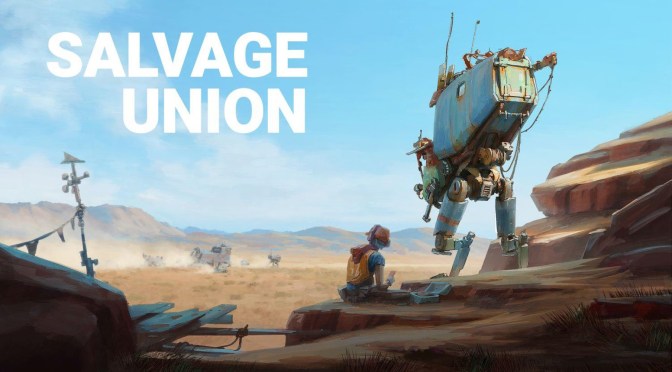
Mecha runs through the history of Cannibal Halfling Gaming; the core contributors would have never met if not for a Gundam play-by-post back in the late aughts. Mecha in RPGs has been popular more broadly as well, though usually best represented by the idiosyncratic and crunchy Robotech and Mekton as well as the more grounded (and also crunchy) Heavy Gear. Salvage Union is the latest in a line of mecha games to aim for the narrative side of the genre, though instead of the high-flying high-drama settings of mecha anime, it’s aiming for a more grounded approach couched in the post-apocalypse.
In Salvage Union your mech pilots are living on the outskirts of a society that has been sequestered in arcologies due to environmental devastation. You make your way through the world by gathering scrap to trade, modify your mechs, and maintain your Union Crawler, a large moving settlement that is your home. Like any good mecha game, Salvage Union is built on interesting decisions: Where to go looking for scrap, what systems to attach your mech, how to manage your energy and heat in mech combat. While the mechanical bones are solid (if light), the supporting setting that explains what happened to the world and what your place is in it are left a bit sketchy for a book with so many specific mech chassis contained within.
Core Mechanics
Salvage Union is built off of the mechanics of a game we reviewed before but haven’t heard from in a while, Quest. Given its use of the Quest SRD, the underlying mechanics of Salvage Union are relatively simple. The game is driven by one d20 roll which breaks out into five outcomes; the middle three outcomes are roughly modeled off of the three-outcome roll in PbtA, and then rolling a 1 or a 20 result in the equivalent of either of a critical hit or a critical failure. Like in Quest there are no modifiers to this roll, it’s intended strictly as a randomizer and not something that is altered based on capability or skill. The only way to alter the results of your roll is to Push the roll, which lets you reroll once and requires adding Heat to your mech (more on that later).
The other core mechanic taken directly from Quest is defining characters based on Abilities. Salvage Union pares the number of Abilities back from Quest along a few vectors: First, Salvage Union characters start with one Ability while Quest characters start with six. Second, Quest characters have access to half a dozen different Ability tracks while most Salvage Union characters start with access to three. Salvage Union Abilities tend to be broader, though; while a Quest Ability for the Fighter would be ‘Disarm’, a Salvage Union Ability for the Engineer is more along the lines of ‘Jury Rig’, representing a range of different potential uses. The use of Adventure Points (now called Ability Points) to activate these Abilities is largely the same, but with Ability Points being recovered in downtime rather than once a session. The Ability trees in Salvage Union are more interesting than those in Quest; rather than a number of floating tracks, Abilities in Salvage Union lead to either advanced abilities within the class or to hybrid classes with their own advanced and legendary abilities. In addition to these options there’s the Salvager class, which lets a player forgo advanced and legendary abilities in exchange for having more abilities and taking abilities from any other class instead of just three tracks.
While the class abilities lead to a lot of potential for character advancement, one of the reasons that characters are so pared down is that a lot of focus is shifted to the mechs. As a mecha game Salvage Union must lavish as much focus on these machines as it does on the characters, and it succeeds at this through both parallel rules as well as a few new ones. Mecha have systems and modules which stand in for character abilities, structure points which stand in for hit points, and energy points which stand in for ability points (with Mechasys having a similar ‘like a player character, but named differently’ approach, clearly the hivemind is onto something – Ed.). There’s also Heat Capacity, which both limits the use of certain abilities as well as the player pushing their rolls, and salvage value, which serves as a neat stand-in for how much a mech or mech system is worth, how much space it takes up, and how much it costs to build. The mech systems and modules (and the chassis themselves) are also defined by tech level, which breaks out six different tiers of mech and mech abilities in ascending order of both capability and cost.
There are dozens of mech systems and modules, though starting the game with just tech level 1 and a small amount of scrap may seem limiting compared to the two-page spread list that both modules and systems get. What’s cool about this is how it relates to salvaging. Your main activity in the game will be salvaging out in the wasteland, but in addition to generic ‘scrap’ you’re going to be able to find mech systems, modules, and chassis out there. To me, driving mech customization not through meta-game mech planning and optimization but rather by what you can find in-game and then bolt up to your mech is a much more interesting gameplay loop. It also illustrates what I believe sets Salvage Union apart. The combat and heat management aspects are simple enough and wholly similar to a game like The Mecha Hack, while the downtime mechanics are a simply less interesting version of those in Blades in the Dark (less interesting because most decisions about downtime activities and advancing your home base have been removed). The salvaging, though, is what builds out a game and story that is more interesting than either similar games in the space or its predecessor Quest.
Setting Creation and Gameplay Loop
The setting beats of Salvage Union are in service to the gameplay loop that’s baked in. This isn’t a bad thing, but it’s important to remember that when you try reading the setting. Ultimately you’re given a high-level premise with little detail; elements like how the world came to be this way, why the core antagonist corporations still control everything, and actual origin stories for any of the other antagonists are completely absent. From a strictly mechanical perspective the game has provided many different enemies for a GM to throw at their players, but if you’re looking for a consistent setting it may make more sense to go to, say, Eclipse Phase.
It is important to remember that Quest was the same way, swapping out post-apocalyptic aesthetics for dungeon fantasy aesthetics. What Salvage Union does significantly better than Quest is establish what the gameplay loop is. There are two core loops that a GM pulls on in Salvage Union; first is a simple region-based conflict that you’d recognize from Apocalypse World but is also de rigueur across PbtA, FitD, and some parts of the OSR. Salvage Union puts a bit more emphasis on the map than Apocalypse World does, but this ties into the other core gameplay loop: Salvage.
Salvaging across the wasteland is what drives progression in the game. Your mech needs salvage, your Union Crawler needs salvage, and ultimately salvage is the key way to advance in capability by allowing you to bolt more and more powerful equipment to your mech. I personally think the most interesting part of this game is how much the needs and capabilities of your Union Crawler and your mechs drive gameplay decisions. The Union Crawler upgrade tiers are a perfect example. You can upgrade your Union Crawler to higher Tech Levels, and in doing so unlock better capabilities for your Crawler’s bays. Upgrading, though, increases the tier of scrap necessary to maintain the Crawler, making it that much more difficult to keep going.
I appreciate that there’s a wide berth given to GMs in terms of how difficult the game is going to be, and the mechanics don’t shy away from tough outcomes. Major injuries, death, destruction of your mech, and even destruction of the entire Union Crawler are on the table, and with many tranches of enemies that are going to be more powerful than PCs there are some good opportunities to introduce challenges and tough choices. Making it through could mean seeing your Union Crawler turn into a veritable city, and maybe even setting off on a new Crawler of your own.
It is this potential in the story space that makes me a bit more dismayed about the setting. There’s a lot of criticism thrown toward the cyberpunk genre about ‘aesthetic’, about having all the cool toys but not any of the themes underneath. Unfortunately, having a surface-level ‘there are corporations, they’re bad and enslave everyone’ setting conceit is the very definition of aesthetic cyberpunk, even if some critics will be satisfied if you throw them the bone of ‘corporations bad’. The underlying themes of cyberpunk are not just about technology run amok and corporatization, they are about unintended consequences, about a society which became that way because that’s what its denizens wanted. Even William Gibson has stated that The Sprawl would have been a better life for many people throughout the world. By simply describing this setting after the fact, by assuring the reader that these are the bad guys and then refusing to elaborate, Salvage Union is skipping to the desired outcome without doing any of the work, and making their setting make less sense as a result. It’s the low point of the game, and could have been done better by going harder in either direction: If the setting was actually written in a coherent way, if these corporations were given the attention and backstory of a Cyberpunk 2020 or Shadowrun, then the game would have made more sense. On the other hand, if the nature of the dystopia was left to the GM; if the Meld, Bio-Titans, and maybe corporations too were part of a longer a la carte worldbuilding menu much like the rest of the campaign creation, then the game would have stayed more Quest-like and demanded less aggressive suspension of disbelief. None of this is game-breaking but it’s not great when the best thing you can say about any part of the writing is ‘you can ignore it’. Ironically, a game whose biggest strength is bulking up the mechanics of its light underlying system has its biggest weakness be aesthetics and implied setting which are only skin deep.
Short-shrift worldbuilding aside, Salvage Union is a strong game and a pretty compelling use of the Quest mechanics. As paring back mechanics is in style, I was happy to see that the designers here knew that giving the Quest mechanics more detail and more moving parts would ultimately result in a better game. You’re still playing narrative mecha, and that’s going to appeal to some genre fans and not others. Even without a seriously granular combat system, the number of options that Salvage Union provides in character builds and mecha builds alike is going to scratch that giant robot itch for a lot of gamers. I would have liked to see a bit more commitment to the core concept; it’s a bit too easy to circumvent the salvaging loop and just build whatever you want, especially if the GM is generous with scrap. In fact, I think lack of commitment is my core criticism with the game. Both the setting and the mechanics could have used a bigger helping of tough decisions, making the story more about making do with what materials and allies you have rather than letting anything be built out of scrap and telling you who the bad guys and good guys are. Even if lacking nuance, Salvage Union still delivers on providing a playground for building mechs and making them fight; swingy combat and tons of build options make the game a compelling option for anyone who likes mecha but doesn’t want to go full Heavy Gear or Battletech with the mechanics.
Salvage Union is available from Leyline Press and DriveThruRPG.
Like what Cannibal Halfling Gaming is doing and want to help us bring games and gamers together? First, you can follow me @LevelOneWonk@dice.camp for RPG commentary, relevant retweets, and maybe some rambling. You can also find our Discord channel and drop in to chat with our authors and get every new post as it comes out. You can travel to DriveThruRPG through one of our fine and elegantly-crafted links, which generates credit that lets us get more games to work with! Finally, you can support us directly on Patreon, which lets us cover costs, pay our contributors, and save up for projects. Thanks for reading!
 Cannibal Halfling Gaming
4 thoughts on “Salvage Union Review”