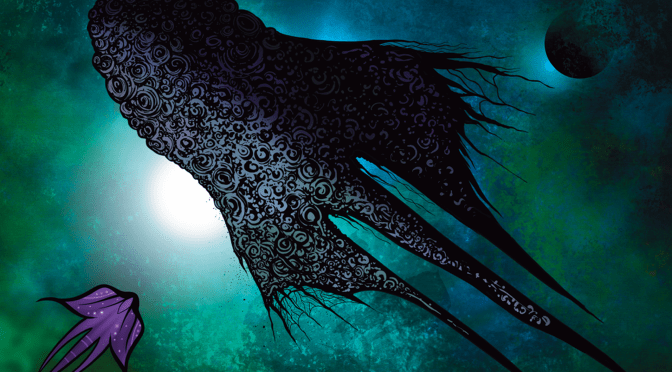
As I’ve been consuming more cosmic horror, I find that my relationship with games set in Lovecraft’s Cthulhu Mythos mirrors my relationship with licensed games. I think there is so much room for them to be great, and then I’m inevitably disappointed nearly every time I read one. In the case of licensed games, this is often because they’re pretty bad; the relationship between licensed games and money is inextricable, and the best licensed games borne out of love and fandom are often from a time in the hobby’s history that’s long gone. In the case of H.P. Lovecraft, it’s a bit more complicated. Lovecraft is a divisive figure, both having essentially invented cosmic horror and changed science fiction forever while also being a known racist, even beyond the conventions of his time. The biggest problem I have with the Cthulhu Mythos in pop culture is twofold: First, the xenophobic roots of Lovecraft’s works are rarely examined or critiqued in games, an omission made even more galling by designers’ desires to hew to a 1920s setting for their games without asking more serious questions about it. Second, the continued sanitization of Lovecraft creations in pop culture (the ‘Cthulhu plushie’ phenomenon) makes it that much more difficult to have conversations about xenophobia, cosmicism, and even New England folklore and dissect how these factors all influenced Lovecraft and his work.
It’s with these biases in my head that I consider Lovecraftesque 2e. Lovecraftesque is a storytelling game where 3-5 players guide a single main character through a story of investigation and discovery of an untold horror which threatens to completely upend their understanding of the world. The game follows a defined Story Track which represents an adept summary of the underlying narrative of a typical Lovecraft story, providing clues, locations, and characters which also adapt existing elements well. And once again, I’m stuck in how I draw my conclusions. Lovecraftesque is a great way to create a one-shot Mythos story for game night. It also lays out a diagram for Lovecraft’s themes and allegories, and then simply doesn’t go any further in interrogating them. I may simply be too demanding in how literary, how analytical I want my storytelling games to be, but Lovecraftesque isn’t just a storytelling game, it’s a Mythos game. As a Mythos game, with dozens of competitors, I feel like Lovecraftesque could have more of a reason to exist than providing a Mythos game to the niche within a niche of people who actually prefer writer’s room style games.
Lovecraftesque itself
Lovecraftesque is a game which brings players through a sequence of events meant to emulate Lovecraft’s horror stories, told through the viewpoint of a single main character. Throughout the game there are three roles, which are rotated between players as the story progresses. The Narrator is a GM-like role, responsible for describing the world as the character sees it, playing supporting characters, and introducing Clues. The Witness is a typical player-like role, responsible for playing the main character and guiding their actions. The rest of the players are Whispers, who provide additional flavor to the Narrator, answer questions about the world when asked, and play supporting characters as needed. Among these roles the Whispers are pretty clearly secondary, but it’s an interesting delineation to take pressure off the Narrator as well as something which lets the pressure on individual players to drive the story ebb and flow.
The two primary mechanisms of play in Lovecraftesque are the Story Track and one of the decks of cards that come with the game; there are Core Decks for building your own story, but also Scenario Decks which come with specific cards. Cards are used for detailing all of the changes in the game; in the beginning the setting and NPCs are defined through location and character cards (the primary difference between creating your own story and using a pre-generated one, mechanically, is whether you draw cards for these or just use the pre-established cards), new details are added through the Mystery Cards dealt to each player, and changes in the procedures of the game as the players continue through the Story Track are detailed in Rules Cards, which are added to the play area at specific points to help players know what the current procedure is. The whole game makes ample and effective use of board game elements like this, which I really like.
The Story Track is what defines how a game of Lovecraftesque unfolds. The game moves, roughly, through three acts. First, the Signs and Portents act is focused on building up the mystery and adding additional Clues to detail out the horror of the story. Impending Doom shifts the story from investigation into being forced to confront the source of the horror, and The Horror Revealed moves the character into coming face to face with the horror and the story to its climax. Each of these have slightly different rules (detailed on Rules Cards) and different pacing, with the Investigation Chapters in the first act being slower and more deliberate and each chapter and step growing more frantic and frenetic as the story makes its way to a climax. The game uses a lot of grounding and constraints to achieve its storytelling template, but overall I think it works well and provides a good balance between being easy to learn and play and still enabling player creativity and participation.
The deal with storytelling games
From a broad hobby perspective, the most accurate label for Lovecraftesque would be a story game or, as used by the designers themselves, a storytelling game. The label can be a difficult one considering how often it’s used in the hobby derisively, but I do believe it’s a useful way to identify a specific kind of game. Storytelling games share some similarities with more traditional roleplaying games, like viewpoint characters and having mechanics for adjudicating the outcome of events within the fictional world being mediated by the players. However, the structure and locus of control is different. The most important difference is that story games have their set of outcomes determined by a structured narrative arc, like the Story Track in Lovecraftesque. Instead of depending on mechanics which are grounded in what characters are capable of doing and how the world around them responds, story games depend on mechanics which are grounded in what’s necessary for the story to continue. Fiasco does not care about how high your character can jump, it cares about whether scenes go well or poorly for them. Lovecraftesque similarly cares little for the character’s abilities; when the character is exposed to risk in the earlier stages of the story, the narrative demands that they fall short, pay a price, or introduce a complication. When the time comes (and not before that), the character must begin their journey to confront the horror.
One of the defining (and divisive) elements of most storytelling games is that these games are typically structured in a way that places players at a remove from characters. In Lovecraftesque this is fairly obvious; there is one main character and the players take turns controlling them. In other games like Fiasco, there’s more subtlety; each Fiasco player has a character, but you’re only guaranteed to ‘play’ them in your scenes, and you must make decisions in service of the story instead of the character. This ‘writer’s room’ style of play is often something that gamers specifically state they do not want, preferring instead to define their play strictly in the head of their character. This is all to taste, of course, but history and current trends both imply that storytelling games will always remain a niche of a niche.
For me, the main limitation of a storytelling game is that it’s built to tell one kind of story. Lovecraftesque hews to a specific template that tells an archetypal cosmic horror story of the kind that H.P. Lovecraft would write. You cannot deviate from that formula; even the deviations allowed by the game (mostly in the form of Special Cards, one of the types of Mystery Card) are specific and structured. For breadth of storytelling, traditional games work better; allowing each player to be an Agent that acts and reacts to other Agents (be those characters, factions, or the world itself in the case of a traditional GM) can create essentially any kind of narrative. Storytelling games, though, allow for depth as opposed to breadth, and allow players to understand how different elements fit into widely explored and repeated archetypes, tropes, and templates. Lovecraftesque lays bare the arc of a typical Lovecraft story in a way that a fan would appreciate and be able to interrogate. And we need to talk about that.
But also, Lovecraft
I feel like every Lovecraft-based game includes some sidebar conceding that yes, Lovecraft was very racist and no, that doesn’t mean you can’t explore the ideas posited in his stories and broader Mythos. As I’ve consumed more cosmic horror, both Lovecraftian and not, I’ve come to the conclusion that most of these games are missing the point by presenting Lovecraft’s Mythos as something that can be sanitized in order to play in. Lovecraftesque was lauded in its first edition for bringing the inherent contradictions of Lovecraft and race to the fore, including an essay that specifically examined the question of race in the context of Lovecraftian horror. While I think this sort of examination is undoubtedly a good thing, I also think it misses the point at a certain level. If you take the example given at the end of the essay ‘Handling Race in Lovecraftesque’ and make the villains of the story some corrupt businessmen instead of a racial stereotype, you’ve kind of stopped telling a Lovecraft story. The xenophobia is the point.
The story arc of a Lovecraft story as presented by Lovecraftesque involves an investigator finding more and more clues that indicate the presence of some strange phenomena. As they get closer, they eventually are forced to confront the horror and have their entire worldview changed as they are either killed or forced to live out their remaining days knowing the horrible truth. There is a broad read on this, about the existential horror of things beyond our understanding or control, that is a throughline for most cosmic horror to this day. There is then a narrower read, which is an undercurrent of all of Lovecraft’s works, which is that the existential horror being described has to do with the erosion and eventual destruction of English-born white society and culture. In some of Lovecraft’s stories this is obvious, like The Shadow over Innsmouth. The Shadow over Innsmouth is a story about miscegenation, with the Deep Ones being stand-ins for any variety of non-white people with whom Lovecraft had a problem (i.e. all of them). When you consider the focus on the facial features of the Innsmouth residents who were hybridized with the Deep Ones, as well as some of the focus on the ‘gently bred’ families in the town who didn’t have exposure, it becomes so obvious that you could teach a high school English class around it. While Lovecraft’s entire bibliography isn’t slap-in-the-face blatant racial allegory, it is broadly built around the theme of xenophobia, fear of the other. There is complexity here; Lovecraft’s views and writing evolved over his life, and his philosophical viewpoint which continues to resonate to this day is that of cosmicism. Cosmicism is a worldview of humanity’s utter insignificance in the broader universe, and grappling with this perspective is arguably the foundation of cosmic horror. It’s all rooted in fear of the other, though, and even works ostensibly pointed outwards towards this grander universe (like The Color Out of Space) continue to focus on these themes of corruption and destruction from unknown and unknowable forces, which not coincidentally mirror eugenics rhetoric of Lovecraft’s day as well as racist and anti-semitic conspiracy literature like The Protocols of the Elders of Zion.
Cosmicism continues to resonate over a century after Lovecraft started writing, but the xenophobia which drove most of Lovecraft’s subject matter and metaphor is intrinsic to this, and an important part of grappling with how he has influenced science fiction, fantasy, and horror since his death. So why is this important for Lovecraftesque? When you look at roleplaying games broadly, you are taking symbols, ideas, and archetypes out of context and giving them to players to put back into a context of their own. In some cases, the original context erodes from the game tradition; this is arguably what happened with Dungeons and Dragons vis a vis the swords and sorcery genre. In others, the games continue to be in dialogue with the source material, creating tension between games which pull away from the literary throughline and those which hew to it. I’d argue that this is what’s happening with the cyberpunk genre, with Cyberpunk in the middle and more fanciful (i.e. Shadowrun) and more grounded (i.e. The Veil, Blade Runner) games pushing and pulling the fandom. Lovecraft’s Mythos has, arguably more than any other single author’s work, inspired gamers to hew closely to the original texts and create games which are set in Lovecraft’s time, in Lovecraft’s setting locations, using Lovecraft’s monsters. When you combine that with what Lovecraftesque does, casting the Lovecraft cosmic horror story into a consistent and repeatable story arc, it becomes clear that we need to have more conversations about Lovecraft if we’re going to keep playing in his body of work.
I do not think Lovecraftesque is much different from other Lovecraft/Mythos RPGs when it comes to interrogating cosmic horror and its place among early 20th century horror and science fiction. However, I do think that when you consider the work Lovecraftesque already does in mapping out a cosmic horror template (and pre-identifying many of the issues with the source material), it represents perhaps a bigger missed opportunity among the corpus of Mythos games. And lest I spend too much time harping on xenophobia, I think this is an issue that is true in many storytelling games. Fiasco identifies the arc of a typical Coen Brothers movie, and lays bare the absurdity of the mounting chaos and self-inflicted doom central to movies like Fargo and The Big Lebowski. At the same time, the game never really gives the freedom or the time to understand the characters beyond the needs and relationships defined at the table; the game could produce a plot like Fargo but it’s never really going to produce a Jerry Lundegaard.
For Lovecraftesque, this comparison is stark because Call of Cthulhu exists, not to mention Delta Green, Arkham Horror, Fate of Cthulhu and numerous other games which all allow players to take the Agentic approach to Lovecraft’s Mythos and play around in it as they please. Lovecraftesque is another Mythos game, but it’s also a storytelling game. In my mind, the strengths of a storytelling game are in the story, in laying bare the underlying symbolism and driving forces that create the arc as portrayed through the Story Track. For Lovecraftesque, this is the strength that needs to be emphasized for it to stand out in a crowded field; it doesn’t have the same advantage that Fiasco does of basically creating its own genre. On a core mechanical level Lovecraftesque is executed well, its use of board game elements and a dynamic but easy to understand Story Track make it a solid one-shot game for cosmic horror. At the same time, though, it’s just another Mythos game. Pretty much all of the genre concerns I had with Arkham Horror remain true, though Lovecraftesque could be the game to interrogate cosmicism a little more thoughtfully. Lovecraftesque could take the work already done to diagram a typical Lovecraft story and use that to enable players to be more thoughtful about the ‘other’ that their horror represents, rather than just stating that racism is bad and walking away from underlying themes that will always be in the Mythos. Lovecraftesque does go further than just playing around in a setting with Dagon, Cthulhu, and Nyarlathotep, and I appreciate that as the basis of a good storytelling game. But if the aim of the game is in fact to be Lovecraft-esque, Lovecraftesque could be doing more. I think there’s room to go from very good to great in a way that a traditional RPG like Call of Cthulhu cannot.
Like what Cannibal Halfling Gaming is doing and want to help us bring games and gamers together? First, you can follow me @LevelOneWonk@dice.camp for RPG commentary, relevant retweets, and maybe some rambling. You can also find our Discord channel and drop in to chat with our authors and get every new post as it comes out. You can travel to DriveThruRPG through one of our fine and elegantly-crafted links, which generates credit that lets us get more games to work with (which is eactly what we did here)! Finally, you can support us directly on Patreon, which lets us cover costs, pay our contributors, and save up for projects. Thanks for reading!
 Cannibal Halfling Gaming
3 thoughts on “Lovecraftesque: Shadows Over Story Games”