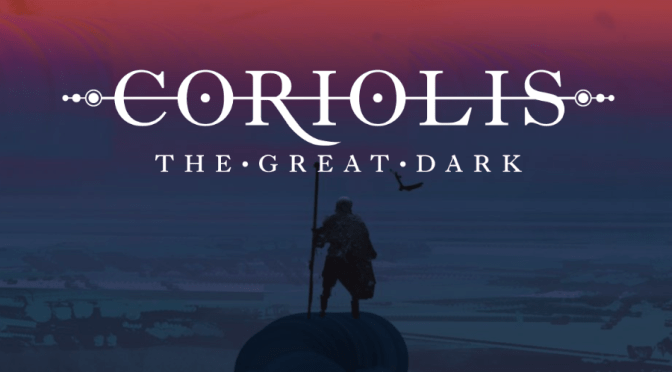
One small step for the Year Zero Engine, one giant leap for Coriolis…
Free League has been shepherding the Coriolis series for nearly a decade now. Originally published by Jarnringen, the original designers of Symbaroum, Coriolis was released in 2008 to much acclaim in Sweden. Free League first got on board creating additional material for the game, but ended up the stewards of the series, releasing their first version in 2016. Now, we get the newest edition, a ‘standalone sequel’ set 200 years after the events of Coriolis: The Third Horizon.
Coriolis won accolades for being a solidly original sci-fi setting, and The Great Dark carries on that legacy by managing to be different even from the version of the game that came before it. At the same time, Free League didn’t mess with the formula of the YZE mechanics too much; we’re staying closer to home with the version of the mechanics established in Mutant: Year Zero and Forbidden Lands than many other recent YZE games have. While I don’t think that The Great Dark is going to win over all existing Coriolis fans, I do think that its combination of strong premise and continued originality is going to help it make a case for itself, either on its own or sitting on the shelf next to all of your Third Horizon books.
Setting
I’m not terribly well versed with the history of Coriolis, other than it being another celebrated Swedish RPG that Free League is now stewarding. When you look back to their previous go at it, though, The Third Horizon, it’s a very different story than what we have here. The Third Horizon was about factional intrigue, crewing a spaceship between the stars, exploring, fighting, and seeking your fortune. The Great Dark is…well, in very broad strokes it’s certainly the same setting. But the details make it very different.
The conceit of The Third Horizon, of portals collapsing and cutting off this area of space from others that were settled before, is used again in The Great Dark. However, instead of an area of space, the settlers of the Lost Horizon were initially trapped in one star system, Jumuah, which had no Earth-like planets around it, only two gas giants. The vast majority of the human population of the Lost Horizon lives in Ship City, a space station carved out of an asteroid and expanded with ship hulls (hence the name). A city slightly smaller than Pittsburgh is the nexus of all humanity in this part of the setting, and with one dead portal in the star system, initially everyone thought there was no way out, nowhere to go. This was expanded thanks to a stellar phenomena called the Slipstream, which allowed big ships with experienced pilots to take advantage of its currents and travel at much faster speeds than would be normally possible. Thanks to the Slipstream and the construction of the Greatships, humanity of the Lost Horizon expanded out into the Charted Sphere, an area of space including eleven different star systems. Even so, Ship City is the only major population center in the Charted Sphere, with small waystations and outposts making up the extent of human settlement outside.
It is hard to overstate how shockingly different this is from not only the previous edition of Coriolis, but also most space opera games dating back to Traveller. Your characters will have a ship, yes, but it’s a shuttle only capable of in-system flight. Those Greatships which actually make the journeys to other systems? There’s canonically only eleven of them which immediately makes you dependent on groups above your paygrade if you’re going to make it out of the system (we’ll get into that).
So there is still factional intrigue, but it’s very much within the city, very much around the guilds who are responsible for keeping parts of Ship City (and the Greatships) running as it should. There’s still interstellar exploration, but it’s much more about heading out to sparsely populated systems and exploring millennia-old ruins as opposed to trading and raiding and all that good Traveller stuff. The entire conceit is folded down to be more directed, smaller.
You know what? I like it. The core campaign framework for The Great Dark sets the characters up as members of the Explorer’s Guild, paid to go delve in ruins from the mysterious Builders, an ancient civilization that built miraculous technology but fell prey to the Blight (which is a constant threat, especially to explorers delving in ruins). It’s hardly the only game that sets up an organization solely as a contrivance for a campaign framework, but it’s one of the better ones I’ve read. I’m not really talking about games like Delta Green or Triangle Agency where the organization is clearly a character and part of the story, I’m more talking about Eclipse Phase with Firewall or the Council Keleres in Embers of the Imperium. You know, groups that don’t seem to have any purpose other than for all the player characters to be members so the GM doesn’t have to puzzle out a way to actually use the game’s setting. The Explorer’s Guild actually makes sense, and the need to explore feels written into the setting deeply.
I was surprised by how much the setting of The Great Dark grabbed me. The setup of Ship City and leaving the rest of the Charted Sphere as unpopulated and unexplored as they did really did a lot to get me to engage with what’s being given to GMs here. I know there will likely be supplements and the like which will expand things, but there was something about how the book was presented that really got across the claustrophobia of having what seems like the entirety of humanity crammed onto one rock. It made deep sense to me that the Greatships are such a point of pride and hope. I felt that if I was living in Ship City, I’d be desperate to explore. It’s partially the framing and the setting choices, and partially the writing, but it works.
To bring it back around, though, it may not work for you if you were a fan of the earlier game. This is different, very different from how Third Horizon is framed. But that framing, in addition to the mechanics, do a great job of pushing the game to be about exploration in a way that space opera games don’t really get to be, at least not when they’re written in traditional, D&D-like rulesets.
Mechanics
The Year Zero Engine has proven to be a solid choice for games built around exploration. Coriolis: The Great Dark follows in that tradition, and like most YZE games there are some key changes made which help enhance things beyond being ‘Forbidden Lands in space’. Forbidden Lands is the YZE cousin The Great Dark is most aligned with, with a d6 dice pool system combining attributes, skills, and gear dice to come up with a dice pool. You’re looking for 6s, generally only needing one of them. Like in other YZE games, you can push rolls which will expose you to costs based on how many 1s you either already have in your pool or are about to roll. To create your character you choose a profession and a specialty, and they define what Talents you start with. Character creation is very much borrowed from other YZE games, as are other core mechanics like gear and combat.
You start getting into the new stuff, the interesting stuff, when you start looking at your party as a unit. The mechanics for ‘Delves’ are a new set of rules designed around exploring ruins; one interesting quirk is that these Delves are designed more vertically than horizontally, intending to model the experience of spelunking into ruins. In a Delve there are five separate roles for each character to take on, which both define how they help move through the Delve as well as give them special maneuvers that can be used when things go pear-shaped. One key thing I appreciate about the Delve mechanics is that the game includes some fairly robust Delve-building tools, which make it relatively easy for someone to take the basic structure (and example provided by the starting adventure) and expand upon it. I was a bit concerned about how much support this aspect of the game would have, especially given the somewhat inconsistent GM support in other YZE games (Vaesen especially could have given the GM a lot more help in writing their own mysteries). That said, at least for a core rulebook, I think the Delve and artifact building tools work fairly well. Delves expand upon the other exploration mechanics provided in the book (for overland travel) by going into more detail on procedures as well as the threat of Blight, but overall the structure and intent is similar to overland mechanics in other YZE games, including the persistent tracking of supplies and threats to your survival.
Blight is one of two setting-driven mechanics worth discussing that are highlighted by (but not restricted to) the Delves. The Blight is a mysterious, almost cosmic phenomena that amplifies the danger of ruins and space travel and arguably caused the extinction of the Builders. Characters not only face Blight-infested (or even Blight-created) creatures but also the presence of the Blight itself, which can do direct harm to their very core. That is mechanically true, too…characters have three “hit point” tracks, the physical Health and the mental Hope, but also Heart, which is directly attacked by the Blight. As I mentioned before combat is very similar to other YZE games, and that means pairing a point track with critical effects…for Health and Hope, these are pretty much as you’d imagine, varying from those seen in Forbidden Lands and Twilight:2000 modestly when they vary at all. Heart, though, is where it gets weird, and as your character is exposed to more and more Blight, the critical effects go from literal bioluminescence and growing vines from your person to having your spirit trapped in ‘The Pale Halls’ (possibly another dimension a la Twin Peaks’ Black Lodge, possibly a hallucination) or even blinking out of existence so fully your crew doesn’t remember you. The Blight is a fascinating addition to the setting that fits with the Builders’ extinction and adds a cosmic horror vibe…I always just wonder if it will remain a static setting element or become something more if the game’s line is expanded.
The last unique setting-driven mechanic is an odd one. Each crew gets a ‘bird’, a kind of electromechanical automata from the era of the Builders. The birds do have some degree of integration into the setting, but overall they mostly provide player characters with supernatural abilities to help them survive Delves and fight back against the Blight. The birds, also called Garuda, are an odd part of the mechanics of the game, though if bird-like automata have been a part of Coriolis for some time it might make a bit more sense. Still, it seems like a part of the game where the mechanics were written first and then adapted to the setting, even as the vast majority of the setting was written to be cohesive and then drive the mechanics from there.
Coriolis: The Great Dark does a good job of presenting an original twist on the space opera genre. While the series has been known for an original, Middle Eastern-inflected setting for years (and that is a throughline in the new game), having a more constrained, more dangerous feeling setting and balancing both internal and external threats makes for a game that manages to have a strong, overriding drive (explore the Charted Sphere, find out about the Builders) while still having a lot going on outside of that (guild intrigues, smuggling, pirates).
Free League did make some fairly aggressive choices in how they differentiated The Great Dark from earlier editions of Coriolis, and while that’s not a downside in and of itself, it does need to be noted. This is a consistent way to do an edition change with Free League’s overall strategy of keeping their first-party games fairly unique and focused; Blade Runner does not play like a typical cyberpunk game, Twilight:2000 is neither a normal post-apocalyptic game nor a normal milsim, and Vaesen is definitely the most Swedish of the monster hunting games. Coriolis was always meant to provide a unique experience compared to a game like Traveller, and The Great Dark is in turn meant to be a unique experience compared to other editions of Coriolis.
Overall, I’d say The Great Dark reinforces the core of YZE, the games that split the difference between specific and general enough that your experiences with one game will carry over to the next. It also provides more and more different experiences in the Coriolis setting, which will help justify acquiring the game to existing Coriolis fans. Overall, though, I look back at the setting’s use of closing off previous ‘Horizons’ and I wonder if that’s the most effective way to continue the timeline. Settings like Traveller and Star Wars are huge, and though that makes them unwieldy, it’s also part of the appeal. I could see a future campaign which sees portals coming back online and all the different cultures of space colliding once again, but given how strong the constrained setting of The Great Dark is, maybe that isn’t the right choice. Overall, though, I don’t think that’s a bad position for the game to be in. The Great Dark may not present space opera as it’s typically envisioned or fantasized about, but its smaller, more intimate setting helps you get in the head of an explorer who’s desperate to get off of the space station and out into unknown space.
Coriolis: The Great Dark is available from Free League and on DriveThruRPG.
Like what Cannibal Halfling Gaming is doing and want to help us bring games and gamers together? First, you can follow me @LevelOneWonk@dice.camp for RPG commentary, relevant retweets, and maybe some rambling. You can also find our Discord channel and drop in to chat with our authors and get every new post as it comes out. You can travel to DriveThruRPG through one of our fine and elegantly-crafted links, which generates credit that lets us get more games to work with (which is eactly what we did here)! Finally, you can support us directly on Patreon, which lets us cover costs, pay our contributors, and save up for projects. Thanks for reading!
 Cannibal Halfling Gaming
2 thoughts on “Coriolis: The Great Dark Review”