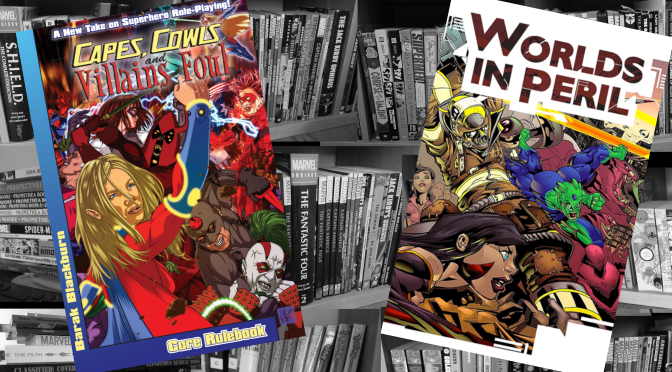
In case you missed them, links to Part 1, Part 2, Part 3, and Part 4. This is going to be the final part of this series where I cover new games; in the conclusion, which will go live on the 16th, I will discuss which games I thought were the best. There are a lot of really good ones!
Capes, Cowls, and Villains Foul
The official title of this game doesn’t seem to have an Oxford comma, which is offensive. I’m going to add one in this writeup. I didn’t write about Capes, Cowls, and Villains Foul in the past because Spectrum Games very infamously completely botched a Kickstarter Fulfillment thing, but ultimately that was an accident, and also as far as I can tell the designer of this game, Barak Blackburn, had nothing to do with that.
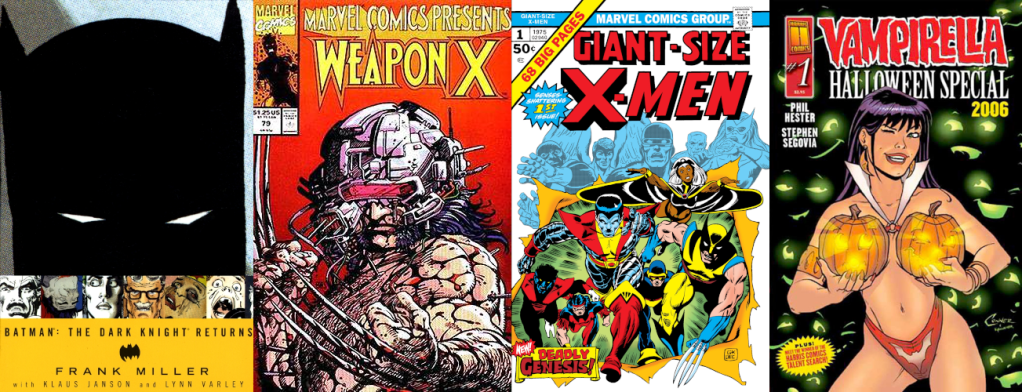
The first thing you’ll probably notice about Capes, Cowls, and Villains Foul is that the cover art is terrible. In the past Spectrum Games published a superhero setting called Omlevex with much better cover artwork, and so it’s disappointing to see such a big step down here. Art isn’t the most important thing in a superhero game, but nobody wants to own an ugly book, right?
Anyways, the core conceit of this game is that it aims for genre emulation above anything else. Characters are built using Points, which are put into Traits. Traits are customized using Modifiers. Christopher Peter compared CCVF to Marvel Heroic in his RPG.net review; I also have seen FATE used as a point of comparison.
Traits are like FATE Aspects or how characters worked in Marvel Heroic; they can be usual powers things like “Mass Manipulation” and “Super Strength”, more skill-type things like “Sniper”, or other things like “Very Smart” and “Flirty and Sexy”. Traits are designed to be used creatively, so Flirty and Sexy could be used to distract a villain during combat. Traits can only be used once in a scene before PCs start to incur a penalty by using them, in order to prevent people from always using their strongest Traits. This is where Modifiers come in.
Players can spend extra points to give Traits extra usages without penalty in various ways [the Trait gets weaker without dipping into penalty levels, or it gets stronger, or it stays the same, etc]. Players can make Traits Linked to use multiple Traits at the same time. There are many different ways in which Traits can be customized, and when you combine this with the Aspect-y nature of Traits you can do some really cool things during character creation.
CCFV also has other superhero RPG mainstays as well, such as a metacurrency called Editorial Control, and Complications. As usual, characters built with fewer Points are given more Editorial Control points when playing with stronger characters. The game includes a list of things EC points can be spent on as well as how much each of these things cost. Complications are essentially negative things that can be activated by a player or GM to make a character gain Editorial Control points. The game includes a neat optional rule that, if a Trait is used in a negative way, it can work as a Complication to gain Editorial Control points.
CCVF also uses d12s exclusively, which is cool. As Seamus has discussed before, d12s have a very pleasing shape and they roll nice.
Players get their Trait value and add it to their 1d12 roll. Earlier I mentioned Modifiers; if a move dips into penalty levels from overuse, or if a move gets stronger before it gets weaker, you use Detriment and Benefit dice respectively. Essentially these are just extra dice rolled, and you take the lowest or highest results depending on the context.
Basic non-opposed action resolution in CCVF is a little wonky. Most games have an internal logic to choosing target numbers that is always consistent. Lifting a 10,000 pound object in one game might always require rolling at least 20, regardless of which character is doing it; characters in these games who cannot lift a 10,000 pound object generally are incapable of rolling a 20. In other games, like FATE, success and failure are determined by a fairly static dice roll, but the GM determines if a player is even allowed to do the roll based on if it would be possible in the fiction, with a modifier being applied depending on the context.
Because of the nature of the CC&VF system, which does not seek to quantify what a specific Trait means in real world terms (that means, there is no chart indicating that SUPERSPEED 7 indicates that a character can run 723.65 mph) and because of the power of Linking, assigning Difficulties to tasks not opposed by another character is very much up to the Editor.
In CCVF, target numbers change depending on how strong the character is in the fiction, and because of how the game is set up it basically has to be this way. That being said, since most superheroes fall into pretty distinct power levels [Batman -> Spider-Man -> The Thing -> Superman], it would be cool if the game just included a handful of target number lists for simple reference.
Of course, this assumes that you’re taking the “assigning things by instinct” approach, but the game also outlines a much more granular approach involving Traits that some people might appreciate, even though it sounds very time consuming and mentally taxing to deal with in practice.
It’s now worth talking about Setback Tokens. Characters gain Setback Tokens whenever they fail in certain contexts, and Setbacks are deliberately abstract and non-specific. Receiving physical damage can be a Setback, but getting frustrated by failing investigative rolls or receiving some other kind of emotional damage can also cause a character to receive Setbacks. A character can only receive four Setback Tokens before they have to leave a Scene.
There are three kinds of Scenes in CCVF; Action Scenes, Extended Scenes, and Contested Scenes. These are important because they relate to Trait usage.
At the beginning of an Action Scene, characters basically completely refresh their Traits and Setbacks.
Contested Scenes are basically for things like chase scenes, arm wrestling contests, etc. Traits and Setbacks refresh for the purposes of the Contested Scene.
The Extended Scene happens over the course of an entire issue, stopping and starting when Action or Contested scenes happen. This is basically where all non-fighting gameplay occurs. Trait usage is tracked over the entire Extended Scene, and if a PC fails a roll, they gain a Setback Token. If a PC, for instance, fails a bunch of investigative rolls over the course of an Extended Scene, they get frustrated and quit.
Something a little frustrating about CCVF is that the way information is presented could be a lot better. The book isn’t boring or painful to read, which is extremely important, but the game is fundamentally quite simple and it feels like things could’ve been written in a way that makes things easier to absorb on a first read-through.
Something else that bothers me about CCVF is that the writing style is sometimes too informal. Here’s an example:
The Primary Trait determines initially how many dice are rolled. A Secondary Trait that has one or more Benefit Dice would add +2 to the roll for each Benefit Die. However, if a Secondary Trait has accumulated one or more Detriment Dice, they are added to the roll as Detriment Dice. Yeah, it kind of sucks, it would be much cooler if they only added a -2 to the roll. Oh well. This allows a player the chance to still be lucky with a Linked roll.
I’ve already discussed the cover of CCVF, but it’s worth talking about the interior artwork as well. There are five different credited artists, and the artwork is a real mixed bag. Some of it is quite good, especially the artwork by Bill Williams, but most of the pieces are like uncanny valley versions of real comic art. I find the rest of the book’s design quite attractive, and it does use the same conceit of being printed in the dimensions of an American comicbook that Marvel Heroic Roleplaying used.
Capes, Cowls, and Villains Foul does include some useful tools. Various fill-in-the-blank templates are included to facilitate quick character creation [e.g. a balanced 150 point character with a powerful Trait that gets stronger as it’s used, a 150 point character who has a lot of non-superhuman traits to simulate Batman-type characters, etc]. The game includes a regular character sheet as well as a “usage sheet” designed to keep track of Editorial Control, how many times a trait has been used, etc.
Various cheat sheets are included for things like calculating common Trait point costs, things Editorial Control can be spent on, and modifiers related to fighting multiple opponents. Because this book is not printed in the standard 8.5”x11” format, it feels like each of these cheat sheets has a little less information on it than it should, and so I’d probably use these cheat sheets as a reference while reformatting the information onto larger sheets of paper to reduce page count.
CCVF also has something that more superhero RPGs, and RPGs in general, should have – an appendix. Sure, an index is useful [and CCFV does have one], but an appendix that briefly describes the things you’ll be looking up 90% of the time in the index with included page numbers is a lot more useful than an index that doesn’t differentiate between important game concepts and other stuff.
How does Capes, Cowls, and Villains Foul stack up against over games? As I said before, I often saw the game compared to Marvel Heroic and FATE, and I do think CCVF is very comparable to both of those on an ethos level. If you are looking for a game with similar mechanics, it’s a compelling third option. The way “damage” is received is more abstract and simple than in Marvel Heroic, and also the metacurrency system is less complicated. Character creation is less vibes-based than character creation in Marvel Heroic while still being extremely flexible. Similarly, I think the big edge that CCVF has against FATE is that character creation is more suited to the genre.
On the other hand, I think it can be safely argued that both Marvel Heroic and CCVF have less support for gameplay involving more mundane scenes, and this is where FATE’s inherent strengths as a generic system get to shine. At one point in CCVF the book says it wouldn’t be an ideal choice for a Watchmen-type game, whereas FATE can easily handle both mundane stuff and high-level superheroics.
A lot of the big marks against CCVF relative to Marvel Heroic and FATE are things that, technically speaking, don’t really matter during gameplay, like worse artwork and informal writing. Something a bit more pressing when getting into the weeds is that CCVF is a less popular game and thusly has less community support, especially relative to FATE, which is very popular for supers play [See: the 4+ FATE supers rulesets1]. Most of the actual mechanical differences really boil down to preference.
It’s worth noting that CCVF uses a modified version of the Cartoon Action Hour ruleset. If you’re unfamiliar, Cartoon Action Hour is a little less superhero, a little more He-Man, Transformers, ThunderCats, etc. So, if you were looking for a supers RPG as a proxy for a He-Man RPG or something, that might be worth looking into.
If you’d like to learn more, this RPG.net thread has some comments from the designer of the game, and he also had a design blog here.
Power Grrrl
Power Grrrl is a rules-lite superhero game that can also be used as a splatbook for comedic teen supers stuff. I wrote about it at length in a recent piece about aethereal FORGE’s games.
Aberrant
Cannibal Halfling contributor Ari David wrote about the first edition of Aberrant here, and Aaron Marks wrote about the second edition here.
Worlds in Peril
Worlds in Peril is a relatively early Powered by the Apocalypse game from 2014, which cites Dungeon World as being its primary influence. Reading Worlds in Peril was my first time reading a PbtA game, so even though I had some rough ideas of how PbtA games work it was still a new experience.
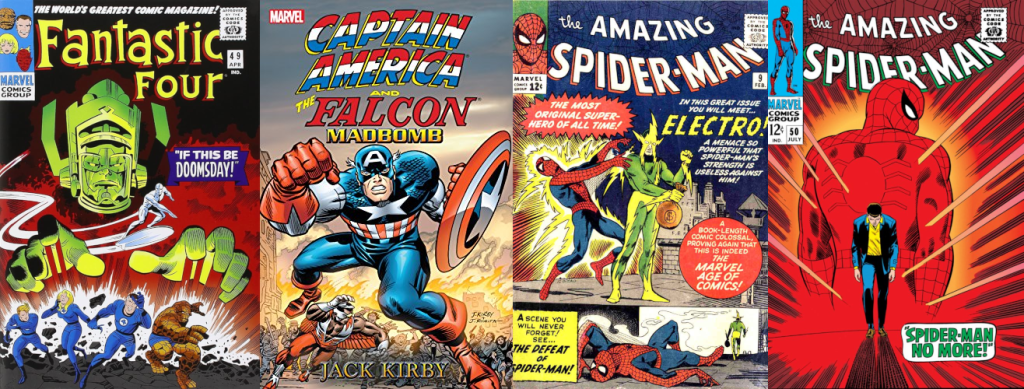
Worlds in Peril opens with a 12 page comic that explains how the basic mechanics of the game work. This comic is really incredible; I thought it was basically going to be a novelty, but the conversation between the GM and players, paired with visuals showing what’s happening in the fiction, really paint a picture of how gameplay is supposed to work. It won’t teach everything, but it does provide a framework of what to expect.
It also needs to be said that the artwork in the book by Jonathan Rector is some of the best I’ve ever seen in a superhero RPG. A lot of artists don’t understand how thick the borders of panels should be [the answer is “not very”], or understand superhero art conventions in general, but Rector gets it. There are books made by companies with greater resources with much worse superhero art!
Things immediately grind to a halt after this strong opening. It can be hard to say why some RPGs are a tough read, but in the case of Worlds in Peril it’s probably because the game is very front loaded with boring definitions and, comic aside, is very lacking in character or flavor. For instance, there’s an entire page explaining how powers work that basically amounts to “Powers explain how your characters do certain things in the fiction of the game”, that also doesn’t even explain how you actually make a power that can be written down on your character sheet.
That being said, the order of information makes learning more difficult than it needs to be. I found myself reading and rereading several sections before I got how it worked. Even then, when we played I had several pieces wrong. Bottom line: the writing makes the game more opaque than it needs to be. I say that as someone who enjoys and recommends Worlds in Peril. It has some great ideas and can move fast. But be prepared for the radically different approach it takes to powers. – Lowell Francis, Age of Ravens
I’m going to continue elaborating on this: before the comic at the beginning the book has a glossary explaining what everything is, and a guide to all the different sections in the book. Then the book has short sections explaining what things are, and the rest of the book is devoted to longer, more detailed explanations of what those things are. I’m sure this looked foolproof on paper, but in practice Worlds in Peril has easily been the most excruciating read out of any of the books in this series [excluding Heroes Unlimited]. And that’s not me hitting a wall after reading too many superhero RPGs; this was going to be in Part 2 but I kept pushing it back to avoid returning to it.
I never finished reading Worlds in Peril. I eventually spoke to someone in a comics-related Discord server, and when I brought up this superhero RPG project we got to talking about various games. Without provocation she started to mention how poorly written Worlds in Peril was. We talked about how it was very unfortunate that the creation of Galaxies in Peril, a poorly conceived successor to WIP that used more Forged in the Dark mechanics, essentially implied that Worlds in Peril would never receive the second edition it desperately needs.
It also needs to be said that, much like Dungeon World, the criticism that Worlds in Peril has a dated approach to PbtA philosophies is quite common.
A lot of people like Worlds in Peril, but its frustrating presentation is a very common complaint. After working on this series for roughly two months, I can’t bring myself to read this notoriously excruciating to read game. That being said, if it ever receives a second edition, I’ll be first in line to give it a look.
If you’re interested in playing Worlds in Peril, someone made a bunch of reference materials that look pretty essential.
Things will conclude with Part 6 on the 16th; see you then!
If you enjoy Sabrina TVBand’s writing, you can read her personal blog, follow her on BlueSky and Letterboxd, view her itch.io page, and/or look at her Linktree.
- Daring Comics, Wearing the Cape, Four Color FAE, stuff related to supers included in official FATE books. ↩︎
 Cannibal Halfling Gaming
One thought on “Rules-Lite Superhero RPGs Revisited: Part 5”