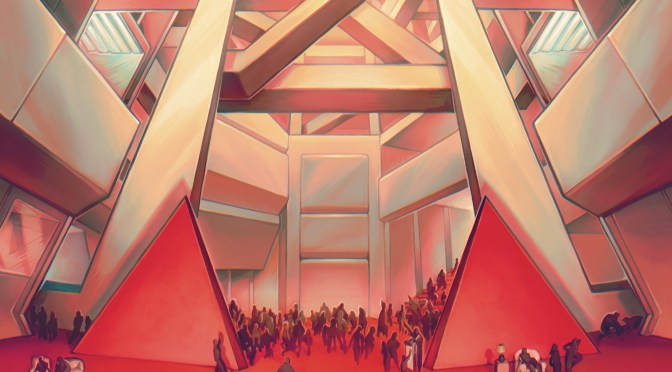
Depending on how you look at it I either chose the best or the worst time to read Triangle Agency. Over winter break I finally beat Control, and found I absolutely loved its setting and vibe. The whole reason I picked it back up again (after getting stuck with it many months ago) was that I had also finished reading all four books in Jason Pargin’s John Dies At The End series, and in doing so discovered that I actually love cosmic horror so long as that schmuck named Lovecraft isn’t involved. When Triangle Agency, a game I thought looked kind of interesting when it was funding on Kickstarter, started picking up some end-of-year momentum, it seemed like a perfect complement to all the other horror/conspiracy media I had been consuming.
In fact, Triangle Agency followed so closely in the footsteps of Control that by the time I finished the player section, I was unclear on how it was going to differentiate itself. Cute-but-horrific is the artstyle of the book, and I wasn’t loving it compared to Control’s “dead serious but yet so absurd you’ll still laugh”. However, as I finished reading the GM’s section, my opinion of the book had picked up dramatically. This is, in part, because Triangle Agency is not Control, but in part because the most interesting ideas in the setting are back there in the GM’s section, telling you how to turn a light and kind of goofy monster-of-the-week game into the conspiracy horror game Triangle Agency actually wants to be.
Of course, talking about the difference between these layers highlights the elephant in the room of Triangle Agency: the playwalled content. Because I do intend on playing this game later, I didn’t read any of the playwalled content. While I can’t comment on what it is, then (obviously), I do have a whole lot of thoughts about the idea and what it means. For one thing, it means you’re only setting yourself up to best enjoy the game and the surprises it has to offer if you don’t engage with the game prior to play, save reading the first parts of the book. For another, it means this game as the designers intended it to be played will only work if you can buy into the social contract of not turning the page. Is your group like that? I’m not sure mine is. While I’m thinking about that, let’s talk about triangles.
First layer: Characters and mechanics
The rule of three is an occult/pagan axiom, that whatever energy you put out into the world is returned threefold. While the practical meaning is something akin to karma, literal interpretations of the rule of three are used in horror and occult-like works, including both Control and (duh) Triangle Agency. In addition to using d4s, which are little pyramids, Triangle Agency has a dice pool in which threes are successes, and rolling exactly three threes has special effects. These mechanics plus highlighting the digit ‘3’ in red throughout the book put a nice numerology bent on everything which gets you in the mood to accept weird things.
Beyond the curiosity of using d4s, Triangle Agency has pretty normal dice pool mechanics. The rolls themselves aren’t modified; you roll 6d4 and count up how many threes you roll. You only need one success (for the most part) to succeed, so a typical roll will succeed a little more than 80% of the time. While these rolls aren’t modified by stats or skills or the like, the character’s Qualities end up making a difference through things called Quality Assurances. Each character gets nine Quality Assurances in character creation assigned to three of their Qualities: Attentiveness, Duplicity, Dynamism, Empathy, Initiative, Persistence, Presence, Professionalism, and Subtlety (as if Gygax, Myers, and Briggs had the worst threesome ever and then wrote a stat line). These Quality Assurances can be spent to change a die to a 3, and are refilled each mission. More importantly, if you have no Quality Assurances left in a Quality (or never had any to begin with, which at game start is true for six out of nine of your Qualities), you’re rolling with Burnout, which eliminates one 3 from your pool. You can also get Burnout for ingame circumstances, and while one or two are typical there is no upper limit to the amount of Burnout on a roll (not even six, although that would be quite severe). Reducing the number of successes rolled means that Burnout also increases the amount of Chaos that is generated from a roll. Chaos is generated from every die that doesn’t show a three, and gives the GM license to introduce ‘Chaos Effects’ into the mission which range from mundane reality distortions to ending an Agent’s life outright (although death is not necessarily permanent in this game).
The most interesting thing about rolling in Triangle Agency is that, broadly, the game assumes that you will fail. That’s right: The game assumes that if you attempt a task that has a probability of failure using only your innate human abilities, you will fail. The only ways you can make things go your way are to ‘Ask the Agency’ or use an ability of your Anomaly. When you ‘Ask the Agency’, you’re trying to get your handlers to set up a situation so that it goes your way. The ingame examples include summoning thieves, dropping pianos from the sky, and getting NPCs into grad school, and are way more convoluted than a typical skill check.
A character’s Anomaly Abilities come from their Anomaly, one of three core templates applied at character creation: Anomaly, Reality, and Competency. These each provide a different layer to the character and do so in a different way; Competency is the role the character has at work, and Reality is who the character is in the “real world”. Anomaly is a bit more primary, though. Each Anomaly has two or three Anomaly Abilities, which are both frighteningly powerful and have equally frightening consequences for failure. Anomalies are also the player characters’ links into the deeper layers of the game. All player characters are Resonants, meaning that they have bonded with an Anomaly and gained powers. This also means that their actual relationship with Triangle Agency, an Agency for controlling Anomalies, is more complicated than the employee handbook indicates.
Second layer: How the GM messes everything up
As presented in the player-facing section of the book, Triangle Agency is at its heart a “Monster of the Week” style game where the characters go on missions to retrieve anomalies. The results of these missions can be that the Anomaly is captured (yay!), neutralized (meh), or escaped (boo!). As you dig further into the game, though, and especially as you read the GM’s section, it becomes much clearer that things are not nearly as simple as that.
I should note this section technically contains spoilers for the GM’s section; while not as sensitive as the “playwalled” material it’s still things the PCs aren’t supposed to read (and we’ll get into the whole social contract of not reading things in the next section). The first thing the GM has to remember (which is implied but not really stated outright in the first section) is that Triangle Agency is a for-profit corporation. They are attempting to capture Anomalies in order to use them, while also tying up Loose Ends (Loose Ends being tracked in the game, people who are aware of the Anomalous and could spread that awareness). One of the main goals of the GM’s section of the game (in addition to some pretty good advice on how to design missions and the setting around the Agency Branch the characters work for) is to disabuse GM’s of the notion that Triangle Agency is either good or telling the truth about what’s going on in the world. This leads to a corollary that should shape essentially every single mission that the GM throws at the players: If Triangle Agency isn’t necessarily the good guys, then the Anomalies being pursued aren’t necessarily bad.
Although there’s an amusing use of the memetic Trolley Problem diagram in the book to imply otherwise, the game should be filled with difficult decisions. Your best outcome, as far as the Agency is concerned, is that the Anomaly is captured and returned to them. This means that the characters will be going around, scooping up people and other creatures with free will and imprisoning them indefinitely at the hands of a corporation that intends to extract their powers in order to make money. As is pointed out, even if you do think these Anomalies could destabilize reality this is a ghastly outcome and easily the worst of the three.
Character advancement plays into this as well. Each campaign has a finite number or advancements given, thirty “Time”. Each character chooses from three tracks to allocate their Time, and it’s a zero-sum game: You can’t reach the end of any of the tracks unless you dedicate all advancement to it. If you put more Time into your Competency track, it means you get promoted within the Agency and have more riding on its success. If you put more Time into the Reality track, it means you have more of a life outside of work, and build up your relationships. If you put more Time into the Anomaly track…well, it means you’re going to get more powerful, weirder, and the Agency will probably try to figure out a way to exploit that.
The tracks aren’t that simple. As you put more Time against any of the Tracks, you unlock “playwalled” content; it actually happens after the very first Time is assigned against your Anomaly track. This means that, at least on first reading, you don’t fully know the implications of your advancement decisions. And that ‘on first reading’ caveat plays right into how a campaign of Triangle Agency is structured.
Third layer: The social contract of the “playwall”
When I said earlier that I didn’t read any of the playwalled content, I lied a little bit. When you read the player’s section, it details out all the different options for Anomaly, Reality, and Competency. Each of these have their own specific rules: Reality defines three relationships, your ‘Reality Trigger’ which can be used against you, and your ‘Burnout Release’ that helps you avoid the mechanical impacts of Burnout. Competency defines behaviors that earn you Commendations and behaviors that earn you Demerits (the meta-effects of which are left a little foggy), as well as which Qualities get Quality Assurances. Each Anomaly has a number of Anomaly Abilities, with different effects and failure states detailed. They also each have a question with two answers, three checkboxes next to each answer, and a code for a “playwalled” page. I didn’t understand how those worked; they are not described in the rules. Well, it turns out that the mechanics for advancing Anomaly Abilities are playwalled. It’s not a huge spoiler to reveal that they’re the content you read after you assign that first Time to the Anomaly track; that way as soon as you’re in the position to advance one of your abilities, you’re taught how.
This particular example is a great way to show how deeply embedded the “playwall” is in the mechanics. If the game doesn’t want you to see something early, it does not show you. This includes literal game mechanics; one of the reasons I didn’t really elaborate on Commendations or Demerits is that, besides mostly goofy diegetic effects, they aren’t fully explained. However, it is heavily implied in the GM’s section that there’s more to them than meets the eye and that, depending on your character priorities, Commendations aren’t necessarily good and Demerits aren’t necessarily bad. I will say that structuring the game like this really amps up the mystery/conspiracy vibe. It also makes some of the decisions a bit weightier. There’s “playwalled” content gated behind box 26 of the Competency track…it is more likely than not you’ll never see it. Decisions you make about your character literally change what you know about the world.
And this of course leads into the obvious disadvantage of the “playwall”. The “playwall” is a social contract; you need your players to buy into the concept and agree not to read any of the sections they don’t have access to. This means getting players to agree to things that some kinds of players really won’t want to do, like getting your optimizers to agree not to read any of the advancement options. Triangle Agency is taking as much of the legacy game format it can to the RPG medium, but without the affectations like destroying cards and having to break the seals on little envelopes, it’s going to fall back on social contract even more than a board game would.
And that brings me to the other issue with a “playwall”. Even if we assume all of our players can resist the urge to peek, that they want to play to find out what happens and are comfortable with not knowing…It only works once. You only read something for the first time once, and this means necessarily the game changes as you play it, with the element of surprise and mystery diminishing with every character you create. And I emphasize ‘every character you create’ because the campaign for Triangle Agency is centered around the Branch. While the actual mechanics and procedures for reaching a campaign ending are playwalled the endings themselves are in the GM’s section, as is the statement that none of the endings are possible within a single Agent’s career. I have to assume this is at least partly intentional; forcing a player to ‘play dumb’ in-character is a small price to pay for giving the players an extended campaign over which they figure out the truth and make a weighty decision about what happens in their part of the world. Still, as much as I can understand that on an individual character level, it also has implications about playing the game, specifically playing the game more than once. After you reach the endgame, you know a whole lot more than when you started. Apparently another element of legacy game design baked into Triangle Agency is that it’s designed to be played once.
Triangle Agency is a game with a pre-written campaign in it; there’s not much else you can do besides play out the specific game that was built into the rules. That’s not a bad thing, especially as I think that Triangle Agency balances player and GM freedom to build their own version of the setting with the pre-established guidelines very well. It’s all a bit sneaky, and I mean that in a good way: Anomalies and therefore missions can be built following very broad guidelines, but at the end of the day there are a few primary actors: Triangle Agency and [Playwalled]. It’s actually very impressive that the game resolves to an end-state with three choices while still being incredibly free-form in the middle. As I mentioned before the game plays out somewhat like a legacy game, though with the absence of any permanent decisions. Each character will only be able to do certain things, sure, but nothing gets closed off as you retire characters, make new ones, and steer the branch towards the end of the game. I’m fine with that. Just like a good narrative video game, Triangle Agency players will have a chance to play again and pick a different path just to see what the new choices get them. But, at the same time, you only get to discover a plot twist once. While it’s true for many RPGs it’s especially true with Triangle Agency: There’s something special about the first time. Don’t read any spoilers, don’t watch any Actual Play, just get a group together and go. You’re going to have more fun if you buy into the idea that there are things you’re not supposed to see. Yet.
Triangle Agency is available on DriveThruRPG, itch.io, and from Haunted Table Games.
Like what Cannibal Halfling Gaming is doing and want to help us bring games and gamers together? First, you can follow me @LevelOneWonk@dice.camp for RPG commentary, relevant retweets, and maybe some rambling. You can also find our Discord channel and drop in to chat with our authors and get every new post as it comes out. You can travel to DriveThruRPG through one of our fine and elegantly-crafted links, which generates credit that lets us get more games to work with (which is eactly what we did here)! Finally, you can support us directly on Patreon, which lets us cover costs, pay our contributors, and save up for projects. Thanks for reading!


8 thoughts on “The three layers of Triangle Agency”