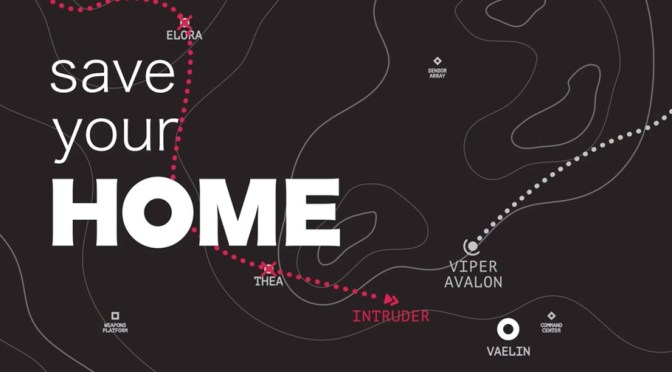
“One year ago the Rift opened and the Kaiju attacked. It tore our cities apart, rampaging for days until we finally dropped the bomb. We killed the beast but lost so much in the process. We knew this was only the beginning so we built the Mechs: giant war machines, the pinnacle of human engineering, and our only hope for survival. The Rift is reponing. More Kaiju are coming, but this time will be different. Your Home depends on you. Are you ready, Pilot?”
This is HOME, the Mech x Kaiju Mapmaking RPG for 1-4 players from Deep Dark Games!
A GMless game, HOME will let you (and your fellow Pilots if there are any) tell a story of survival and loss while also allowing you to create a world together, providing all its details, events, and damages. That’s actually the first thing you do: create a Home for each player on a map, either one of the preexisting ones or by outright drawing it up yourself first. Each player will create, pick, or roll for a name for the Home like the Republic of Dhar or Hiberia, as well as names for five Locations within it. These Locations then get added to the Map, with one of them being crossed out with an X – it was destroyed during the initial Kaiju attack.
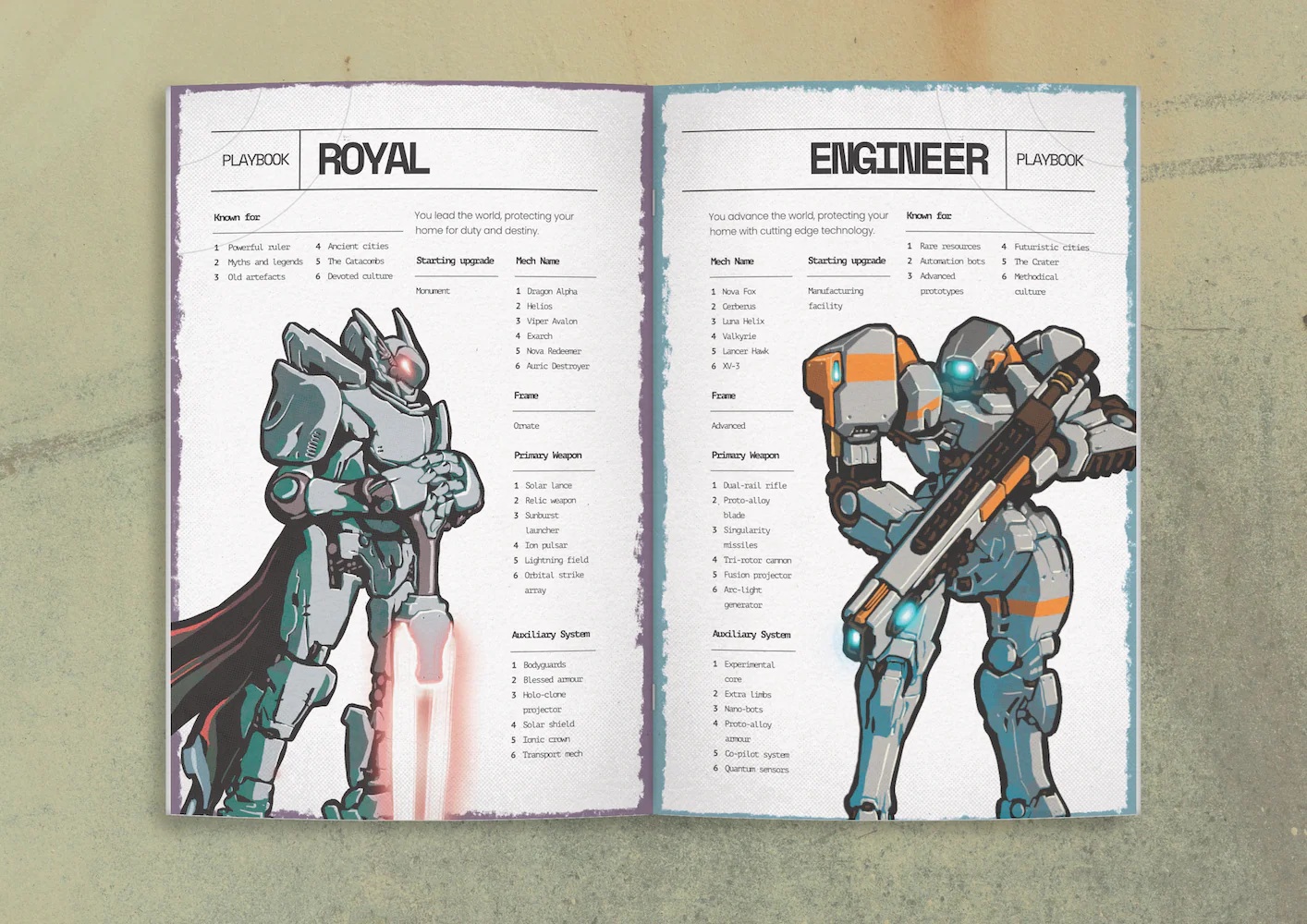
You then create your Pilot, who mostly consists of a name (there are some examples for each premade Home name), a Rank (you start at 1), and a Connection. Your Connection is something that’s a part of your Home that you fight for. It could be a lover, a spiritual belief, or an entire community. You’re going to be prompted to envision your Pilot’s interaction with their Connection multiple times through the game, so it will be granting the game a lot of its emotional heft. Then you pick your Mech from one of six Playbooks. Each one comes with a brief description of how you defend the world, names to pick from or roll for, a descriptor of the frame, primary weapons and auxiliary systems, and what your Home is known for. It also tells you which Upgrade you start with, like a Command Center or a Manufacturing Facility. We’ll get to the mechanical side of Upgrades shortly, but in the meantime it’s another thing to add to the map!
With all the initial character and world creation work done, you’ll have to complete three Fronts, each culminating in confrontations with the Kaiju. Front 1 is The Barricade, pitting you and the world’s preparations against a second invasion just a year after the first. Front 2 is The Rift, which will see you dive into another dimension several years later to try and take the fight to the invaders. Front 3 is The Source; a probe launched deep beyond the Deep Horizon on the other side of the Rift during Front 2 finally reports back, and it is time to try and eliminate the Kaiju once and for all.
Each player has to make three Preparation moves every Front, choosing from a list: Study the Kaiju, Rally the People, Build an Outpost, Unite the Nations, Search the Aether, and Gear Up. You’re doing this to fill up your Preparation track. You always start with one Boon die, a d6, since your Pilot is skilled, and as you complete Preparation moves you’ll add Boon dice and Bane dice (also d6s) based on your result that will then get used for each subsequent move. You roll your dice and keep the highest value of Boon die!
Getting two 6s is a Critical Success, which will add two Boon dice. Getting 6 will add just one Boon die. 4-5 will add one Boon and one Bane die. 1,-3 will add a single Bane die. Now, as Bane dice hit the table, they cancel out Boon dice that share a value with them – roll two 6s on your Boon dice but a 6 on a Bane, you lose one of your Boon 6s and get downgraded to just a normal success. If by plentiful Bane dice and/or bad luck you have no Boon dice left uncancelled, that’s a Critical Failure, and adds two Bane dice to the tracker. Upgrades will add a Boon die as well, but only for its specific move: you’ll get an extra die to Study the Kaiju for every Research Station you have, but those stations won’t do you any good when you try to Unite the Nations. You can only pick a Preparation move once per Front, so you can’t just stack Manufacturing Facilities and Gear Up three times either.
For an added complication, as the game progresses and the the wear and tear on the world from multiple invasions gets worse, more Bane dice will get automatically added to every Preparation move, even the first one of the Front.
Then, it’s time for the Showdown with the Kaiju. Each Pilot will face their own opponent, and this is one aspect where playing HOME solo… well, it doesn’t suffer per se, it’s good enough at being a solo game that CNN highlighted it for crying out loud. However, it is something where I think playing it with others would make it a bit stronger. See, every player rolls to create a Kaiju, establishing the thematic category they come from, their name, and a special trait they have. However, if you’re not playing solo then you’re rolling the Kaiju that someone else is going to fight, and you then control it when it comes time for it to face off against its Pilot opponent. That’s mostly narrative control, although we’ll see in a bit that there’s one very impactful mechanical weapon to fire.
Mechanically the Showdown functions much the same as Preparation – you’re rolling the Boon and Bane dice you have in your Preparation track and eliminating dice that match before getting the final result. However, there are some very important differences. First, what those results get you: how the battle is going and how much damage your Mech and the Kaiju are taking. 6×2 deals the Kaiju 2 damage, 6 deals just one, 4-5 deals one damage to both the Mech and the Kaiju and moves the fight closer to your Home, 1-3 deals one damage to just the Mech and moves the fight closer to Home, and a Critical Failure (no dice) deals two damage to the Mech and rapidly moves the Fight closer to Home. Did I mention that the Mech will always have fewer total hit points than the Kaiju?
Second, canceled dice aren’t just canceled for that singular roll, they’re removed from the pool for all future rolls during the Showdown, meant to show the Mech getting worn down over the course of the fight. On the one hand, you might get lucky and end up with only Boon dice after a few rolls, at least preventing you from getting Critical Failures. On the other hand, if Preparation went poorly it’s definitely possible to reach the minimum of a ingle Boon die and wind up in a death spiral.
To compensate the Pilots have a few tricks up their sleeve, each of which can be used a limited number of times per Front. While each Pilot is fighting their own Kaiju, once per Front they can ask one another for a Team Up, which can add a Boon die to their roll. They can Improvise a number of times per Front equal to their Rank to reroll a single Boon die. They can Remember Why You Fight to reroll all of their dice for a roll once per Front. Notably, all of these can be used for any roll, Preparation or Showdown. A Pilot’s final trick is a terminal one: Detonate Core. When the Mech is reduced to 0 health the Pilot can choose to blow it up to try and take it the Kaiju with them, rolling a number of Boon dice equal to their Rank and dealing up to 3 damage to the beast as a last-ditch effort to protect Home. Suffice to say, there is no chance for the Pilot to survive this.
The Kaiju have a trick as well, though. Once per front a Kaiju (controlled by another player, remember) can choose to unleash their Ultimate Power, immediately rolling 4 Bane dice. While they don’t remove Boon dice from the pool permanently like would usually happen, it can still be a devastating turnaround for Showdown roll that looked like it was going the Pilot’s way.
If the Kaiju runs out of health before the Mech does, Home is safe! If they run out of health at the same time, the Mech and Kaiju are both destroyed and the only question is the survival of the pilot, but Home remains safe. However, if the Mech runs out of health first the Kaiju goes on a rampage, destroying a number of Locations and Upgrades. The number destroyed increases every Front, raising the stakes again and again – it’s even possible for every Location to be destroyed before reaching Front 3, reframing that Pilot’s story as that of a wandering survivor trying to claw their way back to victory.
Once a Front is completed you have to address the Aftermath, and for this I’ll quote right from the book:
“Envision your Home in the aftermath of the Front. Imagine your Pilot, their Connection, the cities, or the hole in the world where they once existed.”
Then, you move on to the next one. Your Mech gets some more health whether it’s the original or you had to roll up another one, and either you create a new Pilot or the surviving one goes up a Rank (which is the mechanical impetus for keeping a Pilot alive). You also get to build another Upgrade on Front 2 and Front 3, either boosting a wider variety of Preparation moves or focusing on making one particularly good.
Throughout all of this, you’re envisioning the results of the dice, tapping into your Pilot’s Connection, and changing the world by adding to the maps: destroyed Locations, Upgrades and their consequences, fallen Mechs and Kaiju corpses, and all the other consequences of the story. Each Front comes with prompts and a list/d6 table of features to help flesh out the story and detail the maps, and there are a number of oracles to help add flavor or resolve decisions, like detailing what is making your Preparation efforts difficult or helping you decide if your Pilot survives the Mech’s destruction. There’s even one that has a result that sees a victorious Kaiju escaping back beyond The Rift and becoming even more dangerous.
You play until you reach the Finale as the dust settles after Front 3, envisioning how each Home deals with the Source. Finally, you roll a die, and take turns envisioning your Home that many years after the fighting is over.
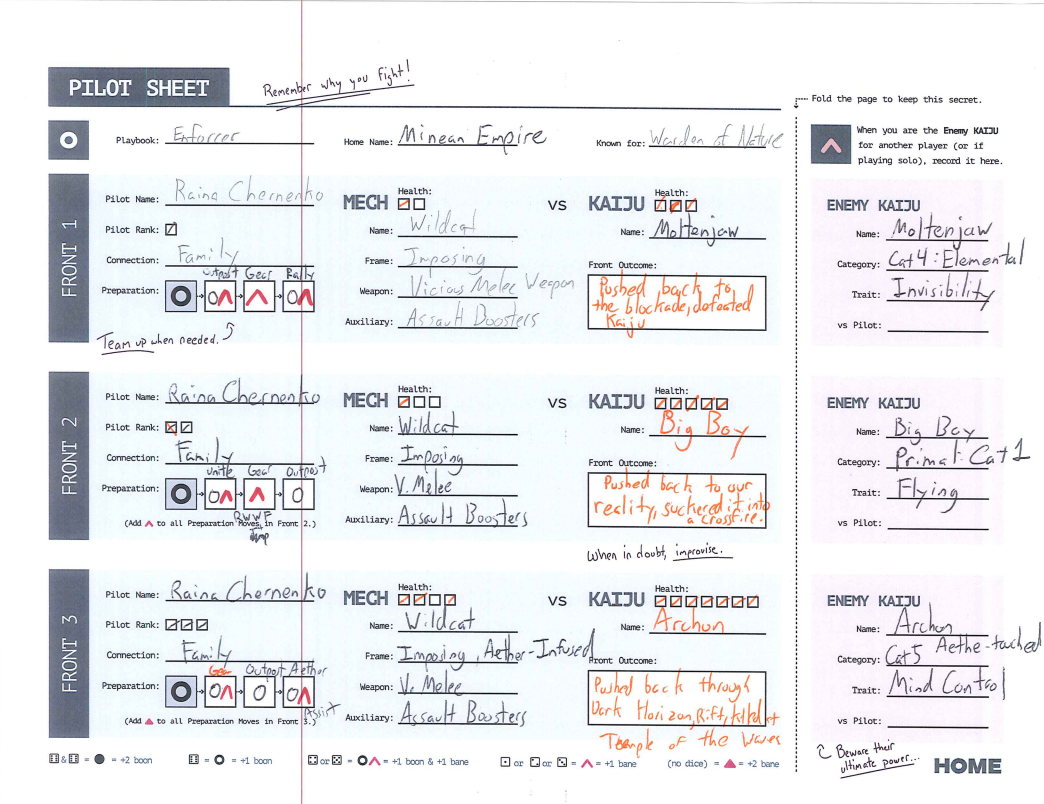
I gave HOME a solo try, and had something of a blessed existence. Raina Chernenko assault boosted the Enforcer-type frame Wildcat to victory again and again: taking out the invisible Moltenjaw on the very edge of the Barricade, luring the flying Big Boy back into our reality and immediately bullying it, and going blow for blow against the Archon in a fight that raged from the Source, through the Deep Horizon, and all the way back to the Temple of the Waves just outside of the Rift.
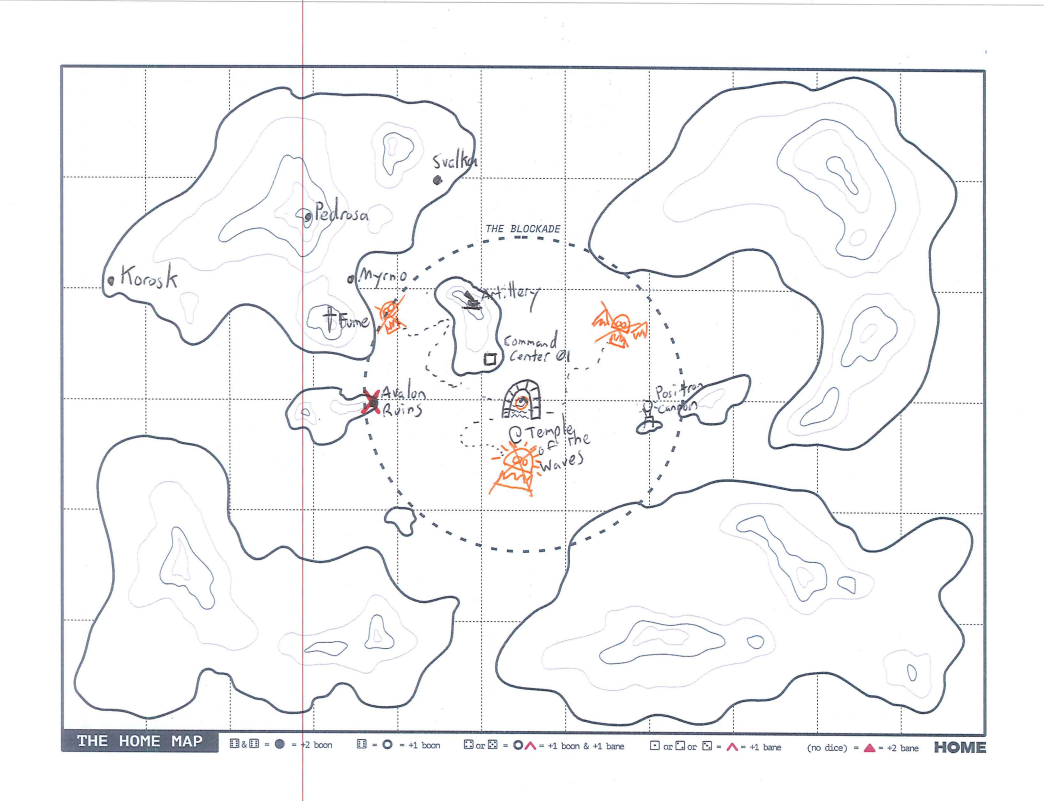
Fortunate Preparation made a big difference. Command Center 01 coordinated the construction of artillery positions, positron cannons, and minefields. Rallying the People and Uniting the Nations showed how wary and tired folks were, but still provided boons. Improving Wildcat didn’t work out much despite the efforts of the Fume weapons manufactory, but just as Raina prepared to attack the Source the already Imposing frame was infused with Aether. That the newly-constructed Temple of the Wave helped Raina commune with the Aether was an amazing coincidence, the dice love the story I guess.
As the Archon sank beneath the waves and the frozen vault where the Kaiju were coming from was destroyed Raina, her family, and the entire Minean Empire rejoiced that the only loss they had taken was the destruction of Avalon in the first invasion, before Wildcat was ever built.
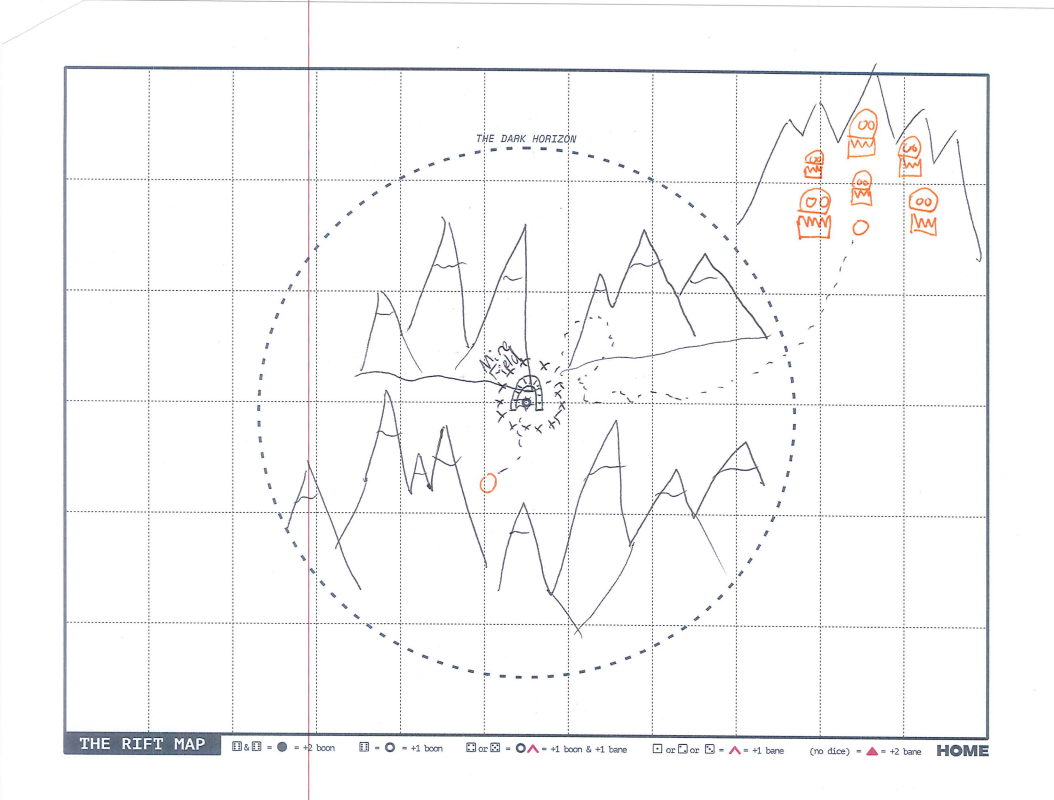
HOME was an excellent single player experience. There was a hearty amount of worldbuilding prompts, scribbling on the map in reaction to Preparation and Showdown results was genuinely fun, the Showdowns were tense, and there was enough mechanical grit to make it feel like I was making important tactical choices. I can’t wait for a chance to get it to a table with other players to see the Homes we can build and defend together, and in the meantime I’m definitely going to be taking it out for another solo spin.
You can find digital copies of HOME on DriveThruRPG and itch.io (the latter of which also has free downloads of the player sheets and some premade maps) for $15.00, and you can get physical+PDF copies from IPR (I got mine at PAX East 2025) for $20.00 and Compose Dream Games. for C$25.00.
Build your Mechs. Map the unknown. Fight the Kaiju. Save your HOME.


3 thoughts on “HOME Review – Mechs, Monsters, and Mapmaking”