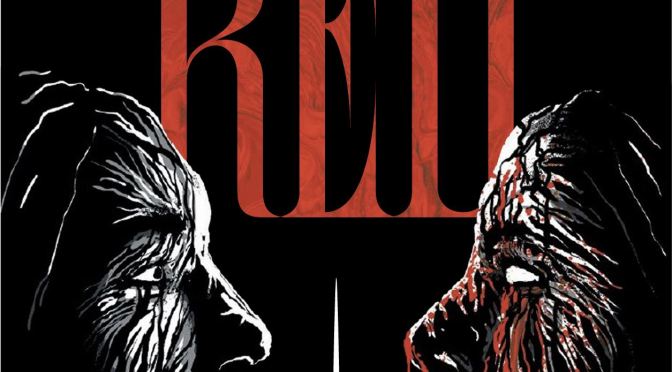
“Something very bad happened to you a very long time ago: you died and it hurt.
You’re cursed. You’re still here and you couldn’t just stay dead. You’re definitely not in heaven, but there’s a pretty good chance this could be hell.
Your heart has basically stopped. You don’t need to eat. Your skin is clammy. Your touch is cold as ice. You have to remember to breathe, to blink, to smile. Those are things people do? Right? It’ll be alright. Everything will be okay. You can get it together. You just have to find the right place and the right people and it will all work out. There are other dead people just like you. They’re suffering in just the same way you are.
The quickest way to forget is blood: someone else’s blood. Your touch won’t be as cold as ice after you drink another person dry. You’ll feel a little more human. Your heart will beat like it’s meant to.
Take a sip. Cut loose. It’ll be alright.
When you’re in the moment, you can almost remember what it meant to feel alive.”
– The introduction to Paint The Town Red
A message popped into the Cannibal Halfling Discord a while back: “Do y’all know if Aki has had a chance to check out Paint the Town Red”?
Now, I am uncertain as to what made me the one singled out for that question other than, well, all the vampire themed games I’ve reviewed. I have a type, alright? And I know that I’m not alone. The great monsters of legend originate and persist in the greatest fears that we have about ourselves. Zombies are a haunting view of the end that comes for us all, and the fears of what’s left of our bodies when the soul (if it exists) departs. Lycanthropes are our bestial urges, and the loss of control.
And then there’s the vampire. The myths and modern fiction portrayals of the vampire are chock full of metaphor: predation and corruption. Isolation. Hunger and addiction and desire. Paint the Town Red is not the first tabletop game I’ve seen to explore these concepts but it’s the one that puts them unapologetically front and center, grabs you by the back of the head and forces you to watch. It is a game that is simultaneously explicitly about embracing hedonism and still having you come to terms with how flawed that is.
At its core, the premise of the game is simple: you are an undead, specifically a vampire, because you have passion (and yes, that is an important distinction). Consider, if you will, how much of your life is waiting for the parts of it that you feel like you live for: the date night, the weekend with friends, that gap between when the kids go to bed and when you have to join them. How much of life is waiting for those moments? Now…extend that across infinite time, where everyone who still actually has life in them will wither away in what are comparatively seconds.
Tonight is the night where you are determined to make that wait pay off.
Gameplay
Paint the Town Red is a relatively simple dice system. There are three stats for the player, which will look similar to those familiar with Whitewolf: Savagery (Physical), Allure (Social) and Duplicity (Mental) [thanks to Discord member nabsy for pointing out some typos and that the stats spell out SAD, which is deeply amusing – Ed.], all of which key off of a success gradient model that is a cousin to the Powered by the Apocalypse & Forged in the Dark models with a sprinkling of the Advantage/Disadvantage model from D&D 5E. One stat gets a +1 (at the edge of human ability), and one stat gets a +2 (obviously inhuman). When a players want to attempt to do or observe something, roll 2d6 and add the appropriate modifier. On a 9 and up, it works; lower, something goes wrong. If you have an Advantage or Disadvantage, roll an extra die and ignore the highest or lowest result as appropriate. This applies to the combat system as well. There are a few methods of engagement the player can choose from, from attempting to win through tricks to purposefully trying for lethal measures, and like Blades in the Dark the more impactful the option the greater the risk the player exposes themselves to in the case of failure.
What I do find interesting is a variation that the rules mention, and specifically encourage the stacking of Advantages and that if the player racks up a net balance of three then the check immediately passes. For example, if your character is attempting to break into a house, one might come up with details like “it’s a rusty lock”, or “I have tools for it” and “I have an accomplice distracting the guards” and you just…do it.
That narrative choice is a hint as to the deeper mechanics under the hood. Dice rolls might be simple but there is a push and pull of running stats that keep the game moving. First is Pulse, the measure of how human you feel right now and no, “human” does not necessarily mean “good”. Importantly, Pulse is most often spent on powers and raised when your character indulges their passion. Next is “Chaos”, a measure of how much of a disaster your character is at the moment and how much that is affecting the city around you, and it tend to rise as powers are used.
From that you might have noticed something: In a game about feeling human, to do so you need do something that makes a giant mess, that then requires your powers to escape the consequences from that makes you feel less human so you have to indulge your passions. In what is a bit of an “on the nose” metaphor, this is a cycle from which there isn’t a clean exit. The demands of the next high are a bit greater, the need a bit more, and eventually you’re going to start breaking enough things to get noticed, and boy, are there people to notice you.
It’s not all bad: Bonds are people, or rather groups of people or causes, that ground an immortal to the world. Characters don’t start with a bond, but when they gain one they replace one of their preexisting passions. Characters can indulge in their bond as if it were a passion with some extra benefits: they don’t just have the option to increase their Pulse, characters can reduce their Chaos. This comes with a fairly realistic caveat: Bonds require investment. For a Bond to be part of a vampire’s unlife, the vampire has to let them in, and that can mean putting their connection in harm’s way, or abandoning the rest of the party to spend time with them, or revealing a personal secret. And if this relationship fractures? The vampire immediately Flatlines, where their Pulse it set to zero and the vampire immediately goes into the middle of a self-destructive cycle.
Look, I’ll come out and say this: these features are personal to me in a way that I don’t see in a lot of games. The designers, along with making a game that has solid mechanical foundations, have rooted them into a lot of very human impulses, and ones that I personally feel acutely. I have made jokes along the lines of “why would I go see a therapist when I can play a session of DIE” and while I wouldn’t say the same about Paint the Town Red, these are behavior cycles I am familiar with and I can easily imagine a great deal of personal bleed in these sessions.
Setting and Session Structure
Again, while the basic mechanics of play are relatively simple, there is a fairly complicated set of mechanics that drive the story. The session begins with a quick intro as to where characters are, with handy charts to reference what kind of scenario you might find yourself from living the high life (high Pulse and Chaos), in quiet misery (low Pulse and Chaos), a quiet moment of connection (high Pulse, low Chaos) or in the process of ripping off someone’s face so that you can eat a guy. From there, the players go off! The GM might have prompts or events, but players are fully empowered to do as they will.
But what happens? Well first, the design team did a really admirable job of worldbuilding. They provide a series of cities filled with iconic locations, contacts, and people to discover. If characters require prompting, GMs are to guide players to the nexuses of both joy and misery within the city (Lurks and Hollows). However, a big part of the game is that, to be honest, players are often the best at making their own consequences, and ho boy, are there capital-C Consequences. Your characters aren’t the only undead in the city, and your group of carousers are likely straying onto someone’s turf. You might lose a Bond, a friend becomes an enemy, or a Faction of NPCs in the city becomes unfriendly to you. We’ve already discussed how the gameplay loop is set to be unsustainable: that spiraling Chaos that players are already primed to cause brings attention, scrutiny, rivalries, and reprisals. The job of the GM is less planning a grand adventure and more to keep that spiral going, to be that “bad friend” who pushes them with a mechanism literally entitled “A Bigger Thrill” where the player who generated the most Chaos in the session (usually the one who faces Consequences) effectively gets an XP boost to buy more powers. I’ve been in games where players will make dire decisions if it nets them extra powers and cool gear, so I can imagine how quickly this ramps up the game. Finally, after players have wreaked enough havoc, enough is enough: the Setting “burns down”, whether literally or figuratively. The party is over, and all that’s left is the hangover. The vampire retreats back to a quiet place, but not before players are prompted for the memories of that city, what will be carried forward…and then it’s time to ask the players when and where the next party will be! You have eternity, and the only time you stop is when players are no longer interested! Heck, you might come back as a different type of undead.
Yes, I said a “different type of undead”. In a truly cool wrinkle, the powers of undeath are so vast and varied that the type of undead you are is more of a high school cliche than anything biological, and players can pick and switch them just the same. The vampire is driven by the thirst for life, but they are not alone: Ghouls think that it’s silly if you want to stop with just blood alone. What’s the difference after all? You’re killing them either way, and yeah maybe eating human flesh is more “conspicuous” but you get to taste the person’s joy all the better. Do you want to play with the concept of time and cycles? Hey, what is more in line with High Pulse, High Chaos on a full moon than a lycanthrope? Zombies have lost the passion, but keep on going, unable to stop. The Lich? Oh, they have their goals, and nothing will distract them, not for all of eternity.
It’s not the most detailed campaign in terms of plot, but I truly believe that’s actually for the best. I am a true believer that the best bits of plot are the ones that the players bring themselves. The choices a player has their character make are often the truest manifestation of what that character is, more than any backstory. In fact, the backstory might be the story the vampire tells themselves, the lie that sustains them through eternity, but what happens when those motivations are put in conflict with another desire? The answer to that is likely to be more compelling than any pre-written plot point, and all it requires of the GM is to let the player and his character explore the city.
Which brings me to a huge piece of what makes Paint the Town Red Unique: its cities. The core rulebook comes with three prepared cities, populated with all the setting features I’ve mentioned and more. Even more impressive is that what they provide is times and places that I don’t see used in vampire mythology: First Century Rome. The seat of the Carolingian Empire. Persia in the Middle Ages. The last days of Feudal Japan. These are places that I don’t often see games set in, and it’s a shame and it’s refreshing and a break from the tropes of the Victorian era codification of vampiric legends and it’s nice to see different cities (though I still lament the omission of Paris to make a truly awful “moveable feast” pun) I think it’s notable to mention: New York City, immediately post-Black Thursday. It’s the death of the Roaring Twenties and the start of the Great Depression, and if you need a snapshot of what this game is about, that’s it.
You can find Paint the Town Red on DriveThruRPG and itch.io for $20, which includes all of the rules and several ready-to-play adventures, but there is also a QuickStart available at both for free with a single adventure.
 Cannibal Halfling Gaming