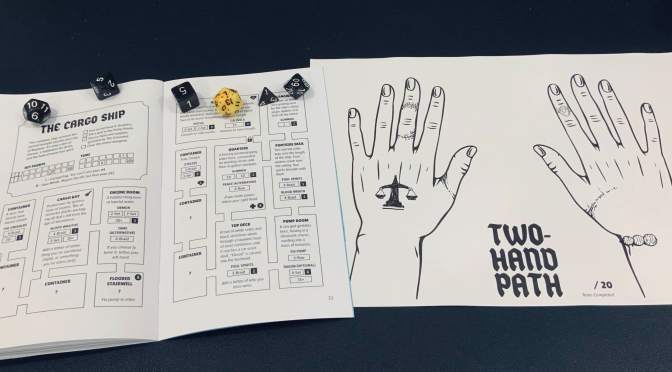
“After the locusts and pits and boiling seas. After the war in heaven and feasting on earth. After the seven years of blood and forty years of night.
There is magic. Magic and bone.
Where streets grow weeds and skyscrapers stand hollow. Where old gods wake and new gods form in the hearts of the wayward. Where cult and banner flourish. Where the dead, they walk. Where the stars disregard their course and Jupiter’s children are born under powerful new signs.
Mages. Mages like you.”
With rings on your fingers, tattoos on your knuckles, and scars on the back of your hand, you’ll delve into the cursed ruins of a post-fall city and walk the Two-Hand Path.
Designed by Mikey Hamm, Two-Hand Path is a single player dungeon-crawling game using a “polyhedral-yahtzee” system with no stats but plenty of dice rolling.
All you need to play is the book, a character sheet (there’s one in the book), something to draw with, and a set of dice: d4, d6, d8, d10, and d12, with a d20 on the side for some special cases. A game of Two-Hand Path consists of five dungeons, each holding some variety of something that needs to be recovered, someone who needs to be saved, or someone/thing that needs to be stopped.
Dice are rolled to create Spells – you can name them all sorts of ways, but there are five types, and each is a kind of result that you’ll be called on to use in order to overcome obstacles. A Total is a combination of dice that adds up to a target number exactly, and represents precise spells. A Total+ is a result that adds up to a target number or greater, and is your choice for “I didn’t ask how big the room was I said I Cast Fireball.” A Set is a group of matching results, simple but effective spells that all have the same number on every die. A Row is a group of sequential results, like 2-3-4-5, complex spells like illusions. A Braid represents exorcisms, counter-spells, and ‘other deep arcana’, and calls for the strangest dice result: the die with the highest result in the group needs to be the one with the fewest sides.
When you enter a room that needs to be cleared, it’s time to roll some dice and cast some spells! Your first step is to Draw Forth, rolling five dice all at once – d4, d6, d8, d10, and d12. Next, you can Shape your results by rerolling as many of the dice as you’d like, although you can only do so once (for now). Then you Unleash, hopefully grouping your dice to get the results/spells you need to. You then assign those spells to targets. Notably, you can only cast each option once, so an enemy with multiple 2-sets, for example, is not going to be defeated in a single turn. One with a Total of 13 and a 2-set, however, could be!
After that, you must Steel Thyself: any surviving foes attack, dealing their damage, which you must mark. Then, you mark one box of Time. Then, you either begin another turn with another attempt to Draw Forth or, if there aren’t any surviving foes, you can move to another room of the dungeon at will.

The majority of rooms are going to have at least one foe. Some will have multiple, and some will have optional targets as well. Optional targets might not be foes per se but can be alternate ways to solve encounters (like making peace with bandits instead of slaughtering them), things that will make the fight against the main foe easier (like destroying a helm that will make an enemy vulnerable), or bonus objectives (like killing an old god).
Some rooms are marked with a ?, making them mystery rooms. Any time you reach a mystery room you roll a die to determine what’s in it – what’s cool about this, though, is that you choose which die to roll. The table doesn’t change, but if you’re just rolling a d4 you’re going to be keeping your results to relatively tame bonuses or penalties to HP or Time. Go all the way to a d20, though, and you might run into some very nasty bad guys… but may also find some treasure, some shortcuts, and even a dead mage you can loot.
Of course, what makes Two-Hand Path stand out the most when it comes to style is the character sheet: a drawing of two unmarked and unadorned hands.
You’ll find all sorts of treasure while delving into the dangerous parts of the city. Rings are associated with a specific number, and can be used to replace the value of a die before you Unleash; they can’t be used for the primary die in a Braid, but that’s about the only limit they have. Gathering beads and assembling them into Bracelets will get you more rerolls when you Shape your magic. Auras will grant you unique abilities, like ‘spending’ dice (removing them from your pool for spell use) in order to gain an effect.
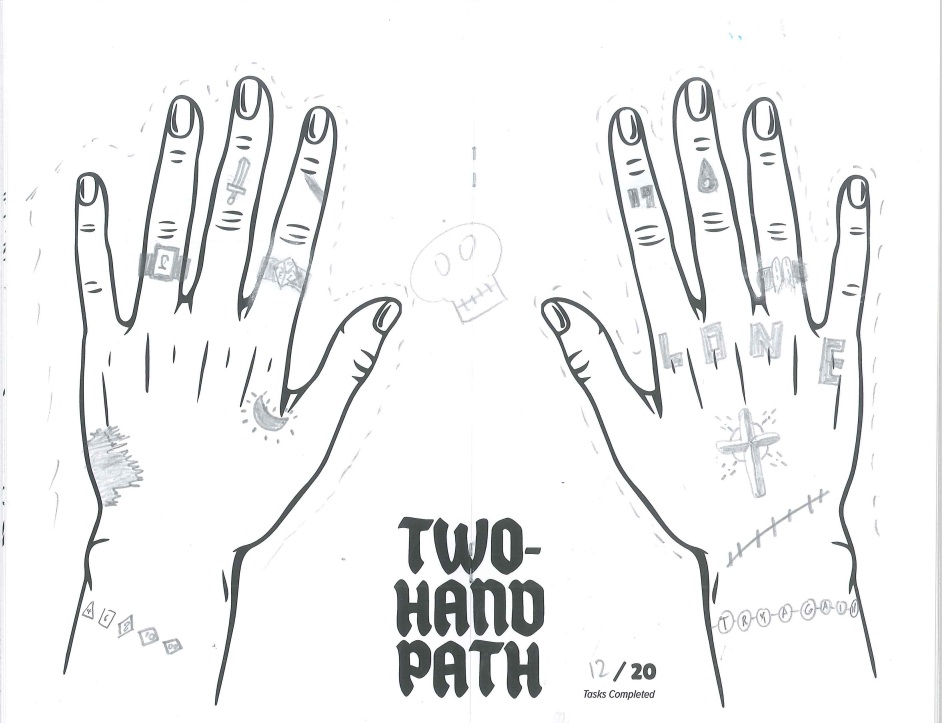
When you lose enough HP, and sometimes as part of an encounter, you’ll pick up a Scar; for every subsequent dungeon you delve into, you begin with +2 HP for every Scar you have. You’ll also be prompted to add Tattoos; these don’t have any mechanical impact, but they are essentially visible manifestations of the story you’re telling. For example, after freeing some captives you’re prompted to either a Tattoo a source of anger on your left hand or a source of hope on your right.
All of these – Rings, Bracelets, Auras, Scars, and Tattoos – are drawn by you on the hands of your character sheet. Several examples of what this will look like are provided, including a d100 spread of Tattoos you can copy/trace/be inspired by. This means that every playthrough of Two-Hand Path is going to create a completely unique artifact for you to keep as a memento of your game.
Now, the dungeons in question are pre-made – The Supermarket, The Subway, The Hotel, The Cargo Ship, and The Church – but you’ve still got a fair amount of choice. Some of the dungeons have multiple starting points for you to choose from, and there are often multiple paths to get to many rooms, letting you choose which challenges to face and which goals to pursue in which order. Toss in the mystery rooms and the ability to choose how much risk you’re willing to take when populating them, and the relatively simple dungeons don’t feel overly restrictive.
Each dungeon has four objectives. One is kind of coded as the main reason you’re entering the dungeon in the first place, like getting vital medical supplies from The Supermarket’s Pharmacy or ridding the world of Apollyon the fallen angel in The Subway. Another is always to clear the entire dungeon. The other two are specific bonus objectives, like healing some mutants or searching a specific area for a missing friend; some of these objectives will simply involve successfully clearing a room, but some will involve Optional targets that may be a bit tougher, or have a limited amount of Time.
Now, I’ve mentioned marking HP and marking Time, and I’ve mentioned Scars, but both can get a bit more involved. First, Time: the more you mark, the more things are going to happen, and they’re never good. Sometimes certain paths will no longer be available, funneling you into nastier challenges. Sometimes an opportunity (and/or objective) will be lost. Sometimes an enemy will become more powerful. Sometimes a hindrance, like bleeding HP or losing access to a specific die, will hit you. You start with 16 HP and 16 Time, and once you’ve marked the 16th box for either one, you begin to Surge with arcane power.
There’s some good news here: you’re immune to damage, and you can start rolling a d20 as well when you Draw Forth. However, once you roll a 5 during the Draw Forth phase of a turn you remove that die from your pool for the rest of the Surge. Then the second time you roll a 5 during Draw Forth you die, torn apart by your own power. You can always choose to leave the dungeon you’re in, which automatically ends the Surge, but that’s the only way to end it, and there’s no returning to a dungeon once you’ve left it.
When you finish the final dungeon or perish you count up how many objectives you were able to complete and note them on your character sheet, and then you take a picture of it. Your time on the Two-Hand Path has come to an end.
This will probably be a rough game for you if you mind being at the mercy of Polyhedros, Lord of Dice; luck can definitely play a big part. I fully cleared the first two dungeons and then got hammered for both damage and time in a single room in The Hotel, and not even by the demon I faced in the Mezzanine – their darn 3-set Bodyguard locked me down for half my Time.
Choice, however, plays just as much of a part. I always rolled the d20 for mystery rooms, and while that got me a Ring of Mirrors and a clutch map with enough extra time to kill the False Prophet of Magos before he could finish his work, it also got me into a few extra fights. I tried to kill Dagon even after I’d fixed the pumps I needed to get further into the ship, and by the time I gave up I had another Scar. I twice chose to not risk being consumed by the surge after rolling my first 5, leaving Mammon to rule over The Hotel unharmed and never opening the door that should stay closed in The Cargo Ship. Finally, I did choose to keep going in The Church, managing to slay the Seventh Messiah during the surge only to then enter the Nursery and join the Silent Ones in their quietude forever.
So, yeah, luck cursed me in some spots, and that can get frustrating. But I also made my own arcane bed and then had to sleep in it.
The worldbuilding in Two-Path Hand adheres to a less-is-more philosophy, and as a result the game has a surprisingly strong flavor to it. For one example, that bonus objective to find a missing friend? The only flavor text in the room the objective tells you to search is
“All empty.”
and a prompt that neither anger nor hope can replace grief, and to Tattoo something you mourn on your hands. For another example, the flavor text for Mammon admits that he’s sorry to say that he doesn’t even know who you are, but he’s about to, and there being an Optional target that involves making a deal and getting a new Tattoo as a result certainly implies a lot about the guy.
Overall, Two-Hand Path is a game that asked ‘what kind of experience do I want the player to have’ and took a lean but effective angle to get there. There’s nothing you can carve away without losing the tension, the apocalyptic vibes, and the artistic outlet that make the game a genuine joy to play.
Actually, an additional note: I have all the art talent of a rock sinking into a muddy lake, but there does seem to be a slice of the TTRPG world that prompts me to scribble things but keeps it simple enough that I actually get to enjoy it. I love Bucket of Bolts, but felt pretty underwhelmed by my own ship-drawing capabilities. HOME and Two-Hand Path, however, keep things very simple and contained, to the point that I can look at what I was asked to draw and feel pretty proud of it.
Acquiring Two-Hand Path is a bit of a dungeon crawl in and of itself, insofar as there are a lot of options and some of them will cost you extra. You can get the PDF version on IPR, itch.io, and Heart of the Deernicorn for $10, but on DriveThruRPG for $12. The print version listed for $20 on IPR is out of stock as of this writing, but the Print+PDF bundle on HotD is still available and is listed at $14.
However you get your hands on it, I’d recommend having a digital version (or swinging by your library to do some copying now and again). Don’t get me wrong the print version is a nice and sturdy 24-page booklet, but there’s a lot of replay value in Two-Hand Path, and unless you want to be erasing your character sheet from earlier games you’ll be printing out fresh copies of said sheet at the least. That’s one small critique I do have, the game isn’t as well supported as it could be; there’s a free demo on itch that you can check out, but it dates from the game’s crowdfunding days, only has one hand per dungeon, and lacks some key things like the Surge. Having the character sheet available for download by itself would be helpful.
Edit: The issue of there not being any any fresh character sheets available has now been resolved! They are available on both the itch.io page and Hamm’s website. – 12/1/25
On the other hand (… darn it), I’ve seen that if you end up with a physical copy at your FLGS you can reach out to Hamm to get a free digital one, so that’s nice!
What magic will you wield, what scars will you bear, and what stories will your tattoos tell? You’ll have to walk the Two-Hand Path to find out!
 Cannibal Halfling Gaming
One thought on “Two-Hand Path Review: Getting a Grip on Luck and Magic”