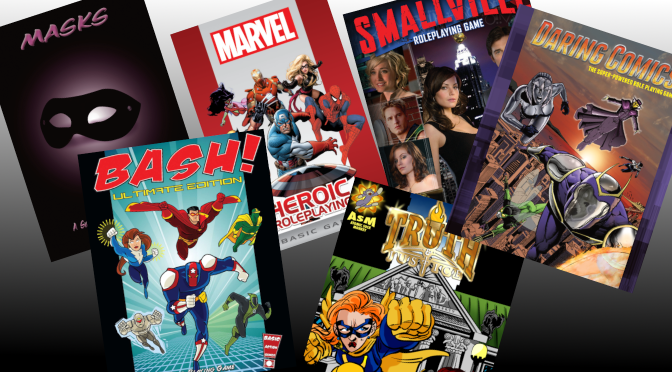
A few months ago I wrote a survey of Superhero RPGs, and more recently I began looking into the best games from that survey in more detail. Here are links to Part 1, Part 2, Part 3, Part 4, and Part 5; since everything I say here supersedes what I said in my original post, I recommend looking at that one after reading this one, if at all [you probably shouldn’t].
I already made my intro for this follow-up in Part 1, so I’m going to discuss my criteria again; I don’t think my conclusions will be very useful if you don’t know what I was looking for. Even if you aren’t looking for the same things as me, this post will probably be useful because I think I go into a lot of detail explaining why I like and dislike certain games.
-Something rules-lite. My very loose provisional definition of rules-lite is “90% of the game can be taught in 30~ minutes”. “All the reference materials you’d ever need can fit on four single-sided sheets of paper” is another good guideline. This excludes things that vary from session to session, like character sheets for NPCs, maps, etc.
-For superhero games especially I really like games that mix traditional and more modern “narrative” mechanics. GMs can create NPCs and complications as usual, maybe even loose adventures. But players should be able to, for instance, spend metacurrencies to do things they can’t normally do, which replicates the flexibility superpowers have in actual comicbooks. What I really value in this genre are games that have mechanics and / or procedures that essentially create emergent narrative, such as mechanics that keep the personal lives of superheroes in focus.
-Relatedly, it’s a huge bonus for me if a game has any focus on the personal lives of superheroes instead of only focusing on team activities. I think secret identity stuff is a very important part of the genre, and it’s always a bit disappointing when it doesn’t really matter in an otherwise solid superhero game.
-Genre emulation, in general, is very important. If a game doesn’t have mechanics designed to replicate genre conventions in some way, I think it fails at being a superhero game.
-”Generic” superhero games are preferred to ones where the setting is highly integral to the intended experience.
-For a lot of people it’s important that the power-levels of the superheroes in their game are accurately reflected, like having Batman be a thousand times weaker than Superman. Mechanics that allow regular human characters to keep up with high-powered ones are definitely appreciated, and I certainly prefer that philosophy to the one where a Batman type more-or-less can’t work alongside a Superman type.
Revisited Conclusions
I’m now ready to make my truly definitive statements on superhero RPGs. Which games seem the best, and for what specific purposes / playstyles would I recommend each of them.
FATE and FATE-adjacent
If you enjoy FATE’s general design philosophies, there are both a bunch of FATE options as well as non-FATE games with similar goals. The fastest option here is Four Color FAE, which uses FATE Accelerated as a basis for superheroing. Daring Comics is a very comprehensive FATE Core-based book that adds granularity.
Marvel Heroic uses Cortex Plus and has a similar metacurrency-heavy philosophy. Smallville is another Cortex Plus game that focuses almost entirely on the drama side of superheroing. Capes, Cowls, and Villains Foul is a compelling non-FATE, non-Cortex option that, once again, has a similar design ethos.
I feel like it’s worth mentioning that the FATE games, being built on a generic system, are much more capable of handling everything than the other systems, which to varying degrees are tuned to focus mostly on fighting and / or interpersonal drama1.
Marvel Super Heroes
Marvel Super Heroes is easily the most popular and beloved superhero RPG of its vintage. Chad Underkoffler called it the greatest superhero game ever [in 2005]. There are a bunch of MSH retroclones. Gurbintroll Masks is a great option if you want some FATE-isms added to the game in the form of Aspects. Advanced FASERIP is a great option if you want something more faithful to the original’s design. If you like Masks in concept but want more support / supplemental material, I recommend looking into Icons.
Traditional Games
It feels reductive to call these games traditional, but that’s mostly because “trad” in many RPG spaces also carries the implication that it’s worse or dated, and I happen to think these are very solid games. Supers! RED is an incredible game that feels like it uses a spiritual descendent of the West End Games D6 system. BASH uses a cool 2d6 multiplier system, and it’s the only game here that uses a grid by default [Supers! RED has optional grid rules]. Truth & Justice uses the very simple PDQ system, and is probably the most intuitive game I’m mentioning in this conclusion.
Other
With Great Power is a solid, highly non-traditional superhero game. It has a “writer’s room” approach to gameplay, which some people will hate and others will enjoy immensely. Risus is a very simple generic comedy-focused RPG that is oddly suited to superhero-related one-shots.
Things That Matter
After covering so many different games in the same genre, I feel like a few things need to be said about releasing a TTRPG product. I don’t think any of what I’m about to say is revolutionary, but-
Writing is very important in an RPG. Prose has to be engaging and informative at the same time. A certain modicum of flavor and character is desirable, but going too far can become annoying or look too informal.
It’s nice to believe that what truly matters with a TTRPG is what the GM and players create at the table; to a large extent that is true. But having a book that’s eminently readable helps facilitate play, and a book that’s difficult to plough through might not make it to the table at all. This is supposed to be a fun hobby; reading a book should never feel like work.
Presentation is important. Once again, it’s a nice notion that a book’s appearance doesn’t really matter, but it does. Artwork provides flavor, and if the flavor desired by the GM feels incongruous because of what’s in the book itself, that can be a problem. Especially if the art feels incongruous because it simply looks bad.
It also goes without saying that using too many fonts, using bad fonts, and breaking text formatting rule-of-thumbs can really lower the quality of a reading experience.
The Final Conclusion(s)
To really drive things home, I’m going to put the games I most want to play into tiers. C-tier games are games that I’m still interested in playing; C is a passing grade. I’m only including generic dedicated superhero systems here, which is why I’m not including Risus or Spider and Man. There is no ordering within tiers.
S-tier: Four Color FAE, Smallville
A-tier: Supers! RED, Truth & Justice, Masks (Gurbintroll), Marvel Heroic Roleplaying
B-tier: Daring Comics, Truth & Justice, BASH
C-tier: With Great Power; Capes, Cowls, and Villains Foul
I already knew that the superhero RPG field was very competitive when I started working on this piece, but having now read over 20 superhero games . . . yeah. The reason there’s a new thread every one or two days on /r/RPG asking for superhero game recs is because there are a lot of extremely compelling choices in a variety of different playstyles. I’ve only been looking at games on the less crunchy end of the spectrum, and I see a ton of diversity and a lot of quality.
If you’ve finished reading this series less sure of what you’d like to play than you were coming in . . . sorry. The same thing happened to me.
If you want to do further reading on superhero games, I recommend reading the History of Superhero RPGs series on Age of Ravens. It is extremely comprehensive, and was written by someone who knows infinitely more about superhero RPGs than I do. It doesn’t have the same focus on rules-lite systems, and there’s a lot of trash and indistinct stuff to wade through, but you might find out about something that seems especially suited to your tastes; it’s essential reading if you have an interest in the subject.
If you enjoy Sabrina TVBand’s writing, you can read her personal blog, follow her on BlueSky and Letterboxd, view her itch.io page, and/or look at her Linktree.
- I am aware that Cortex is a generic system, but it’s modular in a way that can cause it to lose the strengths a lot of generic systems often have. ↩︎
 Cannibal Halfling Gaming
Any chance of a future analysis on Wearing the Cape RPG? It looks like something that has the right amount of Crunch, without being brittle
LikeLike
Now that I’ve finished this series, I don’t plan on looking at any superhero RPGs for a long time. I might write a “coda” piece where I look at a few more games [DC Heroes, Marvel Universe, and a handful of others], but I don’t intend to look at Wearing the Cape, since I’ve already covered a few FATE-related options.
LikeLiked by 1 person
Masks (the one you’re thinking of) does a a truly amazing job, although it does so within a very specific sphere of the genre – a ‘generic’ superhero game it is not. Marvel Heroic Roleplaying will always be the holder of some fond memories – it managed to perfectly capture playing the characters you know and love. This series has taught me, however, that there are always more games to try for what you thought was a relatively narrow genre. More the fool me!
LikeLiked by 1 person