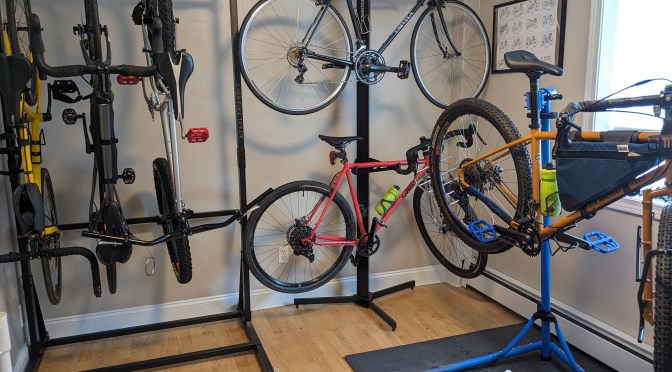
If you hang around in bicycle spaces long enough, you’re going to hear someone say ‘n+1’. This is a joke among the cycling community: “The correct amount of bikes to own is n+1, where n is equal to the number of bikes you currently have.” Needless to say the collector’s impulse in the cycling hobby runs strong, and even if you aren’t interested in trying all the brands or vintage frames or anything like that, you still may find yourself in the throes of n+1. After all, you start with a mountain bike, want to try a road bike, then you need a gravel bike, and a cross bike, and an endurance road bike, a climbing bike, a pub bike, a fixie…
It’s no wonder the collector’s impulse is even stronger within RPGs; you can get twenty hardcover sourcebooks for the price of a relatively cheap bike. And yet, collecting RPGs comes with a stronger risk of missing something. There are many, many bikes out there to enjoy, but at the end of the day you’re still going to be riding bikes, and the forty miles you put down on one bike will still help your legs when you pull out the next bike. The TTRPG hobby is a bit different; playing Masks and playing Pathfinder aren’t going to be similar experiences or pull in the same direction.
While RPG reviewers such as myself are often the ones most liable to try and catch all the RPGs like so many Pokemon, there is another way to consider approaching RPGs and actually playing them, and it comes right from bicycling. N+1 may be a joking mantra, but most cyclists have neither the money to acquire a collection of bikes nor the time to ride them. Instead, most cyclists end up with their ‘fleet’, a group of two to eight bicycles that cover the range of disciplines and experiences they want to have. While having twenty Italian road bikes may not amplify your understanding of cycling, having both a road bike and a mountain bike is something that pretty much every cyclist can understand, collector or not.
I’d venture the ‘fleet’ concept can apply equally to RPGs. Among the vast diversity of roleplaying games there are schools of thought and genre which appeal more than others, and each group is going to have their own unique opinion on which schools of thought and genre those are. Figuring out what’s in your RPG ‘fleet’ may still necessitate a lot of reading, play, and experimentation, but if you know what you like you can focus your time on a handful of games which you want to understand more deeply. You can find your daily driver, a game which delivers most of what you want from the RPG experience and benefits from repeated play. You can still have your experience games, which you pull out less often but which work for you in delivering something specific. You can also have games prepared for special cases, be that impromptu one-shots where you want to play without much advance notice, or having that game which you know works best for introducing someone new to the hobby. The key to developing an RPG fleet is combining the experimentation of RPG collection with the desire to play and prep something specific, something you can do best within the confines of one specific game.
Daily Driver
Somewhere between being ride-or-die for D&D and having a three-figure monthly Kickstarter habit is the gamer with a daily driver RPG. A daily driver is a conclusion you reach usually after running or playing a fair number of games and genres, and realizing that you do have a solidified preference. It’s not only that you have a favorite game, but also that you have a type and genre of campaign that you know you’re going to want to spend most of your time playing and exploring.
Having a daily driver is often a group decision, but it also means that the group all benefits from going deeper in a single game. More supplements, more house rules, and more refinement of how you run all come from repeated experience, but also from the experience with other systems that help you understand what a system does well and also how to mitigate its liabilities.
Most daily driver games are going to have a certain amount of depth to them and, if not outright crunch, at least some ‘chew’. It’s not that you couldn’t choose to play Honey Heist over and over, it’s that there’s a difference, often a big one, between repeated experiences and repeated structures. If your group finds that they prefer to play, say, Fate, they’ve done very little to limit the genre or structure of the campaigns they want to play, although they’ll likely have opinions about narrative control and meta-currencies that are consistent with the Fate designers. If your daily driver game ends up being FFG Star Wars, the play space is narrower but given the range of the game line (including three similar but distinct games, no less), there’s still enough “there” there to power years if not decades of campaign play. A good daily driver game defines a broad enough play space, but also bounds the sort of play space that a group wants to stay in indefinitely.
Go-To One-Shot
If a group has a daily driver game for long enough, it could very well be their go-to one-shot as well. What makes a go-to one-shot is the ability for everyone, players and GM alike, to spend a minimal amount of time developing what they need to play. A go-to one-shot is not a game designed for one session of play, it is a game that is available in the event of an impromptu decision to play a roleplaying game (which, barring long-term living situations of gaming group size, will always be a one-shot). The daily driver could very well be familiar enough that prep and character creation are nominal, but in most groups there’s likely another simpler game which just executes quickly. For me, both Mork Borg and Mothership have served very well in low- or no-prep situations, due to the combination of very fast character generation, easily parsed rules, and readily available modules and setting support that allow you to run a game with no advance notice.
Experience Game
There are a few games in my regular gaming group that just generate vibes. The vibes vary, but each of these games produces an experience that we want to go back to, if not indefinitely at least a solid half dozen times. My two best examples of this are wildly different, Paranoia and DIE. Paranoia is a silly experience, mostly about having your expectations subverted, taking the piss, and then making jokes about drugs and nuclear weapons. There’s more to it, as my reviews indicate, but at the table it’s often just about being silly and getting people at the table to laugh.
DIE is…the opposite of that? As Seamus has detailed in his review, the core gameplay loop of DIE is tailor-made to get adolescent angst and trauma to bubble up to the surface, and in my time both GMing and playing the game it’s basically impossible to avoid getting caught up in it. A good game of DIE not only leaves you affected and raw, but also wanting more.
And that’s kind of a key element of a good experience game: You want to experience it again. My regular group is in different points of the lifecycle with Paranoia and DIE. With Paranoia we’ve played it around ten times over the last 16 years (that’s not a typo) and the experience isn’t doing anything new for us. DIE, in contrast, has been played by the regular group once, with Seamus and myself having a second go as well. We want to see if there are new ways to recreate what we felt the first time, and though our read of the DIE scenarios indicates that’ll be tough, the first play was good enough that we’re still going to try.
First Contact
If you’re running a game for someone who has never played before, what do you pull out? Sure, just like for a one-shot there’s an argument that you know your daily driver well enough to teach it to anyone, but often other games will have less to figure out, better written rules or a better written book, or certain design choices that make it easier to pick the game up. I find that personally I gravitate to Powered by the Apocalypse for the first-time experience, and that’s for two reasons. First, the games actually pick up from the very basic RPG intro fairly easily. A basic intro would be something along the lines of “roleplaying is pretending to be a fictional character, and in this game you’re this specific type of character”. From there, character creation and play lead from what you want to do and what sounds cool; optimization and math don’t really factor into it. Second, the game is driven by handouts. Don’t get me wrong, someone running a PbtA game should read the book. For a player, though, looking through all the playbooks and one or two Moves handouts should be all you need to get started. The whole paradigm of Powered by the Apocalypse makes it easy to start playing and start playing optimally (read: as a dramatic character trying to create dramatic situations) very quickly.
The difference between an RPG fleet and an RPG collection is that the fleet is a specific subset of games that you keep going back to again and again. It doesn’t need to be one game for each purpose, in most cases: You may have three go-to one-shots. The exception here is the daily driver. Having one daily driver, one game that suits most of your gaming needs, is not only extremely common throughout the hobby, it’s a concept that rabid collectors need to understand. You interact with a game very differently by picking it up and running or playing it once, even for a campaign, than you do by running, playing, and refining over multiple campaigns, characters, and even settings. This also means that games that truly distinguish themselves as daily drivers are relatively rare across the RPG universe; as much as the traditional RPG isn’t necessarily distinguished as a good daily driver due to its playstyle, trad RPGs are more frequently associated with the notion of a daily driver because it’s these mainline games where designers can afford to develop a broader, more complex system, or to write out a long supplement line that encourages replaying a game and attacking it from multiple perspectives.
In my view, establishing your RPG fleet requires playing a fair number of games and taking the time to truly understand what you like. It’s not quite saying that there’s an end state to RPG collection, a point where you find your one true game. Instead, the RPG fleet is a group of games that you want to spend more time with. Having a fleet of bikes doesn’t mean you will never swap any out, or replace one that no longer meets your needs. Similarly, having an RPG fleet doesn’t mean you won’t keep buying other games. Instead, your RPG fleet should be the games that make you want to focus on using your games instead of acquiring new ones. In tabletop gaming the play’s the thing, and the TTRPG is a perfect medium to find a fleet of games you want to play and play more.
Like what Cannibal Halfling Gaming is doing and want to help us bring games and gamers together? First, you can follow me @LevelOneWonk@dice.camp for RPG commentary, relevant retweets, and maybe some rambling. You can also find our Discord channel and drop in to chat with our authors and get every new post as it comes out. You can travel to DriveThruRPG through one of our fine and elegantly-crafted links, which generates credit that lets us get more games to work with! Finally, you can support us directly on Patreon, which lets us cover costs, pay our contributors, and save up for projects. Thanks for reading!
 Cannibal Halfling Gaming
I can understand the difference between the fleet and collection as a collector plus long time GM who does not enjoy playing Dungeons and Dragons 5e all that much, even if DnD5e is my go to first contact game. When people want to be introduced to the hobby they often ask for DnD(5e) because of its clout and the need to be in the loop. Since I play with people who are retired military or work in military contracting there has been no better experience game for us than (WH40K)Only War. The straight comedy of being told to go do a job and then rolling logistics to find out that your equipment got mixed up hits for people who work in large bureaucracy. I will say that my group does not have what you call a daily driver since every time we start a campaign it is almost always in a new system that we have taken for a few test runs then decided to go big.
I have had long discussions on what games are good first contact games and we have settle with games with the ability for the GM to be a little loose but with concrete enough rules that it does not confuse the player. DnD(5e) has been a nightmare for me to teach people because the spin up is just so slow. Call of Cthulhu(7e) has been effective since it is a D100 roll under and roughly telling someone that you just do what a human can do then roll has been effective. Traveller(MGT2) is also good because it is just 2d6 plus a number. Just make sure to have the characters premade for any game you give the intro with and if using Traveller do not use the ships.
When it comes to long games I fully agree that any game that is low on crunch becomes a little stifling but I have also found that games that have too high crunch or “complete systems” make house-ruling nigh impossible without breaking the system. I find that house-ruling in Shadowrun(4&5) to be extremely difficult because the knock on effects ripple out so far. So I would say that any game that comes into discussion about the daily driver will fail into its capability to receive modifications and keep going down the road smoothly (When I used to be a cyclist, most people I rode with also like the bikes they could easily modify).
LikeLiked by 1 person