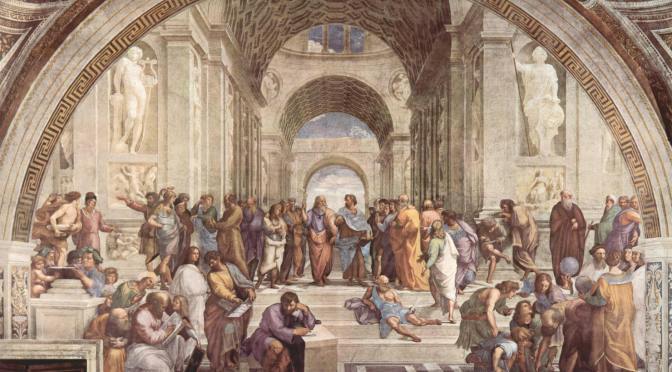
The term ‘diegesis’ (and derived adjectives ‘diegetic’ and ‘non-diegetic’) comes from film criticism, but has been used recently in RPG critique. In essence, diegesis defines the narrated world relative to the viewer (or in our case, the player). This is somewhat of a heady, academic definition, so let me give an example. In a movie, the soundtrack is typically non-diegetic. That means that the music playing that the audience hears does not interact with the narrative, with what’s going on on the screen. In some cases, though, the soundtrack is diegetic, meaning that the events of the narrative do interact with the music. The perfect example of that would be musicals: The soundtrack you hear is in fact the characters breaking into song, that is part of the narrative and the world.
And just like musicals, roleplaying games are creating assumptions about their worlds that do not align with the real world. You are never going to suddenly hear a musical cue and break into song while waiting for a bus; similarly you will never find yourself suddenly able to rebuild an engine or speak Mandarin because you were able to invest ‘skill points’. These aren’t bad things: both dramatic works and games are designed in service to their goals as art and entertainment, not to be ‘realistic’ or ‘grounded’. On the other hand, there is a vast world of critical opinion around how much the conceits of both films and games live in either diegesis or exegesis (the realms of the narrative and the audience, respectively); calling musicals divisive would be putting it mildly, and the same can be said about RPG mechanics which treat the characters more like narrative game tokens than extensions of the player.
Now, there’s already been a fair amount of analysis made regarding game design and choices around diegetic and non-diegetic mechanics. If you look towards narrative/storygame design circles, there’s no critical problem with using mechanics that exist completely outside the realm of the characters to define and advance the story. On the other hand, the OSR (or at least some sects within it) rests on design principles which seek to limit the use of non-diegetic gameplay as much as possible, even to the point of limiting the use of dice rolls. If you want to read a good primer on the impacts of diegetic and non-diegetic mechanics, I’d recommend this one by Emmy ‘Cavegirl’ Allen.
Where things get really weird in RPGs is the setting itself. Diegesis is a concept that comes from Aristotle, adapted and reinterrogated for use in film criticism. Aristotle also coined another term, mimesis. Mimesis refers broadly to imitation of reality in art (same root as ‘mimic’), and when contrasted with diegesis reflects how the world is shown in a piece of fiction as opposed to how the story is told. Therefore, while it’s not a perfect comparison, we can see diegesis in roleplaying games as the way that the mechanics interact with the fiction directly, and mimesis as the way that the setting and world is shaped by those mechanics. While this can be taken to a literal extreme (consider Order of the Stick), every game is shaping its setting through mechanical implications whether or not those mechanics are diegetic. When it comes to purely fictional elements in an RPG, be that magic in D&D or cybernetic augmentations in Cyberpunk, mimesis is what allows us to understand how those elements work and fit in alongside more typical aspects of reality that we are more familiar with.
Every game is a narrative game
Discussion of diegesis was likely inevitable for any media with a viewpoint character (or characters), RPGs included. The reason discussion of diegetic and non-diegetic elements is so messy for RPGs, though, is that the entire construct of the RPG evolved from a medium where viewpoint was largely unimportant: Wargames. In wargaming, it is important to know your ‘side’ and your win conditions, but how those are viewed on the battlefield are largely unimportant. Pretty much as soon as the Braunstein was invented, where win conditions were no longer predicated on the objective and/or quantitative results of the combat ingame, things got more complicated.
Roger Caillois identified roleplaying as one of his forms of play in his book Man, Play, and Games, and it’s perhaps unsurprising that he identified roleplay as a form of mimicry or mimesis. Caillois also identified two types of play which are both broadly compatible with roleplay: Ludus refers to games with structure and rules, while paidia refers to unstructured, spontaneous play (The whole of RPG theory could hypothetically boil down to the continuum from ludus to paidia, but that’s its own article). You can fairly easily make the claim that what a Braunstein scenario was actually doing was taking the structured rules of a wargame and shifting the intent of the game from agon (another Caillois term, defined as competitive play) to mimesis. Instead of being a game simply about winning or losing a battle, you sit in the head of a general, faced with a multitude of decisions and contexts beyond the game board. In order to facilitate this mimesis, this emulation of a world outside of the battle, there needs to be diegesis, or a conversation between those battlefield rules and the broader fictional world being envisioned.
The broader point, though, is that there was a narrative element added to wargames to turn them into RPGs, and it means that a lot of the mechanics intended for games that originally had no concern for narrative can do some weird things. Almost all wargame mechanics are intended to reflect the state of play on the ‘battlefield’, and this means that when used in an RPG context they’re reflecting the world that the characters exist in. In some cases we’re perfectly fine with accepting the abstraction; almost nobody is imagining that D&D takes place in a world where everyone can only move on a grid of five-foot squares (except for the smartass who came up with the ‘Peasant Railgun’). In other cases, the assumptions implied by a mechanical choice are so nonsensical that once you see it, you can’t unsee it, to the detriment of pretty much all worldbuilding in the game. And these mechanics can be huge…like the entire magic system in D&D.
The funhouse mirror of rules-as-setting
In its original context, mimesis is concerned with how reality is represented, and what that representation can say about the work it’s contained within. In roleplaying games, the same discussion can be had about how the game’s reality is represented, especially when considering the consequences of its mechanics. I find that a primary concern within that discussion is how a game presents its unreality, elements like magic. Here, the use of strictly mechanistic definitions of magic and spells can severely limit a player’s understanding of what magic actually is within the setting.
Said simply: I can’t abide by how magic works in D&D. To be fair, it’s not a solely D&D problem, it extends to pretty much every game out there which defines magic with a spell list. Here’s the issue: Magic as a game mechanic must be designed to create a gameable and knowable set of effects which define what a magic-user can do. The easiest way to delineate this is by writing a finite list of effects, generally called ‘spells’, which can then be balanced against the power level and participation level of all potential characters in the game. The issue here is that magic as it’s understood or perceived in the real world (and clearly we’re getting into a weird bit of territory here regarding the occult) is very broad, essentially existing as a counterweight to things like science and religion. The D&D spell list brings up all sorts of questions: Why these spells? Why aren’t there more spells? Why do the spells work that way? And in D&D specifically, these questions trickle down to what I view are serious failures of worldbuilding, like the fundamental lack of distinction between wizards, sorcerers, and warlocks. While some games do it better (GURPS has a spell list that can be perceived as comprehensive, many games attempt to make ‘casting of spells’ less predictable), magic as it exists in the real world defies mechanization.
We run into this wherever a game’s setting tries to mechanize a fictional element; given the element’s non-existence in the real world we’re dependent on what the game gives us to judge its verisimilitude. An example that hits close to home for me is the Humanity mechanic from Cyberpunk. There’s two main issues with Humanity in Cyberpunk: First, the notion of becoming less empathetic to humans as you have more of your body augmented is more of a literary device than anything that is anywhere near reflective of scientific literature. This means that it makes implications about things like mental illness which can be problematic, and that we have to align ourselves with the designer’s view of how this thing is supposed to work to see how we’re supposed to understand what the abstracted mechanics mean. The second issue is that the designer bears the weight of creating Humanity and Cyberpsychosis as a consistent and persistent element within the game world, and broadly this has been a failure. One particular example of this is the existence of full-borg conversions within the game. The full-borg conversion rules in Cyberpunk 2020 are, to put it charitably, a mess. A character being implanted into a borg body would blow past most of the (already fairly flimsy) attribute limitations to create an essentially superhuman character. This was “balanced” by creating Humanity costs that were literally impossible in-game, and explaining this away by inventing the setting conceit of “Scandinavian Cyber Clinics” that could enable characters to have cybernetics installed at notably discounted (50% if I recall correctly) Humanity costs. The other balancing mechanic that was introduced around the same time was an increasing prevalence of weapons called ‘borg-droppers’ which assured that the arms race was continuing equally on both sides. Full-borg conversions were one of the main gameplay elements that turned the supplement publication schedule for Cyberpunk 2020 into an arms race, and ensured that many groups would never see the grimy, street-level play the game was arguably written about.
Full-borg conversions in Cyberpunk 2020 were inconsistent with the existing humanity mechanics, but they brought in elements that rebalanced that consistency around a new nexus. The same thing is happening again in Cyberpunk Red. Interface Red Volume 3 reintroduced full-borg conversions to the new edition of the game, and in doing so dropped a bomb on both the balance of the game and the role of full borg conversions in the setting. First, the conversions have significantly cheaper humanity costs than in 2020, making them more attainable to any character with the money (and money itself is not a balancing mechanic, so this really means anyone who has played for long enough or with a generous enough GM). Second, Cyberpunk Red is built around a significantly constrained palate of weapons, meaning that ‘borg-droppers’ as they existed in Cyberpunk 2020 cannot exist (I discussed this a bit in my review of Black Chrome). The result is both a wholly unbalanced gameplay element as well as a violation of how full borgs fit into the setting previously.
Of course, the degree of this violation ultimately depends on how you see the Cyberpunk setting evolving. We have a work written in a future timeline of Cyberpunk, Cyberpunk 2077. While this notion of full-conversion borgs isn’t really discussed within the video game, the cybernetics system could be taken to imply a path forward that rationalizes the significant drop in humanity costs seen in Cyberpunk Red. Think of the scene in the game trailer where a woman is doing her makeup while her entire cybernetic jaw is removed and on the table. There is an implication in Cyberpunk 2077 that an entire segment of society has gone completely full borg, and that this has been 100% normalized. Of course, that introduces other questions: why isn’t this evolution discussed in Cyberpunk Red? And if there are so many full borgs in Cyberpunk 2077, why does cyberpsychosis still exist? For a mechanic that is intended to explore a central idea in the cyberpunk genre, Humanity and Cyberpsychosis falls short both in execution and consistency.
Mimesis of what?
In the context of games, mimesis tends to refer more to the logic and self-consistency of a game’s world than how that world is reflecting the views and norms of the designers. Considering the mimesis of D&D, for example, sees critics talking about consistency (or lack thereof) and not so much about how the game reflects the Christian values of its designers, or the neo-colonialist values of most of the sword-and-sorcery authors in Appendix N. Similarly, a conversation about Cyberpunk 2020 talks more about the mechanistic nature of the humanity rules and less about Mike Pondsmith’s perceptions of American city cores in the 1980s, or how much more sense the game’s setting beats make if you know that his literary influences didn’t include mainline cyberpunk authors like William Gibson. One reason that you don’t see as much discussion of mimesis in critique of roleplaying games is that both the ludological and literary definitions of the word hold value…and a word which means two different things ends up being pretty confusing.
As you look to more recent game design, you see more active consideration of mimesis. Take Apocalypse World. First, the game is clearly reflecting a reality aligned with the themes and conventions of the post-apocalyptic genre, with several touchstone works (i.e. Mad Max) clearly referenced. Second, the game’s mechanics are building a reality which is rooted in this genre quite directly. Character options aren’t based on career paths or wargame unit types, they’re based on genre archetypes, and the character’s abilities conform to those archetypes. Understanding the genre the game is built in and the assumptions it makes is key to understanding how to play the game, or any PbtA game…it’s been said elsewhere, but if you try to play Blades in the Dark without understanding how a heist movie works at least superficially, you’re going to have a bad time.
It therefore stands to reason that the most popular games in the space tend to resemble a genre ouroboros after two or three editions. When you consider what world *Fifth Edition* D&D is reflecting, it might still be reflecting the values and reading predilections of Gygax and Arneson, kind of…but what it’s really reflecting, what really influences the design of 5e D&D, is fifty years of marketing a roleplaying experience. The genre of D&D is D&D, and the version of fantasy it portrays is so heavily Flanderized that it takes both a close eye and some design work to build out a game pointed at D&D’s original influences. To be clear, this phenomenon isn’t limited to D&D. The World of Darkness did the same thing to vampire fiction (among other things), and Cyberpunk did the same thing to, well, cyberpunk. The current designers didn’t shoehorn full-borg conversions back into Cyberpunk Red for some literary or game balance purpose (it accomplishes neither), they did it because full-borg conversions were a celebrated part of the lore in previous editions of Cyberpunk, and there was demand for players and player characters to be able to engage with that again. Although there are plenty of RPGs with more direct literary influences, more allegorical character arcs, pretty much any game with popularity and more than a single edition under its belt has already started the transformation from a window into a mirror.
Roleplaying games provide a singular experience combining mechanics of play with elements of narrative. It is the interaction of play and narrative that provides the unique experience; wanting one or the other generally means you’re best served by a different sort of game or different sort of media. This interaction, though, can be done in a million different ways and it can be done well or poorly. When we talk about diegesis and mimesis in games, we’re talking about the linkages, the elements that let you play with narrative and narrate your play. While these concepts are perhaps a bit more academic than many other game mechanic concepts, they describe elements of a game that players have strong opinions about. If you’ve ever talked about a game being immersive, you need to understand diegesis and how the game works around the player/character divide. If you’ve ever discussed suspension of disbelief, you need to understand mimesis and how game logic and world logic interact. I can’t argue that you need good understanding of these concepts to make popular games; most games, including our examples D&D and Cyberpunk, prize mechanical balance and accessibility over setting consistency or verisimilitude. This isn’t the end of the world. But for a medium designed for building stories, I think that RPGs would benefit from a little more consideration of how their mechanics create setting and create narrative. After all, every roleplaying game is a narrative game.
Like what Cannibal Halfling Gaming is doing and want to help us bring games and gamers together? First, you can follow me @LevelOneWonk@dice.camp for RPG commentary, relevant retweets, and maybe some rambling. You can also find our Discord channel and drop in to chat with our authors and get every new post as it comes out. You can travel to DriveThruRPG through one of our fine and elegantly-crafted links, which generates credit that lets us get more games to work with (which is eactly what we did here)! Finally, you can support us directly on Patreon, which lets us cover costs, pay our contributors, and save up for projects. Thanks for reading!
 Cannibal Halfling Gaming
Great article!
This exact topic has been on my mind as I have digested the ashcan release of Austin Walker’s Realis, which has the further wrinkle of being presented as a document written by people within the setting it describes. Characters start out with broad abilities that have weak mechanical weight that only get stronger by narrowing either the scope of what it does (I always use weapons skillfully -> I always use swords skillfully) or the circumstances you can apply it in (I always use weapons skillfully in duels).
The way its presented had me trying to think about the game parts of it were trying to tell me something about how the setting actually works, which I was having difficulty with. The narrowing of capabilities doesn’t trip me up as a convention for emulating a certain kind of story though.
Other games that use this conceit I’ve read, thinking “system is setting” like this did make a kind of sense – Nobilis is written as though it’s titular characters are fact and even play the RPG you hold in your hands, but the rules its gives for how the Powers work feel like they’re trying to tell you some kind of truth about how they really do.
LikeLiked by 1 person
Wonderful!
You are doing a lot of heavy thinking so the rest of us can more gently engage with the concerns and concepts.
—
What follows are some reactions prompted by your article. Apologies for the scattered results of my mind. Maybe there will be something useful to read within the mess? (If not, let me know and I will try to curtail my enthusiasm to bake salad in the future. After all, I really do appreciate your writing. Perhaps a simple “Awesome!” should be enough.)
—
Quin (of Quin’s Quest) recentish said something about we are not good at creating Stories in TTRPGs.
To some degree PBTA and other Story Games structurally counter that. But they feel like they do so by limiting some of the open participation other kinds of game structures (potentially) support.
At the other end of that, GURPS (or Savage Worlds or Basic Roleplay/Chaosium) provide us with flexible game Structures to approach many Settings and Character ideas.
These systems are so open, it can be difficult to create good world building and gripping stories. This not withstanding GURPS amazing variety of Technically well executed Settings and Genre supplements.
But even with the support of clear Settings (Call Of Cthulhu for example), it sometimes feels like many stories are more about survival, or the failure to survive, than about the kind of rich emotional and philosophical areas that Story games get to.
Do you think there is a way to have both Mimesis on a Material World level, and have an Emotional level of Mimesis as well?
—
DnD is weird, because it is highly structured, but has almost no tools for what kinds of Stories it wants to tell.
And, that may be useful from a Product point of view, because you may need to buy “professionally” created settings and stories. But it makes Running DnD unnecessarily complex.
Indeed, the game systems for DnD magic have no real tools for building your own magic. And I think that is partly because they had no formal idea how magic was supposed to work. Or at least they didn’t articulate such an underpinning to us, the purchasers of their products. They seem to have “made fun stuff up”. which sort of functions. Some of the DnD spells are iconic. But magic doesn’t, for the most part, get reflected in the settings as published.
The cities of DnD are not shaped by the Spell Lists of the Game. They are shaped by the engineering of a hodge podge of different time periods from a world of much lower magic impact (Our world … to make the comment explicit).
DnD magic exists in the world, but largely, does not shape it.
What does it mean, from a Diegetic perspective, when one part of the Fiction serves the Audience, but peripherally interacts with the rest of the world building?
—
Maybe TTRPGs are more similar to Ritual Theatre (perhaps Noh or Commedia dell’Arte) in that we Play/Act as Characters, but have rules about our Play (whether the Rules are about Carry Capacity in OSR or Role playing your Archetype or Character in a Story focused system), and less perhaps about Script (which is more typical in modern drama. Though there are exceptions in modern drama like the movies of Mike Leigh or possibly Yorgos Lanthimos).
We are an Intermediary for a Trope.
Instead of being Mimes to a Script.
(Apologies if I am misrepresenting Noh and Commedia dell’Arte.)
—
Finally, for successful TTRPG Games,
I think the fans/players/purchasers become part of the Collective within the Exegetic Stakeholders. They maintain a Fiction of the Fiction. Thus, they push to reinvest a game’s Ludic and Diegetic aspects with their projection of what the game should be.
This affects Games made from IP related to other Media very strongly, as well.
In the case of DnD, its somewhat random initial presentation has led to a fun house effect of players wanting to push onto the game not only the original kitchen-sink aesthetic, but also expectations about almost every genre of fiction.
End scrambled message.
Cyberpunk had a cleaner, more focused aesthetic, and so it remains relatively coherent. But as you say, the fans want to bend Red back into the shape of 2020. They want to continue the Fiction in their minds.
End scrambled message.
LikeLiked by 2 people
I always appreciate thoughtful responses, scattered or not. Only time I have difficulty engaging is when someone goes and replies to something I wrote three, four, or five years ago…then it’s really hard to put my mind back into the place it was when I wrote the article, no matter how earnest or thought-provoking the comment.
Your ritual theatre comment stuck out to me. I think that idea is something I’m going to return to when I return to the idea of RPGs existing along a continuum from ludus to paidia and what that means for designers…but I have to go back and read Caillois’ entire book before I tackle that one.
I hope to keep engaging with these ideas and have my own scattered thoughts and considerations. I still feel a bit like the engineering student who signed up for a 400-level literature class (I actually did that senior year of college, had no idea the deep end I jumped into), but it is helping me understand what I get out of games and why certain things elicit such strong reactions (the Cyberpunk full-borg anecdote came fresh from a discussion in my own gaming group).
LikeLiked by 2 people
ttrpgs ARE a form of ritual which IS the origination of theater. (ive done a lot of research and praxis around this in my life). storytelling is a kind of play that serves community needs: meaning, education, synchronization of nervous systems, community hygiene, exorcism, behavioral pruning, etc.
ttrpgs as story-games, or emergent improvisational narrative “movies” — requires much more skills than approaching them the way we approach chess or checkers.
in acting, especially devised physical theater’ (closest thing to ritual theater in a post-modern context) we learn techniques to give spotlight to our partners, know when to “take the spotlight”, know when to fade into the background and not be a part of a scene, etc. This essentially makes each actor a co-op owner of the story — a jack-of-all-trades. each actor is a bit of a writer, bit of a director, bit of a designer etc.
so its no wonder why mechanics actually gets in the way of storytelling, especially if the GM and/or players is not that great at storytelling. this is my biggest gripe with D&D: the mechanics are just power fantasy stat accumulation. nothing about stories really. the player has to be a great actor first, to make D&D engaging (see: critical role. all of them are professional actors and artists)
i could go on & on, but its all on my mind as ive been creating my own game this year.
love the dialogue here
LikeLiked by 1 person
Being challenged (vis a vis the college point) is a joy.
And the feeling of disorientation mixed with gathering elation while wonderful, can bring panic. Your base beneath your feet is rendered insubstantial. (Or maybe that is my Fiction derived from reading about your Experience?)
TTRPG gaming keeps reframing itself, for some of us. Each reframing, whether of Diegesis or Memises, Theatre or Bell Curves, gives us new ability to reflect on how how the various forms of participation (Group Play, Reading, Design, Solo, Analysis, World Building, Myth Making and so on), impact our Selves and our understanding of the World around us.
Like other Arts, it is a Beautiful Lense.
But the high Participation and Agency, along with Collaboration in many cases allows for both Internal and External exploration.
A Deep Well to Ponder and Delight in.
Thanks again for your work and your thoughts!
LikeLiked by 1 person
This is really interesting, but, at least on my client, it’s all one wall of text with no line breaks. Is there a better place to read your post?
LikeLike
Remote Reply
Original Comment URL
Your Profile
Why do I need to enter my profile?
This site is part of the ⁂ open social web, a network of interconnected social platforms (like Mastodon, Pixelfed, Friendica, and others). Unlike centralized social media, your account lives on a platform of your choice, and you can interact with people across different platforms.
By entering your profile, we can send you to your account where you can complete this action.
Really thoughtful article, nicely put.
LikeLike