When it comes to nerd hobbies, the convention scene is bifurcated. There are local, volunteer-driven cons that put a lot of effort into building content from enthusiasts around the area. There are also the massive, national affairs that bring attention and revenue to their parents. Gaming cons moved quickly into the latter category, even if the initial efforts were modest; both GenCon and Origins came to prominence after their alignment with TSR and GAMA, respectively. And now there’s a massive leader in the corporate con sphere: Penny Arcade Expo, or PAX.
While calling these events ‘corporate cons’ outright is meant to be a bit provocative, it’s an accurate statement, and not necessarily a negative one. Local cons can only go so far before they begin to collapse under the weight of amateur organization and project management. The events that escape this fate are notable: Dragon Con started in 1987 as a local, fan-run con, but in order to manage its growth and popularity the original organizers restructured the event in 2000, running the event more as a corporation and less as a fan co-op. Even so, the event’s growth resulted in the con of 2003 being called ‘the year that broke Dragon Con’ and required more structured event management and attendance caps.
PAX benefitted from the profile of the Penny Arcade creators, Jerry Holkins and Mike Krahulik, from the start. While the first PAX in 2004 had fewer than 4,000 attendees, the event grew very quickly and the first PAX East, held only six years later, had over 50,000. It’s also notable that even before the expansion of the brand into multiple events, the PAX team began partnering with professional events company RX (under their sub-brand ReedPop); their partnership started in 2009, prior to the debut of PAX East. PAX Unplugged is the newest PAX event, started in 2017, and has been growing every year since its debut. 2025 was the first time I made it down to Philadelphia for the event, and what I experienced was starkly different from my earlier experiences at local events like Arisia and the Boston Festival of Indie Games. Being a corporate event dedicated to tabletop gaming presents a unique opportunity for game makers of all stripes to get access to a huge number of people for the price of a single con booth, and as a result it is the place to go to meet game designers and find things you’d never see anywhere else. On the other hand, it’s very difficult to ignore the fact that, if you’re used to local events, it’s all about the money.
What actually got me to bring my introverted ass to PAX Unplugged was both the focus and the location. PAX East is right in Boston, but the size and overwhelming focus on media has kept me from taking the plunge so far. PAX Unplugged had a focus on tabletop gaming, like GenCon and Origins, but was in the Northeast, like PAX East. I had also been dissuaded from trying to set up logistics by stories of how quickly passes and hotels sell out, but what got me over this particular hump was a boring but useful solution, signing up for the PAX newsletter. When I got the notice that Unplugged badges were on sale, I was able to buy on the first day and not worry about repeated site refreshes or items selling out instantly. Knowing that it’s that easy might even get me to check out PAX East in the future, though with my experience at Unplugged I’m still undecided on this.
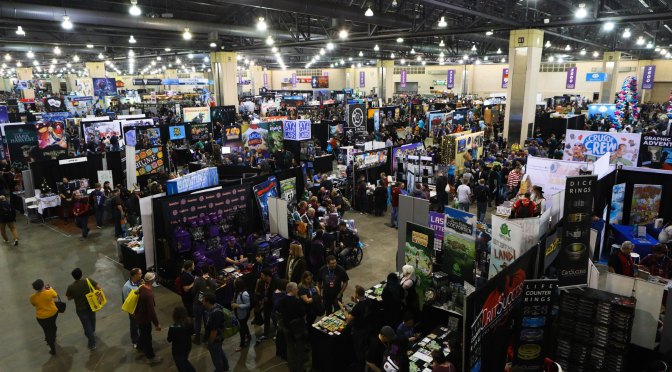
I knew Unplugged was a big event, but I wasn’t prepared for how big. While I did not show up right at 10 for doors on Friday, I still ended up in line for over 30 minutes just to get in the front door. The size was further emphasized as my partner and I walked through the convention center and then got to the massive main hall, split between the expo and the gaming hall. Rows upon rows of tables were set up for gaming, but it was the expo hall that most reminded me of the sorts of massive conferences I attend for work. Here, of course, instead of technology and equipment vendors there were companies and stores hawking dice, games, apparel, and of course pins, the PAX tradition now spearheaded by the punny Pinny Arcade. I ran into game designer friends manning booths for single person or small design groups, I saw booths split between multiple designers, and of course there were larger affairs put together by stalwarts like Indie Press Revolution and Plus One XP. And if you wandered over to the really big booths, the stuff put together by companies like Asmodee or Renegade, everything was on an entirely different level; Asmodee’s booth was more similar to what I see from major Chinese battery manufacturers at the other conferences I attend than of most of the other game designers who were there.
And of course that begins to highlight a lot of the other booths I saw. First, there were a number of booths, mostly from the board game side of the world, promoting games that were either crowdfunding or in pre-production, which I found wild. Doing a bit of research, one of these basic sized booths (10×10, for reference) costs somewhere between $1,000 and $2,000 per day (the numbers I found were all historical, and inflation exists, but that should be a good approximation), which is just at the line where putting together a booth to try to launch a product may not seem that crazy? $10,000 is going to be in the marketing budget of a solid midrange Kickstarter (I’m thinking $100,000, that’s midrange these days), though it is a serious gamble if you’re going to see that sort of marketing investment recouped. That said, online advertising can be more expensive and much less effective, so I don’t exactly fault the designers who go this way. When it comes to designers and companies who are bringing product to sell, though, the math is a lot easier. You need to recoup the cost of the booth rental, the cost of staffing it (though solo designers may swag this part) and all the collateral you produce for the booth in the form of product out the door by the end of the con. There are areas where you can optimize this a bit; I imagine most designers can make a nice vinyl backsplash and other collateral and keep it from one year to the next. This still doesn’t take away from the fact that you need to move at least $8-10,000 of product for your investment in a booth to be worth it…and if you think you can swing a bigger booth, those requirements are larger. This means that even a smaller designer in a modest or shared booth probably needs to move at least $5,000 of product, or at least 100 units of a typical RPG, to make the trip worth the (financial) bother.
Will most designers hit this threshold? Honestly, a lot of them will. With a projected attendance of around 30,000 people, the typical booth at PAX needs to sell something to around 0.5% of con-goers in order to get near that breakeven point. Admittedly, the distribution of con-goers and their spending habits likely doesn’t favor game designers; most people are more likely to go home with dice or a pin or con merch than any one specific game. That said, people are primed to open their wallets. I myself bought four games and one cocktail book at PAX Unplugged, and I even got one of those pins, too. The whole design of the show is primed to get you into the buying mood, and while that’s not unique to PAX I do think it’s easier in nerd hobbies like tabletop gaming.
Back in an earlier Cannibal Halfling article, I said that collecting was the capitalist manifestation of the RPG hobby. I got some pushback for that; there are clearly modes of collecting that aren’t strictly about spending money, and there are plenty of ways to spend money in this hobby that don’t involve collecting. That said, I still want to double down on the statement. There is very little left in any collecting hobby (except maybe rock collecting) that isn’t supported by a secondary market, and in RPGs the collectible markets are thriving and ready to take your cash. In addition to dice and pins and other knick-knacks, cons are where vendors take their ‘Deluxe Edition’ remainders, trying to sell them at a perhaps discounted but still elevated price to everyone who felt FOMO after missing the crowdfunding. There is an incredible amount of money flowing around this hobby, and even if you can claim to be a collector without spending money, you aren’t the one the support structures are designed for. The most depressing thing will always be that it is the designers in the smallest booths, the publishers one rank up, while the sellers of $150 D&D dice sets (it’s always D&D) and bespoke gaming furniture are the only ones up rubbing elbows with the actual corporations.
The focus on money is the cost of admission for running an event this large. If you want to get critical mass for things like Games on Demand, or if you want to purport to cover a breadth of a hobby as large and as fragmented as tabletop games, you need a lot of people buying badges and you need a lot of things for them to do. That means the expo hall will be huge, the panel lists will be more focused around who’s there than what’s being discussed, and it means you’re going to be doing the pay-to-play autograph rodeo. In spite of that, I’m glad PAX Unplugged exists, and I’m glad I went. I haven’t decided if I’d go every year (I don’t have a lot of vacation time and I am, as mentioned above, an introvert), but I’ll definitely go back. That said, PAX Unplugged, like all the PAX events, like all the Comic Cons, like Origins, and like GenCon, is a corporate con. That is going to define how they operate, what they emphasize, and how many people they attract. And that last item is what will ensure that they will keep attracting the attention of the hobby for as long as we’re still going to conventions at all.
Like what Cannibal Halfling Gaming is doing and want to help us bring games and gamers together? First, you can follow me @levelonewonk.bsky.social for RPG commentary, relevant retweets, and maybe some rambling. You can also find our Discord channel and drop in to chat with our authors and get every new post as it comes out. You can travel to DriveThruRPG through one of our fine and elegantly-crafted links, which generates credit that lets us get more games to work with (which is eactly what we did here)! Finally, you can support us directly on Patreon, which lets us cover costs, pay our contributors, and save up for projects. Thanks for reading!
 Cannibal Halfling Gaming
This, and the experience of some of my other friends who went this year, just kind of has me thinking of how differently people can experience the same event – specifically that I have a pretty hyperfocused experience.
The group I’m referring to are primarily attending Unplugged as board gamers. They go, have a day, day-and-a-half of frenzied demos followed by Capitalism, and then wind down fairly quick – most of them skipped town before Unplugged opened on Sunday this year. While they had a great time they’re already talking about giving next year a pass because they saw a lot of the same board game stuff in ’24.
Meanwhile when I go I spend most of my time embedded in Games on Demand, running things or hopping into games, doing Meet & Greets, chasing people and throwing CHG business cards at them, panning for review copies… my Capitalism is typically squeezed into a frantic hour or two of running around before I have to leave.
I do take note of the CAPITALISM – it’s not just D&D, I saw some CRAZY expensive L5R dice when the FFG edition came out – but here I think I may be jaded after attending too many of these – I just sort of roll my eyes and don’t really remember it after the fact.
Idk, don’t really have a conclusion here, just musings – and thinking of how when I got PAX East I’ll probably be just walking right past 70% of the stuff that’s there and have a great time.
LikeLiked by 1 person
@cannibalhalflinggaming.com Most of my free time and money spent this year and past years was with booths like Exalted Funeral, Plus One Exp, and Indie Press Revolution. I'm not much of a boardgamer. From what I understand, pretty much every vendor has been grandfathered in from previous years. With such a large space, its a shame they don't have smaller booths, artists alley, etc that you see at other big cons.
LikeLike
Remote Reply
Original Comment URL
Your Profile
Why do I need to enter my profile?
This site is part of the ⁂ open social web, a network of interconnected social platforms (like Mastodon, Pixelfed, Friendica, and others). Unlike centralized social media, your account lives on a platform of your choice, and you can interact with people across different platforms.
By entering your profile, we can send you to your account where you can complete this action.