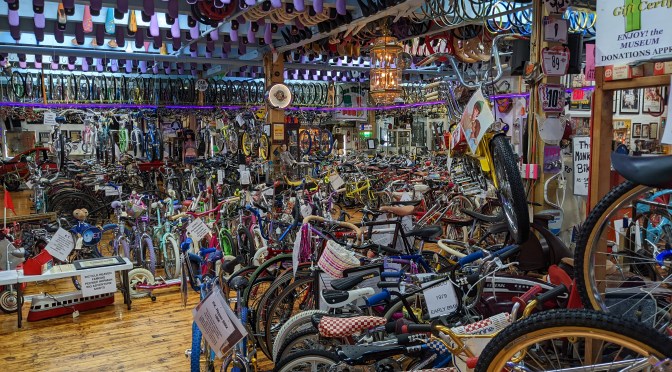
As readers of the site know, I’m a cyclist in addition to a gamer. I spend at least as much if not more time riding and working on my bikes as I do playing, reading, and writing about RPGs, and riding my bike is an integral part of how I get around and interact with my community. I’ve even written about RPGs and bicycles before, though in that article I was speaking more to how the economics and business models of the hobbies compare. There are also comparisons to be made about how one actually rides a bike compared to how they play a game, and while this analogy is imperfect it can provide some insight to how we both play games and engage in games discourse.
When it comes to bicycles, the hobby for the vast majority of people is ‘cycling’, the act of riding a bicycle. There are some who enjoy tinkering and even some who pursue framebuilding, but by and large what connects you to a bicycle is riding it. In the act of riding the bike, there are two main elements you decide for each ride: What route you will take, and what bike you will ride. Many people will choose routes based on what they can do and want to do with the bike they own, while those who own multiple bikes will choose which bike to ride based on how it fits with the route. To a certain degree, the kind of route you choose determines what part of the hobby you belong to, but the true divide based on discipline comes from the kind of bike. You can tackle some forest singletrack on a nearly-road bike or on a full-suspension mountain bike, or several other types of bikes in between.
With this talk of ‘the bike’ and ‘the ride’, it should hopefully become clear how this analogy applies to RPGs. Instead of bikes we have RPG systems, sets of mechanics which allow us to play games. Instead of rides we have the actual games, the sessions we have and experiences we create. When you look at this analogy from the perspective of an RPG collector, it seems to break down: You have dozens if not hundreds of games, and the actual sessions you play with them may be driven by what that game specifically can do. When you look at gamers broadly, though, their purchasing habits are well-aligned with how most people buy bikes. Typically, most people want to make one purchase that is capable of doing all the things they associate with the hobby. For casual gamers, that tends to be the fantasy genre. For casual cyclists, it tends to be local paths, cycleways, and other easily accessible infrastructure. In both cases, there’s an easy option that will be a safe one-time purchase; for gamers, it’s D&D, and for cyclists, it’s an aluminum hybrid bike. And in both cases, if the hobbyist enjoys the hobby, they may expand their horizons down the road.
So far this has mostly been a cute observation of parallels between my hobbies, but I think there are some important observations to make here which will color your perspective of key discursive debates. While I’ve been loath to jump in the discourse waters of “system matters” in more than a cursory way, I think the bike/route divide helps lay out why the discourse keeps recurring. At the same time, “are games art” is another old chestnut that the hobby writ large keeps chewing on, and I think, oddly, that bicycles provide a perfect parallel.
System and Game, Bicycle and Route
It’s been said in OSR circles that a well-written adventure need not have an underlying system at all. The same is true of bicycling; pave a path well enough, and you can traverse it without a bicycle at all! While the point here is not to compare freeform to pedestrians, FKR to unicyclists and so on ad absurdum, it still does raise a point that the divide between your rules and what you do with them is certainly analogous to the divide between a bike and where you ride with it. It also illustrates a perspective that is held throughout much (though not all) of the hobby: Rules are technology which enable. Just as almost no walker is going to be able to get down that path at 15 mph with just their Nikes, no GM is going to be able to create the same experience for their players with their brain and sense of fairness alone as they would with a good set of mechanics which provide inspiration, arbitration, and structure of play. One who scoffs that you can easily do the mile loop around the pond on foot misses that they’d never be able to walk the extended ten mile trail in one sitting (and do it in an hour or less, to boot). Even while on a bicycle, there are certain places you need the right equipment to go; a delineated, complex game can be much like a full-suspension mountain bike. Both are capable of helping you do things you couldn’t otherwise do, while also being slow and ponderous on rides they weren’t designed for.
It is important to see the other side of this analogy, though. Most rides you do don’t care what bike you bring. Most rides that don’t already require significant experience and skill can be tackled on a road bike, gravel bike, rigid ATB, hardtail, you name it. There will be different limitations in each case, there will be different pain points, but on the vast majority of routes, the right bike to take is the one already in your garage. This can be read in a couple of different ways. First, like I said earlier, the ‘bike you already have’ for most people is Dungeons and Dragons. While I certainly have gripes with how Wizards of the Coast got the game to that position, it doesn’t change the fact that more people are familiar with it and, for what they want to do with RPGs, it suits their purpose. Designers and commentators often miss this point, and I have certainly been guilty of not realizing that most gamers are perfectly fine sticking with fantasy as their genre.
The flipside of this is that, just like in bicycles, there is a very limited market for very specific tools. In bicycles they barely exist at all unless there’s already a sanctioned sporting discipline around it, like triathlon. Triathlon bikes are very specifically their own thing and do basically everything else worse, but as long as triathlon is a sport, the market will exist. There is no parallel for RPGs. The analogy also breaks down here, as there are many games which are designed, really, to provide one specific experience. There’s no such thing as a bicycle that only works on one route, and if there were you could see why very few people would buy it. Luckily games are quite a bit cheaper, but selling games tied to a specific experience first limits your market to people interested in that experience, and second limits your market to people who are interested in viewing the game as its own holistic experience. The game may be appealing to collectors, which is also true of bicycles that hold limited but unique or aesthetic merit.
Are Bicycles Art?
Bicycles are designed, aesthetic objects, and they certainly can be art. Custom frames, high-end or decorative parts, and simple intention can all move a bike from something to get around on to a thing of beauty. The same can be said of games, but in both cases there is a vast gulf between how designers and builders view these works and how players and riders view them. Ultimately, games ‘belong’ on a coffee table in the same way bikes ‘belong’ hung on a wall. They can be objects of beauty, they can evoke emotion, but if they aren’t being played or ridden, your experience of them is incomplete. And, if they look better on a table or wall than they are experienced, they aren’t really good, no matter how good they look.
Framebuilders and game designers are very similar in their unique, often idiosyncratic views of the things they design. In both cases, designers are trying to make things that they can’t get anywhere else that fit their unique tastes. In some cases this means a unique spin on a tried and true formula, and in some cases it’s the small builders that really make the formula pop. I’m a big fan of steel bicycles, and most individual framebuilders work in steel due to the relative cost and accessibility of brazing compared to TIG welding for aluminum or mold-building and layup for carbon fiber. Steel bikes are also almost completely gone from the mainstream. Trek and Specialized have exactly one steel bike between them, a low-cost beach cruiser that’s more for looks than for rideability. While I know where to look for steel frames, including some truly gorgeous and even relatively lightweight ones, the average cyclist isn’t going to be interested in the heritage, durability, or ineffable ride qualities that are mostly masked by ever-wider tires. Similarly, most gamers, even those already willing to strike out beyond D&D, are much more concerned with a system’s baseline complexity and how much supporting material exists than they are about the particulars of system or layout.
Recently, a friend of mine reached out because he wanted to start cycling more seriously. He wanted a recommendation for a bike, and I needed to consider what was really important from his perspective and how different it was from mine. In centering priorities like cost and shop support, I ended up recommending a bike I’d never personally buy, even considering we had overlapping priorities like comfort and cargo flexibility for commuting. The important thing, though, is that as we talked about bicycles and what bike would suit him best, we always centered what the bike would do, not the design or the artistry. And honestly, when I put collecting aside, I talk about RPGs in the same way. Within my group, we’re always considering how games align with what we want our experience to be like. Reading these books or considering their aesthetics barely happens, and when it does it’s usually because something pops out as particularly bad or annoying. That’s not to say I don’t want more artistic games, or more singular designs! Properly artistic games are a delight, and they’re way more accessible than the fillet-brazed art deco showstoppers out in the bike world. Ultimately, though, my relationship to the hobby centers around play, just like how my relationship with bicycles centers around the ride.
Like any analogy, comparing bikes and RPGs too closely will make the whole concept fall apart. I can’t really say something like ‘GURPS is a 150mm trail bike’ or ‘Apocalypse World is a Crust Lightning Bolt’, even if it would be fun to do that. However, there are some core ideas that hold true across both hobbies. Cycling and RPGs are hobbies defined by their implements; in both cases the tool we use for the job necessarily changes our experience, hopefully for the better. At the same time, these tools can be beautiful, they can be art, both art to be seen as well as art to be experienced. They don’t need to be, and workmanship and aesthetics don’t necessarily create a better ride or a better game session. They do, however, create a divide between the perspective of a designer and the perspective of a user. This is one place where bikes and RPGs are nothing alike: the Discourse. The strongest voices in cycling discourse are riders. This creates its own issues, because often these riders are racers, able to ride professionally and (stop me if you’ve heard this before) having a very different set of requirements from the rest of us. Still, use is centered in cycling discourse and while that comes with its own problems, it’s generally a good thing. RPG discourse is dominated by designers, and while designers also play (framebuilders also ride, of course), their perspective is completely different than most people either playing a game with their friends or trying to run a game for their friends. In both hobbies, perspectives of design often come from niche voices; the biggest publishers and manufacturers have little pressure to make their voices heard because, well, they already are.
If there’s one thing to take away from this analogy, it’s to focus on what actually represents the experiences you will have by pursuing your hobby. In bikes, frame material and drivetrain choices are academic until you throw a leg over your bike and go for a ride. Similarly, while there’s entertainment value in reading and dreaming with an RPG manual, games are meant to be brought to the table. The whys and wherefores of what system to use are as individual as what bicycles people own, and the popularity of 150/150 trail bikes doesn’t mean you can’t load up your rigid bike with three inch tires and have a ball on the same trail. At the same time, there’s some very good reasons people pick the trail bike, even if you see it as too expensive and too complicated. As commentators, it’s easy to focus on games as the signposts for where the hobby is going, but ultimately what is being sold (new games and new bikes are being aggressively sold more than anything else) and what is being used are not the same. It’s easy to focus on the equipment, but I’m telling both you the reader and myself that sometimes, you need to focus on the ride.
Like what Cannibal Halfling Gaming is doing and want to help us bring games and gamers together? First, you can follow me @levelonewonk.bsky.social for RPG commentary, relevant retweets, and maybe some rambling. You can also find our Discord channel and drop in to chat with our authors and get every new post as it comes out. You can travel to DriveThruRPG through one of our fine and elegantly-crafted links, which generates credit that lets us get more games to work with! Finally, you can support us directly on Patreon, which lets us cover costs, pay our contributors, and save up for projects. Thanks for reading!


A very cool article.
I like it in both substance and concept.
I also like how it breaks Gaming down from a different perspective. It lets us see structure from a different set of affordances (amongst other benefits of your discussion).
Some comments from my own thoughts while reading your exploration:
I am glad you mentioned Art as Experience. Art need not be Passive. Whether you are Creating Art or Interacting with Art already made, it is mostly a Relationship. So, to decide whether Bicycles (or Riding Bicycles), or TTRPGs are Art, the question is more one of Impact and Transformation, rather than are you looking passively at an Object or a Performance that someone has judged to be “Art”.
…..
There is, I think, in the discussion of TTRPGs as System, another element we don’t maybe conceptualise well. This kind of Gaming doesn’t have 2 Pillars (System and Play). It has some other Pillars as well (Implicit Structure … brought by the Referee and Players, Context … the Route in your Biking analogy, and Table Culture).
TTRPGs are Multiply mediated.
When I run a Game, I am not only using the Rules and Setting, but also considering the people I am playing with (the Table), and also my own understanding of the World we live, Thematic references to the Game’s Genre, and my own ways of deriving analysis from Systems. I run games from my own internal gestalt of many anchoring awarenesses. I think probably we all do.
As a Biking analogy to this (and something I learned from Dance), you ride “as your body moves”. You bike from Your body with each Bicycle and Route.
This is important (to me), because if I am designing a Game, or running a Game, I want to contemplate how the System and Setting evoke my internal concepts. Do System or Setting complement my internal concepts, or do they create dissonance. Are they going to be Evocative for Players, or other Game Masters (when I am working on a design)? Am I building useful cognitive tools?
To return to the “Does System Matter” discussion. I think there is no simple answer to the question, because it depends, in the moment, on the other elements at Play at the Table.
LikeLiked by 1 person