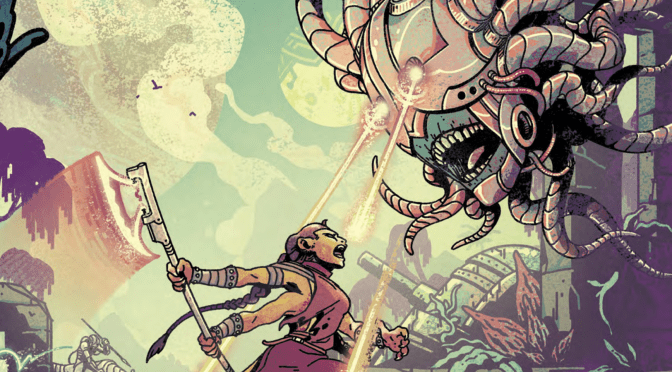
For over twenty years, Fate has been a pillar in indie gaming. From its newsgroup origins in 2003 through its Kickstarter breakout in 2013 and on to today, Fate’s clever design and extensive modularity have kept it relevant to mechanics nerds and rules hackers and inspired designers and players alike. That said, Fate is a design for hackers above all others, and the popularity of systems as granular and mechanical as Fate has waned in favor of frameworks with fewer moving parts. Even Evil Hat Productions, publisher of Fate, is spending more development resources on publishing games like Apocalypse Keys and Blades in the Dark than it is on the Fate ecosystem. And it’s this context into which Umdaar bursts onto the scene.
Masters of Umdaar was originally published back in 2015 as one of the settings in Fate Worlds: Worlds Rise Up. In that original format, the setting was intended to use Fate Accelerated rules and allow for semi-random generation of character species and monsters to fit into its ‘planetary romance’ setting which read like a beautiful car crash of Star Wars and He-Man. The new Umdaar is much, much more than that original entry. Clocking in at over 450 pages and now using the more traditional skills-based Fate Core framework, Umdaar has evolved from a small setting guide to a full-fledged game, complete with its own set of completely new frameworks employing Fate’s usual building blocks of Aspects, Stunts, and Extras. Both the volume of content and number of new structures not seen (or only vaguely alluded to) in Fate Condensed or Fate Core is what solidifies Umdaar’s role in the Fate line-up: Fate’s current and primary worked example.
The history of Fate worked examples
Fate arguably stepped out of the internet and into the broader hobby with the 2006 release of Spirit of the Century. Spirit of the Century also established, in its own weird way, the beginning of an informal framework that would hold across the releases of Fate 3.0, Fate Core, and Fate Condensed: Each generation of Fate would have a core mechanics guide, and then a more detailed worked example which would be informed by and expand from those core mechanics. Fate 3.0 fits weirdly into this because Spirit of the Century was both a fully standalone game and the core mechanics guide. The worked example in this case was the Dresden Files RPG; Spirit of the Century served essentially as a test case for Fate 3.0 before employing it for Dresden Files. After that, things lined up a bit better. Fate Core (and Fate Accelerated) served as broader guides than Spirit of the Century, though the default ‘minimum viable game’ in Fate Core was heavily inspired by the same pulp genre throughlines that the first game was. That pulp influence would continue in the Fate Core worked example, Atomic Robo. Atomic Robo took the Fate Core baseline and expanded it, adding in some new mechanics and a lot of game-specific stunts (and some extras) that helped make it more unique. When you open the book, though, you can clearly see that the game is intended to be fully grounded to Fate Core: About two thirds of the game’s page count is dedicated to restating and reframing Fate mechanics, while the final third is the actual setting and game-specific material. As the game is standalone this restatement is certainly necessary, but it’s also interesting because it shows how considerations of Fate mechanics would change with each subsequent publication.
The continued incremental evolution of Fate is one of the main reasons that Evil Hat produced Fate Condensed. While Condensed is, well, condensed compared to Fate Core, it also serves as an updated statement of Fate’s core mechanics, taking lessons learned from existing games and toolkits and using them to rewrite things. What gets fuzzy here is that Fate Condensed doesn’t really represent a new edition of Fate, not the way Fate Core did. The evolution from Spirit of the Century to Fate Core included some pretty significant changes, not the least of which was paring down the number of Aspects characters had. Fate Condensed and Fate Core see many fewer big changes, though Fate Condensed does alter the default presentation of some rules like stress tracks and initiative. Even without major mechanical changes, the restatement did well to address considerations of how best to use Fate mechanics that evolved across all the toolkits as well as major first-party games like Fate of Cthulhu, Uprising, and Tachyon Squadron.
All the changes and expansions that have arisen in the last 13 years have brought us to Umdaar. Using another indulgently pulpy setting as the backdrop, Masters of Umdaar is the worked example that highlights not only the philosophical changes in Fate but also a huge swathe of new mechanics and options that were introduced across the five toolkits: System, Adversary, Space, Horror, and Accessibility. Umdaar also demonstrates why Fate needs a worked example: Items, Monsters, Stunts, and even Campaign Threads are all written out for the reader to behold. This isn’t a framework, it’s a game, and it’s a game in important ways that Fate Condensed (and even Fate Core to a lesser extent) can not be straight from the book.
Not building blocks, the full tower
Some hay has been made about Umdaar being the ‘end of Fate’, mostly tied back to Rascal’s interview with Fred Hicks. There is some reality to this discussion (hence me using “maybe last” in the title), namely that if Umdaar doesn’t meet certain financial metrics, it will likely indicate an end to further investment in both it and Fate as a product line. That’s not to say that there couldn’t be another Fate-based game in the future, but given the long development timeline involved in expanding Umdaar from the Fate Worlds version and the seemingly contracting audience, it does make sense that Evil Hat would focus more on games with a stronger business case.
While I don’t necessarily think the desire to expand Umdaar was based on marketing analysis or anything like that, it seems very well designed to be a Fate Hail Mary. Umdaar is pulling out all the stops, bringing Fate to life with as many frameworks and optional rules as possible. In producing this doorstop of a book, Evil Hat seems to be encouraging you to take any claims that ‘Fate is a rules-light game’ and trample them with your dinosaur mount. The choice of setting portrayal is also interesting. While ‘planetary romance’ would likely not be your first choice for more grounded stories, Umdaar does a solid job of grounding its setting to its predecessors, mostly through deconstruction.
Umdaar is a setting built mostly out of abstraction rather than concrete maps and lists. The planet Umdaar was at one point tamed by the godlike Demiurge, who disappeared in a manner as mysterious as their initial appearance. The technology used by the Demiurge has now been exploited by the Masters of Umdaar, despotic overlords who serve as the ‘big bads’ of the setting. Of course, there are artifacts of Demiurge technology scattered across the planet, usually hidden in massive ruin complexes which in turn are located within Wildernexuses: Massive, hostile wildernesses of extreme conditions and mutant animals. These artifacts can help serve the missions of the Freelands, small nations resisting the Masters, or the rebels located within the Masters’ Dread Domains.
While there are pre-written adventures that come with Umdaar, the setting is largely designed to be specified and customized at the table. Ruins, Wildernexuses, Freelands, and Dread Domains aren’t just location types, they’re key locational foci for each of the four campaign ‘banners’ described in the game: Dignitaries, Rebels, Pathfinders, and Archaeonauts. Each of these banners provide a more detailed set of structures with which a play group can outline a campaign; the group’s region, base of operations, key issues and key NPCs are all defined with some structure around each. There are example groups to provide worked examples (within the worked example), but the structures are more intended to make it easy for a play group to design their own.
Like any good Fate game, ‘designing your own’ extends beyond characters and campaigns to the shape of the game itself, thanks to a number of ‘dials’ which are intended to allow a group to tweak exactly what feel they’re going for in the campaign. This is part of the ‘Umdaar toolkit’ chapter which, to me at least, best illustrates the potential of a good Fate game. I don’t want to take away from the written examples in the book, be they regions, enemies, or banners. There’s a good amount of material here and it’s all internally consistent and very useable, in part because it looks like it was created with the tools that are also included in the book. What makes the setting good, though, is not the fixed points (as much as I chuckle every time I read The Dread Domain of Necrokednezzar), but the consistent theming around the entire setting. It’s why the book is well-served not only by the dials above but by the chapter ‘Interrogating Old Stories’ as well. Planetary Romance pulp fiction is often coming from the late 19th and early 20th century, and there are a lot of embedded colonial attitudes in many of the stories. Reading through the thematic breakdowns included in this chapter helps illustrate that a lot of archaic attitudes that pervaded through the source material inspiring games like Umdaar isn’t necessarily embedded in the underlying themes; there are plenty of ways to write stories about adventure, exploration, and even treasure hunting without falling into the world views held by Edgar Rice Burroughs or Robert E. Howard. This stands in contrast a bit to the treatment Lovecraft sometimes gets, but part of that is that xenophobia (though not necessarily racism per se) is thematically embedded in Lovecraft in a way that colonialism need not be when the actual unifying themes of the stories are more about adventure and heroism than the attitudes of those heroes or the backdrops of those adventures.
It is perhaps unsurprising that in Umdaar we have another very pulpy Fate tentpole; like Spirit of the Century and Atomic Robo before it, Umdaar leans into genre touchstones that align to Fate’s internal assumptions of proactive, empowered characters. It also happens to do it in a way that I personally prefer, providing tons of frameworks and creation tools in addition to characters, regions, and adventures which all show how best to employ those tools. If you want to run a Fate game with a lot of options but don’t want to be puzzling through how to adapt and expand Fate Core, Accelerated, or Condensed, Umdaar is a great choice. It both maintains the breadth and removes the guesswork from Fate in a way that’s needed for first-time players.
That all said, I find myself concerned that this is the last big play for Fate. I don’t blame original Umdaar designer Dave Joria, or Evil Hat for that matter; the expansion of Masters of Umdaar was set in motion years ago and no one could have anticipated what happened in those intervening years or that Fate itself would get to this point. Still, while Umdaar is different from Atomic Robo and different from Spirit of the Century, from the outside it looks like the same kind of game. Pulp, like superheroes, is a big box with a ton of themes thrown in, and the result is that the ‘planetary romance’ of Umdaar and the ‘mad science mecha’ of Atomic Robo, even if their themes and inspirations are different, read like they’re in the same genre box. The same is true of Spiderman and Punisher; even if the stories are very different, outside observers see them as ‘comic superheroes’. In that way, Umdaar could be a very uneven release for Fate, at least from a marketing perspective. Then again, the audience may have driven the game to this point. Fate of Cthulhu and Tachyon Squadron are both solid games, and they’re both intended to make Fate do something different: Tachyon Squadron really drills down into the mechanics to make a space combat game, while Fate of Cthulhu takes both unique campaign-level frameworks and lessons from the Fate Horror Toolkit to recast cosmic horror into something a bit more empowered (whether that’s what a cosmic horror audience wanted is perhaps harder to say). While neither game failed, nor did either game succeed more than modestly. It would be very easy to read that as an indication that a game like Umdaar is what the Fate audience wants.
I personally see it as a bit of a catch-22. Designers of course need to play to their game’s strengths, and Umdaar does that well. It does it so well, though, that it’s hard to say there’s a new, unique Fate experience on offer here like there was with Tachyon Squadron or Fate of Cthulhu. Designers also, though, will only make a big splash when they show their audience something new, something they didn’t know they wanted. This was what was on offer with Tachyon Squadron and Fate of Cthulhu, but the relative performance of those games shows the inherent risk of this strategy.
Even if it’s not exactly new territory, Umdaar does succeed in tying itself to the new generation of planetary romance. She-Ra: Princess of Power, the new Masters of the Universe movie, and even the stratification of Star Wars into a much wider range of stories are all getting people to pay attention to the genre, much like its mid-century revival in comics brought new attention to the original pulp stories of earlier in the century. Even if Umdaar is “just“ another pulp banner for Fate, it’s a very good one. That said, perhaps both the form and finality of this newest, best Fate worked example is, more than anything else, telling me the future of Fate that I really didn’t want to admit to myself.
Umdaar: Rebel Broadcast Edition is available Pay What You Want.
Like what Cannibal Halfling Gaming is doing and want to help us bring games and gamers together? First, you can follow me @levelonewonk.bsky.social for RPG commentary, relevant retweets, and maybe some rambling. You can also find our Discord channel and drop in to chat with our authors and get every new post as it comes out. You can travel to DriveThruRPG through one of our fine and elegantly-crafted links, which generates credit that lets us get more games to work with! Finally, you can support us directly on Patreon, which lets us cover costs, pay our contributors, and save up for projects. Thanks for reading!


One thought on “Umdaar: Fate’s Best, Maybe Last, Worked Example”