Crowdfunding began to change the RPG world in 2012, when Monte Cook Games campaigned Numenera. At the time Monte Cook was best known for his work at Wizards of the Coast, and a new game with new mechanics in an unfamiliar science-fantasy setting was not what one would call a sure bet. On Kickstarter, though, the project gathered more than half a million dollars and made it clear that the DIY financing opportunities presented by crowdfunding were very real and very useful. Fourteen years later, crowdfunding is both an enabling technology for hundreds if not thousands of creators and is the way many RPG creators are able to get their games made at all.
Like most of the hobby, all crowdfunding is not created equal. In 2016 the first RPG Kickstarter crested a million dollars, and then in 2024 the first RPG Kickstarter exceeded ten million dollars. While Numenera went on to have a long sales cycle after its crowdfunding, more and more companies are building their revenue around Kickstarter; many crowdfunded games will earn 80% or more of their revenue from crowdfunding and provide little to no sales tail (what I call the “Kickstarter Thud”). And these two phenomena are encroaching on each other, with new creators often leveraging massive YouTube audiences into equally massive crowdfunding campaigns which then melt into the hobby with little fanfare.
So who’s actually joining the seven figure club? How is this rarefied project list growing? And how are these projects making their money? Well, I combed the historical projects of both Kickstarter and Backerkit to come up with a complete list of every RPG crowdfunding campaign that crested a million dollars. By ‘RPG crowdfunding campaign’ I mean those generating TTRPG materials, so ancillary campaigns like the Worlds Beyond Number graphic novel aren’t included in the dataset. I also left out minis and accessories; this data is focusing only on written play material (though some of the campaigns had minis as part of their rewards). In total, I looked at 56 campaigns that ran from 2016 to 2026, earning cumulatively nearly $150 million dollars.
The Basics
The very first million-dollar Kickstarter RPG was 7th Sea second edition, which campaigned in 2016. It was an outlier at the time, both being the first Kickstarter to break a million dollars and the first to do so outside of the Hasbro D&D environment. It would be two years before a second campaign broke a million dollars, and it would be five years before a second campaign which wasn’t selling a 5E tie-in product would do the same.
The trend of million-plus projects simply by project count is interesting:
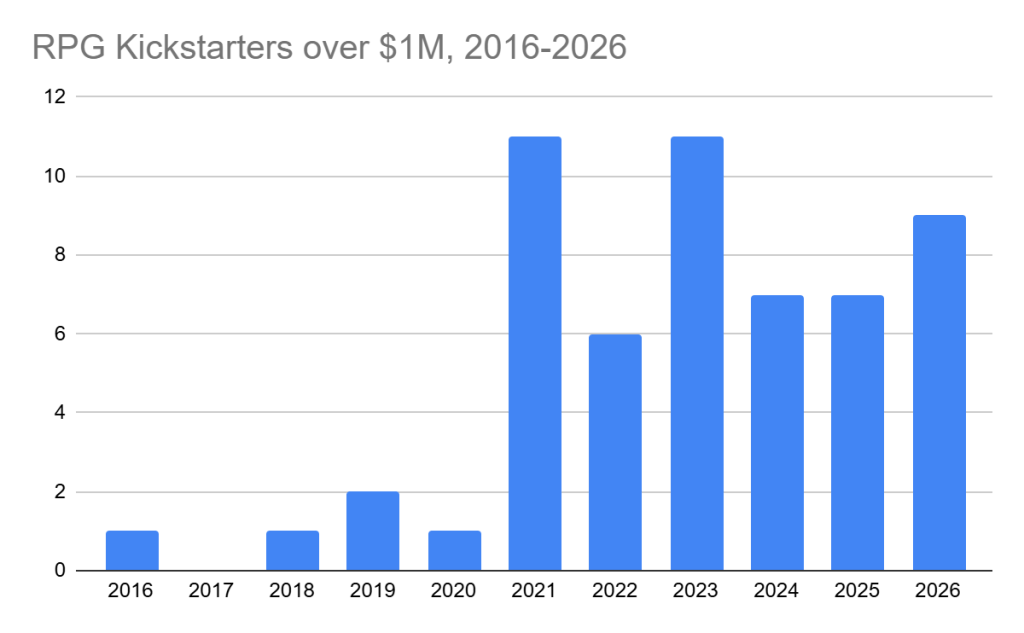
In the latter half of the 2010s, there were a few projects which poked through the one million dollar threshold; essentially all of those projects can be attributed to two 5E content creators, Matt Colville and Hit Point Press. In 2021, high-dollar crowdfunding exploded, and I’m pretty comfortable attributing that to COVID. The pandemic both juiced the TTRPG market as well as forced many creators to pivot to alternate distribution and funding models. This is still mostly D&D, but 2021 alone saw immensely successful campaigns for Mothership, The One Ring, and Avatar Legends.
Looking at the graph above, 2021 is certainly an accelerating year in the high-dollar Kickstarter trendline, but both it and 2023 are likely outliers in the underlying growth story. For 2021, the pandemic played a large role in that, and 2020-21 is likely an ‘outlier’ time period for most people who lived through it, too. 2023 is interesting, and I have a theory as to why it was also an outlier. 2023 was the year of the OGL debacle, and while the revised OGL would have certainly been a net negative for creators had it come to pass, it encouraged creators who were interested in leaving the 5E ecosystem to do so. 2023 had Draw Steel, Tales of the Valiant, Dolmenwood, and Shadowdark, and the negative press for Wizards of the Coast likely helped large non-D&D campaigns of that year like The Magnus Archives and The One Ring’s Moria expansion.
This means that 2026 itself looks interesting. Nine high-dollar campaigns doesn’t make the year an outlier…except it’s only August. The most popular month for high-dollar crowdfunding is February, but we’ve got one more heavily-weighted month, October, that hasn’t happened yet. Knowing that, the possibility for 2026 to meet or even beat 2021 and 2023 is certainly on the table.
Some Breakdowns
You know me, I’ve been warning about Hasbro’s monopoly in the RPG space since 2019. The data, at least as far as high-value crowdfunding is concerned, bears me out.
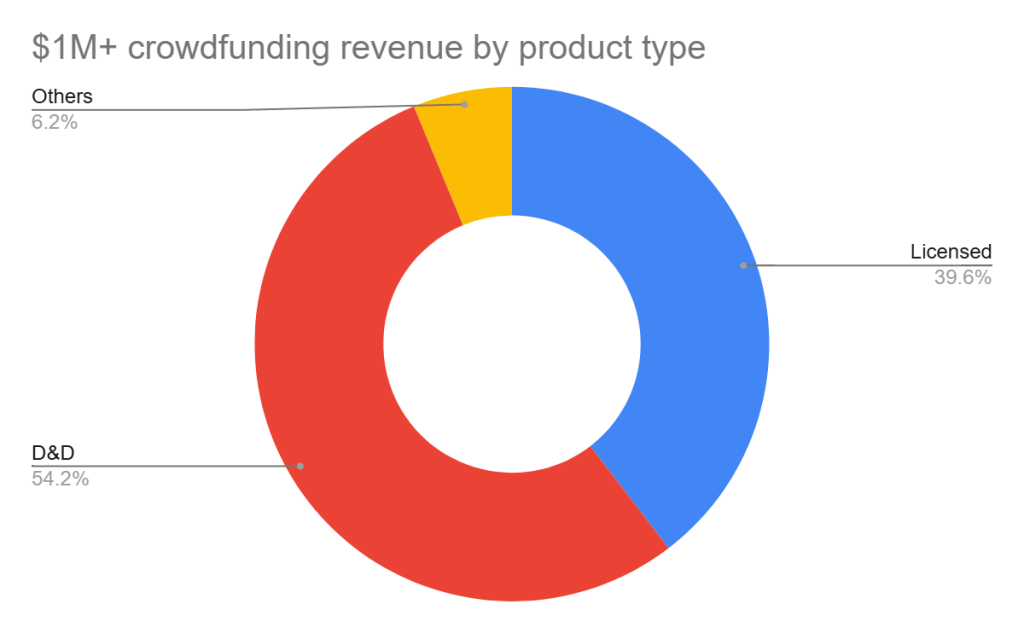
54.2% of crowdfunding revenue, some roughly 80 million dollars, generated by high-value campaigns goes to games that are D&D. That’s any game product which is intended to be compatible with D&D, replace D&D, be a version of D&D, or otherwise be used with a game with six stats from 3 to 18, d20 dice, and levels. Of that, over 75% (around $62 million) was generated by campaigns explicitly compatible with and designed for 5E.
The next largest product type is licensed games, and this one’s much clearer. The Cosmere RPG, Dungeon Crawler Carl, and Avatar Legends are both some of the largest crowdfunding campaigns ever (not just RPGs) as well as licensed properties. These giant campaigns are also important to the overall number, because while the category makes up 40% of the revenue, it’s only 25% of the projects by count.
Finally, the originals. Not a single original game campaign exceeded 2 million dollars, not one. The largest is a campaign you may not have even heard of, a game called Pumpkin Spice – A Magical Cozy RPG. To be fair, though, that’s in nominal dollars. When adjusted for inflation, the largest original game campaign is also the oldest, 7th Sea Second Edition (and to be clear, yes, I did not consider editions and/or revisions when judging originality, merely whether a game was licensed, based on D&D, or neither of those things).
There’s another interesting metric I examined, which serves as a proxy for how much excess money the campaign generated through collectibles, be they special editions, dice, minis, what have you. What I’m calling the ‘core revenue ratio’ I first saw used by Dr. Emily Friedman when she discussed the performance of the Seven Part Pact Kickstarter campaign on Bluesky. The core revenue ratio is the ratio of the number of backers multiplied by the price of the tier which gets you a basic physical copy of the book being campaigned to the overall earnings of the campaign. The lower the ratio is, the higher the average ticket size a backer paid and the more backers got higher-value tiers including collectibles and non-core content. The lowest core revenue ratio I recorded was just 9%, but it was an obvious outlier when I looked at the specific campaign. Mythic Legions was a campaign for a 5E-based RPG, but it was for an RPG based on the Mythic Legions toy line, and the rewards tiers were full of action figures and minis. As the backers were often Mythic Legions fans, it’s unsurprising that there was a huge turnout for high tiers with a large number of figures included; that also makes the structure of that campaign a bit different from the others I assessed.
For the others, there was a huge range of core revenue ratios, from around 20% to around 90%. A lot of it has to do with campaign design, and for the most part there isn’t a strong correlation between core revenue ratio and Kickstarter success. For the most part.
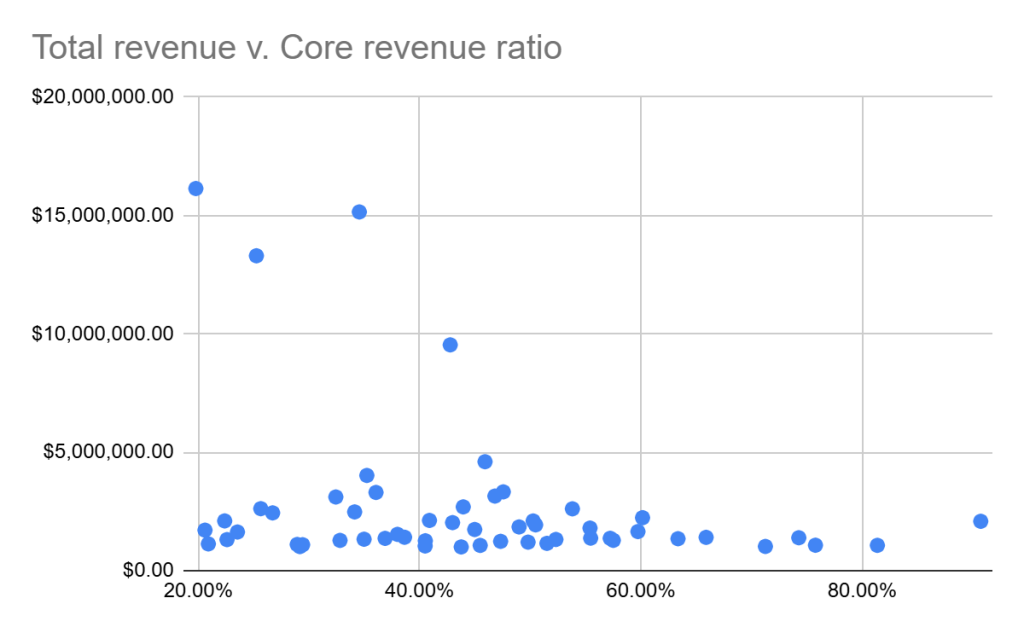
Once you get near eight-figure territory (above around $5 million per campaign), there is a strong negative correlation between total revenue and core revenue ratio. The lower the core revenue ratio (that is to say, the less money came from the core product and the more upselling and accessories sold), the higher your revenue will be. The dot all the way up and to the left is Neon Odyssey, the second Legends of Avantris Kickstarter, and they convinced over 5,000 people to buy in at a $999 tier. That’s some truly masterful upselling. What this evidence suggests is that your only chance to become a ten million dollar Kickstarter is to appeal to “whale” backers, those who are willing to pay hundreds (or, yes, thousands) of dollars for “exclusive” items regardless of the content of the book. Having those upsell opportunities doesn’t guarantee you’ll go to the moon (just look at the bottom left of the graph), but they are seemingly a prerequisite to even getting the opportunity to turn your seven figure Kickstarter into an eight figure one. When combined with observed reviews for Avatar Legends, the Cosmere RPG, and existing Legends of Avantris releases, it also seems to indicate that quality of the game doesn’t come into the picture at all when looking at the biggest, most profitable Kickstarters.
There are many more opportunities to analyze crowdfunding data; both Kickstarter and Backerkit make it very easy to look at historical campaigns. However, building this sort of dataset is incredibly manual work, so keeping it human-made has so far required cutting it off at the million number. Going down to $100,000 would increase the number of campaigns at least by an order of magnitude. At the same time, even at $100,000 you’re already primarily focusing on professionally-run campaigns, and much of the data would look similar. You’d get smoother count trends, and maybe some other insights about core revenue ratio, but the overall message on where the money is going would likely be the same. One proxy for lower-dollar campaigns that I have analyzed, ZineQuest campaigns, indicates a very similar breakdown between D&D, other existing properties, and wholly original materials (with the caveat that licensed games do almost disappear below the $100,000 mark for obvious reasons).
Even with this small dataset, though, there are interesting conclusions. It’s hard to make a million dollars from a TTRPG, and that’s one of the main reasons those that do are usually either D&D-based or licensed. At the same time, there’s seemingly a bright line at the ten million dollar mark where crossing it requires much more strategic thinking about how to extract money than effort put towards game design. There aren’t many crowdfunding campaigns that large, and it seems that for now they will continue to be rare and driven more by money than anything else.
Crowdfunding continues to grow as a core financing method for TTRPG designers, and 2026 in particular has been a banner year for large, high-dollar campaigns. As we go into the future, it’ll be interesting to see how things change; so far 2026 is the biggest year ever for non-D&D, non-licensed high-dollar campaigns, and I hope to see that particular campaign count increase going forward. We’ll just have to see how much growth comes from continued injections of creativity and originality, and how much comes from increasing efficacy of separating gamers from their money.
Like what Cannibal Halfling Gaming is doing and want to help us bring games and gamers together? First, you can follow me @levelonewonk.bsky.social for RPG commentary, relevant retweets, and maybe some rambling. You can also find our Discord channel and drop in to chat with our authors and get every new post as it comes out. You can travel to DriveThruRPG through one of our fine and elegantly-crafted links, which generates credit that lets us get more games to work with! Finally, you can support us directly on Patreon, which lets us cover costs, pay our contributors, and save up for projects. Thanks for reading!


I think you categorise too many projects as d&d. Draw Steel and Daggerheart are high fantasy but are different enough to be categorize as something different.
I suggest that a categorisation by genre (fantasy, horror, science fiction) and system (OGL, PbtA) would be far more interesting. Also type of product for the campaign such as core book or an expansion could also shed light on some interesting results.
LikeLike
From a financial perspective, projects like Draw Steel and DC20 perform differently because they are targeting a D&D audience, and this is very clear in the project-level results. While I do think the same is true for Daggerheart, I’d note here it’s not in the data because Daggerheart was self-financed by Darrington, not crowdfunded. As far as the genre labels are concerned, I thought so too, and I do have fantasy, horror, and sci-fi labeled in the backend dataset. It’s…sobering, really, because what’s most notable about sci-fi and horror is how few of them there are and, like I note in the article, how many of them are licensed. Literally the only non-licensed, non-5E sci-fi game in the entire dataset is Mothership.
I do want to share my raw data, but right now the spreadsheet is a bit of a mess with my chart pulls and other calculations, including a real value analysis that didn’t end up being as interesting as I hoped it would. I’m going to try and get it cleaned up and available on the site in the next couple of weeks (when my larger, less gaming-oriented spreadsheets for work aren’t demanding my attention).
LikeLike
Interesting, thank you for sharing the additional results. Fantasy do tend to dominate crowd funding by a very long shot. If you want help with the data let me know, I’m a data scientist and I can probably clean it up and pry some more information from it easily.
LikeLike
Another interesting breakdown might be System as Focus vs Setting as Focus.
Draw Steel, DC20 and (Daggerheart) seem to be primarily about a new (or semi-familiar) System as the appeal.
Most everything else is Setting?
7th Sea has a lot of previous fans, so that makes System vs Setting a little harder to decide.
And Mothership?
Mothership may be more about Genre as Focus? Though there is also the point that Tuesday Knight Games did a great job of acquiring fans long before they went to crowdfunding.
LikeLike
Licensed games are strongly setting-driven, naturally. 5E is heavily setting-driven as well; reviewing the campaigns gets a lot of setting but few mechanical expansions. Matt Colville’s early work (Strongholds and Followers and Kingdoms and Warfare) provides the main exceptions where the product was primarily about mechanics. OSR is split; I’d say Shadowdark leads somewhat with mechanics, but Dolmenwood leads much more heavily with setting. Of course, Shadowdark’s setting campaign being so much more successful than the original system campaign is a curious punctuation mark, but I think it also has to do with how successful Shadowdark was after Kickstarter (which is in itself rare). Going to the originals…it varies. I’d put both 7th Sea and Mothership in the category of being at least about the game more so than just the setting; when comparing it to the other expansion campaigns (Dragonbane Trudvang and Fabula Ultima bestiary), Trudvang is clearly about a new setting for Dragonbane whereas Fabula Ultima is more about system expansion. Coyote and Crow always seemed to me to be setting forward, although it is a full game, and I’d say the same about Pumpkin Spice though as it’s newer I haven’t read nearly as much on it as I have Coyote and Crow. The only original (not licensed, not D&D) campaign I haven’t yet mentioned is Seven Part Pact, which like 7th Sea and Mothership is more holistic than simply being about a system or a setting though if I were to make a judgment about why it captured the attention it did that would lie on the ‘system’ side of its pitch.
LikeLiked by 1 person