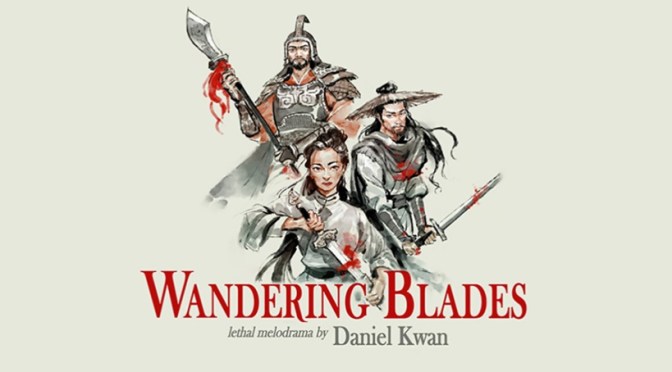
Highly skilled martial artists roam the lands seeking to redress wrongs, help the downtrodden, and free the innocent from oppression. Heroism, action, melodrama! These are the hallmarks of the wuxia genre, and when they show up in the tabletop sphere they tend to come with a pretty big set of rules and no small amount of actual magic. In this case, though, we have a game trying to use old school renaissance-style mechanics to enable wuxia genre conventions: Wandering Blades!
Created by a small team led by Daniel Kwan (who you might recognize from the ENNIE Award-winning Asians Represent! podcast) and published by Plus One Exp, Wandering Blades is at first glance a contradiction. OSR style games have too many dials to completely pigeonhole, but they do have a tendency to be hardscrabble games where death comes very easily, and while wuxia characters certainly die all the time they do tend to get a fair amount of time and effort devoted to trying to kill their opponent first. Also, while outright magic is rare in wuxia media the action tends to be over the top (complimentary), while even outright magic in most OSR games tends to be muted, costly, and/or dangerous to the user. So, how does Wandering Blades try to blend the two?
The base action resolution is as simple as any other OSR game: 1d20 plus an Attribute against either a target number or an opposed roll. If an action is AMPLIFIED you receive a +5, and if it’s HINDERED you take a -5 penalty; if you’re both, they simply cancel out. There are options presented to use clocks for larger tasks, but by and large that’s it.
Characters have four of those Attributes: STRENGTH, AGILITY, FOCUS, and INTELLECT – these all start with a rating of 10, and then you roll 4d6 and add a die’s result to each Attribute. Characters also have a Drive that they pursue, shaping their behavior, and even allowing them to automatically succeed on a check once per session if they can tap into it. They have a Connection with another player character (or with a key NPC if it’s a 1-on-1 game). They also have Reputation Scores with the martial artists, court officials, and ordinary people of the world – notably, they’re going to start off on Unfriendly terms with someone.
There are three classes of character: the Youxia (“knight-errant-style hero”) with signature weapons and martial arts sect styles, the Outlaw whose martial arts focus on trickery, control, and bravado, and the Scholar whose martial arts depend on keen analysis and knowledge. In the print copy of the Quickstart I got at PAX East, we get deeper looks at the Youxia and the Outlaw. Each is going to have a few unique traits, some stats like hit die and starting wealth, and techniques to choose from.
The Youxia belongs to a martial arts sect that will both provide mechanical impact and a narrative place in the world, has a signature weapon with improved damage, and a unique disguise that they use to stay under the radar until the dramatically appropriate time. The martial arts techniques available are split between general ones (such as being able to convert a successful attack into a CRIT) and sect specific (like the Mountain Orchid Sect’s Gale Slash that can knock opponents off-balance at range or the Floating Lotus Sect’s Redirect Energy that forces an opponent to reroll a missed attack against another target).
Outlaws start with less health and more money than the Youxia, can leverage their Notorious reputation for an extra die on checks, and can put an Ear To The Ground to gain information. Their techniques are things like Rally, which lets allies that have taken damage this turn roll a hit die to heal, and Immobilize which does exactly what you think it does in exchange for less damage on an attack. Rather than specific groups of additional techniques, Outlaws have groups of skills via Talents. Each Talent renders any check within its purview AMPLIFIED, such as anything related to intimidation, interrogation, and brawn for Brutality and anything related to pickpocketing and sleight of hand for Thievery. In this way the Outlaw is doing a good job of showing off another common OSR ideal, that being the fact that resolving a situation without fighting can pay off in a big way. Talents can also be upgraded as a character advances – becoming an Expert in Brutality swings back towards combat with unarmed strikes dealing more damage and more skilled use of improvised weapons, while doing the same in Thievery extends its AMPLIFIED skill package to device tampering, trap disarming, lock picking, and locating helpful criminal allies.
Qi Points are something every character also possesses (a base amount determined by how high your FOCUS is above 10 and some more from your class), and spending them is what powers those martial arts techniques described above. They can also be used for a suite of universal Abilities available to every character regardless of class, such as gaining extra actions, healing, making checks AMPLIFIED, and automatically succeeding on saving throws.

Qi points and the things they fuel might seem like the way that Wandering Blades best uses mechanics to enable a wuxia action experience, and they do a great job at it, but I’d argue that they’d fall a little short if it wasn’t for the base mechanics of combat. After dealing with any ambushes, characters announce whether or not they are going to use a Fast Turn or a Slow Turn. Fast Turns are obviously going to get to act first, and can perform one Action and one Reaction (although you can get additional Reactions by, you guessed it, spending Qi points). Slow Turns, though, get two Actions and one Reaction. These decisions are announced in order from the character with the lowest AGILITY to one with the highest, so more agile characters are going to be making a more informed choice. Actions include moving, attacking, and the use of some abilities and techniques.
When making an attack (1d20 + STRENGTH or AGILITY), the target number is the opponent’s Dodge (AGILITY). Whether it hits or misses, however, the targeted character has the option to use their Reaction in a wide number of ways. If you get hit, you can PARRY to make a check of your own, dealing damage if you roll equal to or higher than the original attack. You might instead choose to WITHDRAW with AGILITY, avoiding all damage and moving away on a success but suffer damage and get the next attack made against you AMPLIFIED if you fail. On a miss you could COUNTER to make a free attack action of your own against their Dodge, or BIND by making an opposed STRENGTH or AGILITY check to lock your weapons together. Finally, if you have the right kind of item you can GUARD to negate incoming damage, but can only do so for as many times as the item’s Guard rating.
So, right there, before you even add in all the really cool abilities and unique techniques, you have this extremely dynamic combat system that’s going to see characters jockeying for initiative every round, making action economy choices, and firing off attacks and reactions. ‘Empty’ turns are going to be difficult to get, because even misses open up the chance for something to happen. Honestly, the only boring one is the GUARD reaction, but it’s very limited in availability and uses, so you’re not going to get trapped in a void of perfect defenses slap-fighting it out. That’s without even getting into special actions like Feints and Grapples!
The end of every round offers the chance for Morale to get tested – every NPC has a MORALE SCORE from 2 to 12, and if the right conditions are met than the GM can roll 2d6. If the result is higher than their MORALE SCORE, the NPC is going to be trying to extricate themselves from the fight, so there are plenty of opportunities to resolve a fight without going to the bitter end. Even better, being reduced to 0 HP doesn’t take a player character or a non-follower NPC out of the fight. Any damage beyond 0 inflicts a WOUND (which could certainly serve as a trigger for a Morale check, by the by), and every 5 WOUNDS inflicts a CONDITION. Some CONDITIONS can be gained via techniques, weapons, and environmental issues as well, but they’re all rough, like Dazed hindering all attack actions for a number of rounds, Internal Damage limiting your number of actions and reactions and reducing Qi points, and Severed Limb doing exactly that. Notably, there’s no insta-death – even if you’re Dying, your Focus will keep you alive a bit longer so there’s a chance for medical assistance. In most cases, though, your character (or your opponents) can stay in the fight – if it matters enough to you/their Morale holds up.
If you want a more maximalist design or the ability for a character to punch a mountain at someone, this just isn’t going to do the trick, but there are other games for that. There’s nothing here with a steep learning curve on its own but there’s plenty of opportunity to make smart tactical and strategic decisions, exactly how the OSR likes it. You also get over the top back-and-forth fights that are appropriately tense, dramatic, and deadly without getting obviously supernatural, just like wuxia likes it. I think the self-assigned assignment for Wandering Blades was both well-understood and well-accomplished.
The Kickstarter has fully funded and has only an actual play stretch goal left to reach, and is coming to an end tonight at 8:00 PM EDT, so I’d recommend choosing a Fast Turn for this round and backing it while you can. The basic get-a-PDF tier will run you $15, while the PDF with a physical copy tier will cost you $35. If you want to take a look yourself, though, the digital version of the same Quickstart I read for this can be downloaded from itch.io.
Danger is everywhere, but you can carve out your own legend with Wandering Blades!
Thanks to Tony of Plus One Exp for giving me a physical review copy of the Wandering Blades Quickstart at PAX East ’25!
 Cannibal Halfling Gaming
One thought on “Wandering Blades Review: Old School Tech, Wuxia Style”