You and Granma were, frankly, on the worst terms. That’s what made it such a surprise when you got a package from your cousin, who had wound up being the executor of her estate. Maybe, your cousin writes, Granma was able to overlook your differences since you had become a fellow academic? Either way, the actual package is a copy from her rare books collection, willed to you. You can’t help yourself, so you start to read the book. It’s a weird one, an anthology of works all talking about books and stories and death and living forever and… rituals? Hold on. You really can’t help yourself. You consider just not turning the page, but you turn it all the same. The notes you’re writing in the margins stop being the words you intended to write. You can feel the book pulling you in…
The book is Siderius Plug’s SPINE – Immortality in Ninety-nine Endnotes.
Written by Asa Donald, SPINE is a curious tome indeed. The book is a game, the game is a book, and the only way to play is to read it. The only way to make progress is to change the physical book. The only way out is to get to the end, and ‘out’ may in this case mean ‘out of luck.’
After reading the intro material and the Preface by ‘Plug’ and signing your name into the book’s Ex Libris, you play the game by reading the book – the game will only end when you read the last page. After reading each page, you take stock of the endnotes numbered on that page to flip to the back of the book, and read whichever endnote(s) strike your fancy. Then you pick one; each endnote also comes with a prompt, which will usually have you go back to the noted page and make some alterations.
At first, most of these alterations will be pretty academic in nature: commenting on the text, asking questions, answering questions, underlining or circling words, solving some ciphers, and so on. However, relatively early on and with increasing frequency you’ll instead by properly defacing the book as it takes hold of you: ripping out sections, jabbing it until parts become illegible, even dampening or burning parts.

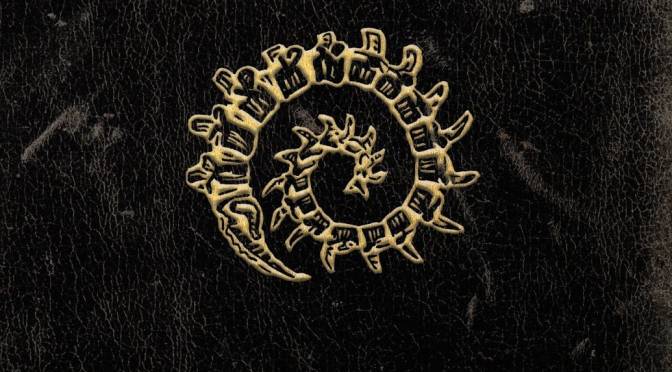
This only becomes more intense when you read certain endnotes – some will have a swirling symbol in their text, and if you read past them you lose the ability to choose which endnote/prompt you’re working off of – you have to choose the one with the symbol. As you hit more and more prompts, swirling symbol or not, it starts to become very clear to the reader that the book is a trap – it is attempting to draw you in, feeding your compulsions to keep reading and marking the pages until help there is no escape.
This is represented by a clock in the back of the book that takes the form of a portrait – every time a prompt tells you to advance the clock, you draw a part of your own head and cross that part off of the list around the portrait. If your entire portrait is complete the clock has struck midnight, and you’re trapped in the book. It’s possible to rewind the clock, even after it strikes midnight, erasing the part of you that’s been captured and un-crossing its word. However, you’ll have to find the correct prompts and complete their tasks to do so, and there’s certainly no promise that you won’t advance the clock again later.

You’ll start to be forced to write certain things, your will and that of the book fighting each other. Some of your writing will be rendered into gibberish. The efforts to deface the book to try and escape it get more extreme, more damaging. On and on it goes, until you reach the final page and find out if you were able to fight your way out or if you remain trapped in the pages forever for a day until the next reader takes your place and you take theirs.
At the end you have a copy of SPINE that is itself unique compared to all other copies of the game, full of your marginalia and defaced by your chosen methods and efforts. As the final, ultimate expression of the possession and handling of the book being the game, the final instruction in the rules is to – after playing the game once or twice – give it away. “Trade it with a friend. Place it in a Little Free Library. Hide it in the shelves of a public library. Mail it anonymously to an unsuspecting victim.” imsorry
Now, if you like fiddling around with game mechanics or using a solo game to create a completely unique-to-you story… no. The most mechanical thing in SPINE is seeing if you can figure out some ciphers, flipping some pages to land on a random one, and finding the book after you hurl it across the room to try and stop it from sucking out your soul. As for story, you are quite literally bound by the pages of the book no, really, GET ME OUT and while there is some wiggle room based on what prompts you pick or get trapped by there is still essentially only one story to tell: that of the researcher getting lost in the book or not.
Within those bounds, however, it’s an extremely creative game – while you’re given structure with the prompts, exactly what you put into or do to the book is often very freeform. One prompt asks you to write a love poem! I got all the way through, narrowly escaping the book in the end areyousure, and had a lot of fun playing the part of a researcher who got way over their head, being delightfully dramatic with frantic writing and cryptic gibberish.
I find the idea of being the second or third person to play SPINE to be fascinating, especially if you were to receive or stumble upon it unexpectedly. Just reading through my own copy, which I was prompted to (mostly) do towards the end, was an atmospheric and pretty spooky experience. A second or third playthrough is going to increasingly run into prompts they can’t engage with because (unless instructed otherwise) you strike them out when you complete them so that they can’t be chosen again. Their options will narrow, they’ll stumble upon hints or warnings, and either be much better or much worse off than the first player.
Now, I can’t just clone myself or time travel to be the second person to play this particular copy, so I can’t speak to that aspect definitively, but as the game ages and spreads out a bit I think we’ll see some interesting stuff happen. I’ll also point out that there actually is a good amount of replay value for a single person – a second go could be played as if you were a second reader, but some of the prompts feel a bit favorable towards a second go being the same reader still trying to escape. There are only three clocks in the book, so three players/playthroughs seems to be the upper limit – which also seems fair considering I’m not sure how intact the book would be after three playthroughs.
Overall, SPINE is a very smart game – you might even learn a few things, I know about palimpsests and polyalphabetic ciphers now! – that takes the Venn diagram of reading and playing a game and makes it a circle. It’s not going to be for everyone, sure, but this is one of those its-strengths-are-its-weaknesses things because it is a truly unique game. I’ve played solo games and horror games and legacy games and games where you change the book, and yet I don’t have anything to compare SPINE to – it stands on its own.
If you enjoy reading and you enjoy creative roleplaying games, with some bonus points for if you like existential horror and/or legacy games, you need to give this one a try.
I’m sorry, I’m so sorry, don’t read this book, don’t even open it, don’t open it doNTOPENITDONTOPENITSTOPPLEASESAVEYOURS
If you’re reading this on the 31st of October 2025 you can get the digital version for free at DriveThruRPG and itch.io – otherwise, it should be available for $6.99. Said digital version includes a booklet-style copy that will make it a lot easier to print and organize, which I would go so far as to say is mandatory – this is not a game I would recommend playing on a device, if you can play it there at all. You can also get a properly printed copy of the book via mixam for $9.99; you don’t get the digital version with it (mixam just isn’t built like that), but honestly why would you need to? That being said, I read something in a margin somewhere that there’ll be a note where if you provide proof of purchase to a certain address, you’ll get a free digital version in the bargain.
Beware of books inherited from estranged grandmothers, watch out for tomes hiding among the stacks, and overall keep your wits about you, and you might get to enjoy SPINE without getting lost in it. Either way, well, then it’ll be the next reader’s problem.
Speaking of which, I need to swing by my local library…
The End?
 Cannibal Halfling Gaming
3 thoughts on “SPINE Review: Making A Game Of Getting Lost In A Book”