Video games owe a lot to tabletop roleplaying games, with mechanics, terminology, and tropes all being borrowed during the 1980s and 1990s. For obvious reasons, though, the two media drifted, and even video games calling themselves roleplaying games have little to do with their forbears, given both the capabilities of digital games in terms of graphics and gameplay as well as their limitations in terms of breadth and story. All this to say, when I see a claim that a video game is able to capture some of the feel of a good tabletop session, I perk up. This was the case with Esoteric Ebb.
Esoteric Ebb is not the first video game I’ve seen making this claim; we covered Wildermyth a ways back, and I appreciated the way that game tried to incorporate emergent storytelling and feel more like a sandbox than other games in the tactical RPG genre. Esoteric Ebb is perhaps not as different as Wildermyth; it’s built strongly around the mechanics and tropes of another (admittedly very good) video game. However, its writing and the understanding of the TTRPG medium that that writing demonstrates still end up making Esoteric Ebb, in my view at least, a must-play.
Esoteric Ebb is heavily based on Disco Elysium, the hit game released in 2019 by ZA/UM. Both games use virtually the same adaptation of classic CRPG mechanics, employing an isometric perspective to show your character wandering around the game area. Both games are built around expansive dialog choices interspersed with dice rolls as the primary mechanic, with little to no combat (Esoteric Ebb has more combat than Disco Elysium, but other than an initiative tracker doesn’t have a combat engine in the way Baldur’s Gate or Icewind Dale do). Both games also feature a main character with some amnesia waking up in a district of a city and then having a limited amount of time to solve a mystery. To go yet further, both games also feature a single companion who acts as a foil to your character throughout most of the playtime and whose writing is a standout part of the game. When I say the game is heavily based on Disco Elysium, I’m not kidding.
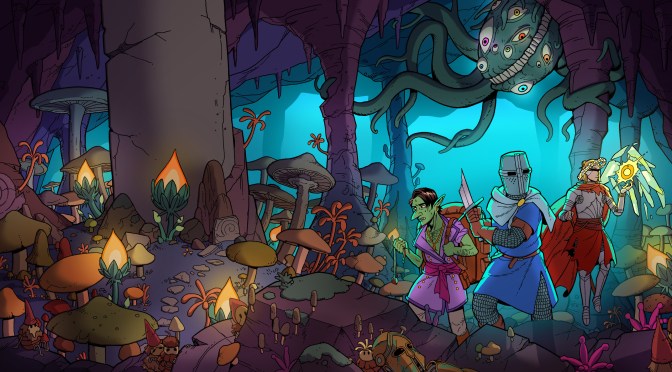
That all said, as much as many of the structural beats are the same, Esoteric Ebb differentiates where it counts. The writing has a very different voice from Disco Elysium, and the NPCs are unique, weird, and delightful. The art style is completely different, blending something cartoony with a distinct Moebius-like flair. The world-building is fascinating, and a lot of that has to do with the fact that this game is a love letter to Dungeons and Dragons. In Disco Elysium you had various parts of your subconscious providing constant running commentary in your head; in Esoteric Ebb it’s your six attributes, each having their own voice and (weirdly enough) political views. When you assign your stats at the beginning of the game, you’re unwittingly aligning your character with voices in your head you haven’t met yet, and it’s going to change how the game goes for you. At the same time, there are many, many ways to complete each challenge, and while focusing on one stat to the detriment of all others will get you in trouble, pretty much any combination of at least two strong stats is probably playable. For my playthrough I chose Dexterity and Intelligence, and to say it colored the game is likely an understatement.
Beyond the stats, the game aims to convey the feel of a D&D session across the mechanics, the writing, and the superstructure of the program itself. Whenever you return to a save file, you get a short Witcher 3-esque recap, but it’s done from the perspective of a DM reminding you what happened last session. There are other D&D mechanics at play, namely the use of spell slots, hit point and initiative calculation, short and long rests, and advantage and disadvantage. When you get into it, though, the core elements of the game work more like Disco Elysium than D&D. The items you pick up add bonuses and penalties directly to your stats, just like in Disco Elysium. The ‘gated die roll’ mechanic is the same, though unlocking die rolls ends up a bit easier in Esoteric Ebb. Most importantly, though, this game, like Disco Elysium, is really about the prewritten character at the center of it, The Cleric. Or is he a wizard? Nah, maybe a dashing rogue.
Your character in Esoteric Ebb serves as the best basis for describing why Esoteric Ebb is an excellent TTRPG video game but also why it does not achieve that watermark by emulating a TTRPG. Your character is an arcane cleric, and while there’s a long-running quest/joke regarding what class you actually are, the character is set in the story. Very much like Harry DuBois in Disco Elysium, the pre-written central character in Esoteric Ebb is key for how the story evolves and the perspectives you can take as the game progresses; even if you the player have a number of choices for the direction the character takes, the character was written for you and that writing is key to the story working as well as it does.
If you overlook the pointedly limited nature of character creation, though, Esoteric Ebb makes for a pretty decent simulacrum of a short D&D campaign. Part of this is that what makes the game’s writing good is the same thing that would make any GM’s prep good: maintaining focus and interest on a subset of events and locations that would naturally draw a player towards those events and locations. While there’s certainly a fair amount of humor derived from putting in elements that emulate the sort of random or off-topic things a D&D player would attempt, they also serve a gameplay purpose as they make the world and its choices feel broader than they are. Being able to get stuck on a windmill or climb a tree will stick in your head more than the fact the main street just ends, or that in a city that theoretically has 300,000 residents, you can traverse roughly one city block.
I need to point out here that in the little slice of the city you have free reign in, there’s an incredible amount of worldbuilding. This is clearly the designer’s homebrew world, and it’s very successful at pulling off the sort of odd fantasy-punk vibe you expect from quirkier parts of the OSR. There are a number of in-universe texts as well as interstitial links within your dialogue which lead to world topics, and if you read it all you’re rewarded with a world that has been written very thoughtfully. This is a world of the standard D&D fantasy races, yes, but also of sentient snails and friendly mimics and all sorts of other tropes turned on their heads. The backstory is also quite thoughtful, managing to both show hundreds of years of history while neither letting the world feel static nor avoiding the reality that the most significant events almost necessarily had to happen less than a generation ago. It’s also hard to avoid mentioning the world’s politics, which follow in the footsteps of Disco Elysium but manage to be crafted in such a way that they don’t seem out of place in a D&D world. This is important, because the main event that serves as the backdrop to your adventure is an election.
The more you look at it, the more you realize that the strength of the writing is really what’s carrying Esoteric Ebb towards feeling like D&D, and at a certain level it’s an extreme example of showing that if you’re a GM who’s a great writer, you can get away with a lot. If your players are interested in your conflict, and want to see it play out, they will follow you to where you want them to go. I strongly remember one (very good, I must emphasize) campaign in college where the GM laid out their arc at the end and ‘showed us the tracks’, for lack of a better term. Was it kind of a railroad? Perhaps. Did we care or get bored enough to try to jump off the train? No and no.
So Esoteric Ebb is a CRPG with some TTRPG flair. The Disco Elysium foundation is good, but it’s a video game foundation through and through, a specific take on the RPG video game like a JRPG is or like a Bethesda game is. It is not really like Wildermyth, it isn’t trying to offer TTRPG sandbox mechanics or change the way we look at video game character development. Like most video games, it is and must be significantly more scripted than a TTRPG because that’s how code works; code cannot truly GM for you. That said. When you take in designer Christoffer Bodegard’s world, his characters and his writing, it’s so easy to read the game-as-DM narration that your playthrough begins with and settle in with comfortable suspension of disbelief. Esoteric Ebb doesn’t really aim for the flexibility and potential of a TTRPG, and that’s a good thing. Esoteric Ebb is one well-written module for 3-5 sessions of play, and when you finish it you don’t blame it for not being a campaign. So while this is definitively a video game, it is a video game that evokes D&D and RPGs incredibly well. You may not blame the game for not being a full campaign, but when the credits roll it will make you want to run a campaign of your own.
Esoteric Ebb is available on Steam.
Like what Cannibal Halfling Gaming is doing and want to help us bring games and gamers together? First, you can follow me @levelonewonk.bsky.social for RPG commentary, relevant retweets, and maybe some rambling. You can also find our Discord channel and drop in to chat with our authors and get every new post as it comes out. You can travel to DriveThruRPG through one of our fine and elegantly-crafted links, which generates credit that lets us get more games to work with! Finally, you can support us directly on Patreon, which lets us cover costs, pay our contributors, and save up for projects. Thanks for reading!


One thought on “A Glimpse Into the Vault: Esoteric Ebb”