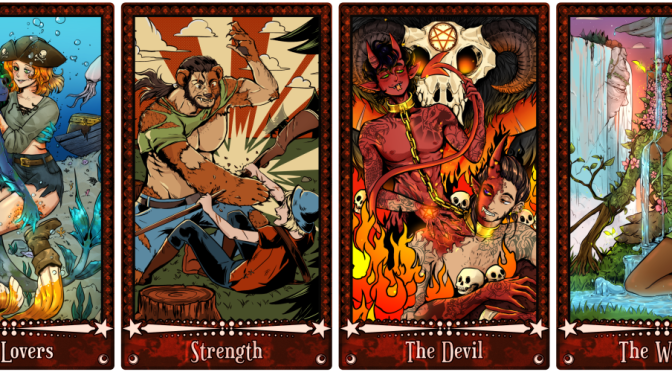
Stories of transformation are both very old and very common. From Tiresias and Circe to The Emperor’s New Groove and Turning Red, people have been changing gender, species, state of matter, and all sorts of other things up and down the stories we tell through the ages. Heck, on a personal note one of the first stories I was ever told was about the Children of Lir. To Change seeks to put that kind of story in the spotlight through the medium of a roleplaying game, using short sessions and Tarot cards to explore dramatic transformations and the consequences of becoming something new.
The last time we saw Ulysses Duckler around these parts it was with a game of small bugs in a big world, Cuticorium. This time out Duckler has teamed up with Ewen Albright, and together the pair (with help from a whole host of additional writers) has brought us a game that will hardly feature any bugs at all. Unless, of course, you’re doing your own version of Cronenburg’s The Fly.
The Characters
Characters have four different attributes that define them. Mental Fortitude is your ability to withstand things like persuasion and mental intrusions, deal with stress and pressure, and keep your head in the game while being overwhelmed with input or sensation. Mental Aptitude is your ability to think through problems, thinking fast and analyzing your situation to come up with solutions. Physical Fortitude is a measure of your inner strength and your ability to withstand punishment. Physical Aptitude, then, is outer strength, your ability to act in and upon the world and shape your environment through actions. Every character starts with a value of three in each of these attributes – no Mental Aptitude min-max build here – although they’re not displayed in a numerical way. More on that in a bit.
These attributes can be damaged, which aside from being relevant in the fiction and coming into play when it comes to resolving actions, can severely take you out of action. Depleted Mental Fortitude means behaving like a thoughtless doll, Mental Aptitude send you unconscious as your brain shuts down, Physical Fortitude makes you just as out cold as your body fails, and Physical Aptitude leaves you drained of energy and paralyzed. There are no specific ‘take action X, heal X attribute’ rules – healing, rest, therapy, and medicine in the fiction is what get characters back on their physical or mental feet.
Where we first interact with the 22 Major Arcana of Tarot, here gathered into what’s referred to as the Fortune Deck, it’s as part of character creation. Three cards are drawn to be a character’s Face card, their Rising card, and their Falling card. The Face card represents the character’s core values, and also grants them a special ability. The Rising card represents success, good fortune, and positive personality traits. The Falling card in turn represents failure, bad fate, and negative personality traits. The Fool as a Face is joy, has freedom as your keystone while Rising, and threatens you with shame when Falling. The Hierophant is an educated and knowledgeable Face, grants discipline while Rising, and is vulnerable to disorder when Falling.

The Cards
The primary use of the Fortune Deck while playing To Change, however, is going to be to resolve actions that will have consequences. Players draw and reveal a number of cards equal to the undamaged points they have in the attribute being tested. That means three, if they haven’t been damaged at all. If another player helps, that means another drawn card (although it means everyone involved will suffer the consequences of failure). They then pick the card to use for the action and resolve it; the used card is discarded, and any unused cards are shuffled back into the Fortune Deck. While each card does have a number on it, that’s not used to beat any kind of target number. Rather, each card has a specific result. The simplest are cards that mean “Success in [Insert Specific Attribute Here]”, and there are three of those for each attribute. So you might be testing Mental Aptitude, but if you only draw two cards and get The Hanged Man (Success in Physical Aptitude) and The Emperor (Success in Mental Fortitude), then you’re out of luck. Well, mostly, hold on to that thought for a second.
The other ten cards each have a unique result. The Fool is a success, but in the worst way possible. Judgement is a success or a failure as decided by the Storyteller running the game (or whoever drew the card in a solo or duet game). Death is a success, but can only be used if it is the only card drawn; if it is used, you undergo a Change. The Moon is either a failure or you draw the card from the bottom of the deck and use that one instead, discarding both. There’s some cool decision-making to be done here, and a simple success might not be what you want. For instance, let’s say you’ve discarded all of the cards that lead to success in Physical Fortitude – Temperance is a failure on the current action, but shuffles all discarded cards (including Temperance) back into the Fortune Deck, so it might be a good pick instead of a short-term success.
Things can get a little spicier when you factor in a character’s Face, Rising, and Falling cards. As mentioned before, the Face grants a special ability. If your Face is The Fool and you fail an action while The Fool is in the discard pile, you shuffle it back into the deck. If The Hierophant is your Face, then it grants success on all checks (usually it only does so for PF) and said success teaches an unforgettable lesson. It does not matter which specific Arcana got chosen for the Rising or Falling cards. When the Rising card is drawn, the player can draw an additional card into their hand, but if the Falling card is drawn then the first card that was drawn for the hand is shuffled back in before resolving the action.
Things get even more interesting, though, because really you never have to fail at all regardless of what cards you draw: you can always Succumb. After drawing their cards a player can choose to have their character Succumb to the transformation instead of choosing a card, undergoing a Change in order to succeed at their action. All drawn cards are then shuffled back into the Fortune Deck. Whether it’s a kind of sacrifice or a gleeful charge towards a desired end, it puts the transformation front and center mechanically because even if you never draw any of the cards that trigger a Change themselves it is still always on the table.
The Changes
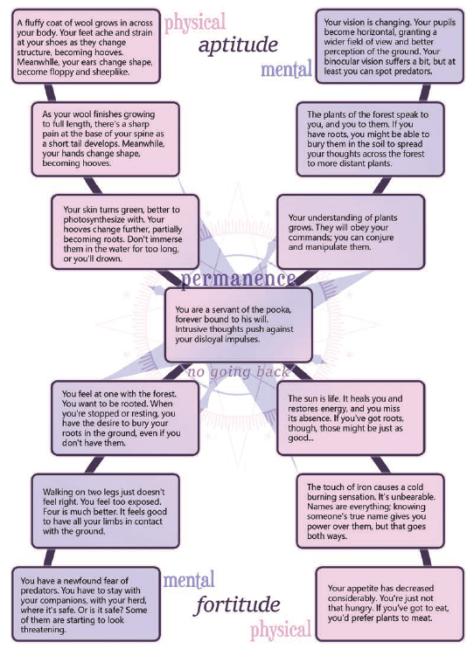
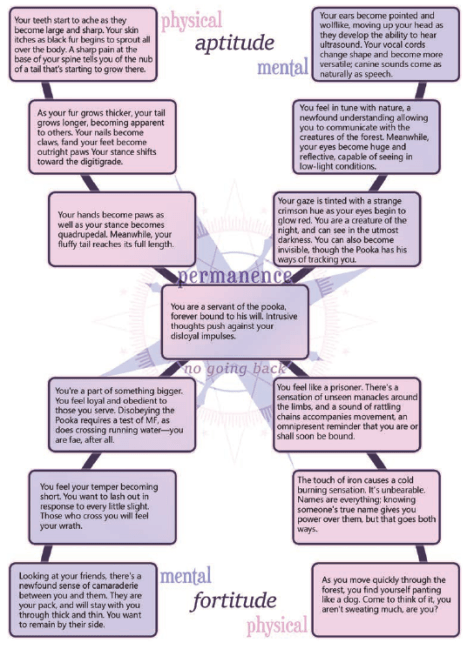
Here it is, the entire point of the game: To Change. A character’s sheet is presented as an X-shaped cross, one leg of which is devoted to each of the four attributes, with three sections each. These sections get marked when they’re damaged, but independent of that is that each section also denotes a stage of the transformation. When you experience a Change, whether because of the rules of a scenario, a card draw, or the choice to Succumb, that change occurs for the relevant attribute starting at the outermost section. The center of the x-cross is Permanence; if an attribute Changes all the way to the center there’s no going back, and the transformation of that attribute is permanent. If it’s your Mental Fortitude you no longer think the way you used to. You no longer perceive the world in the way you used to if it’s Mental Aptitude that becomes permanently altered. Experience all the Changes for Physical Fortitude and you no longer feel the way you once did, while if it is instead Physical Aptitude you look completely different.

One of the stated principles of the game is that the transformation should cause the character some trouble while also providing a degree of assistance. For instance if you’re being transformed into the Princess of the Element of Candy in another world (and yes, this example is drawn from an isekai scenario), the Changes to your Mental Fortitude will have you acting gradually more Princess-like, which may cause some problems as you believe you deserve to be pampered and then feel compelled to fight for or against the Agents of Darkness (which is not as straightforward as it might sound). However, as your Physical Fortitude changes you gradually become stronger with your Element, gaining additional power (and card draws) when you consume or stay near it. Eventually, you can simply conjure your Element into existence!
Body horror is certainly a story beat that can be explored in the game, but its opposite is just as likely depending on the scenario and players. Firmly on the side of body euphoria is how the game handles the transgender experience. Unlike many of the transformations talked about and provided as examples in the book, gender transition is both a real-world process and something that works differently for everyone who experiences it. As a result, the linear X-shaped format of other Changes doesn’t really work, and actually might be troublesome – quite a few of the changes on that X-shape might be viewed as negative or as falling out-of-control towards an end state you don’t desire.
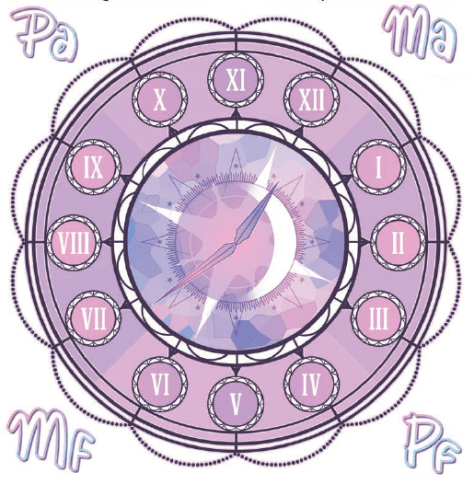
As a result, transgender Changes are instead represented by a circle. Different changes (such as breast loss/growth, voice changes, genitalia external and internal, and euphoria/dysphoria) are loosely associated with different attributes (PA, MA, PA and PF, and MF, respectively). However, they’re not sequential. When a character experiences such a change, the Storyteller is encouraged to let the player choose the Change for the attribute that’s relevant in the moment. Perhaps even more importantly, Permanence on the wheel is only established when the player decides it is, regardless of how few or how many Changes they’ve gone through. The Transgender Change Wheel could be used on its own or could be used alongside the standard x-cross if there’s more being transformed than just gender.
It should come as no surprise that To Change is not a game for transphobes, fascists, or bigots.
If you happen to be among those nominal people and you’ve managed to come this far through this site’s history or this article and not figured it out, allow me to joyfully take a few words to clarify that that is also Cannibal Halfling Gaming’s policy, and to invite you to go pound sand. Happy Pride!
The Content
So, all of that is more or less how the game works, but what does the book then give you to work with? The answer is, uh, a lot. Like, a lot a lot.
First of all, there are rules for solo journaling play. After you figure out what your transformation is going to look like, you pick a Starting card that provides a framework for what’s going on and an additional rule. Then, play is broken up into days: for every one you undergo a Change and draw a card from the Fortune Deck to determine an Event. Whether the card is Upright or Reversed will tell you whether or not that Event is positive or negative, and how many Changes you’ve already experienced will further alter things. If there’s ever an action that could have consequences, you resolve it just the way you would with multiple players, drawing cards.

For an example, The Magician is going to involve arcane forces warping your being, but it’s a spell that you can still nudge – every time you draw an Upright Event you can either remove or add a Change to an attribute of your choice. Early on Upright Events will have you indulge in strange thoughts, and Reversed Events force you to behave in uncomfortably divergent ways. Later on, Upright Events will allow you to accomplish things you never could have if you weren’t so Changed, but Reversed Events will see you willing to sink low for the slightest scrap of your old self.
There are tables for things like random characters, Changes, and minor events. There are Moves that the Storyteller can add into the game, such as an attribute taking damage whenever it’s Changed, the option to mirror the Succumb rule to reverse a Change by deliberately failing an action, the Changes only manifesting under certain conditions (such as a full moon causing one to shapeshift), and so on. There are tips for players and Storytellers alike, advice to make a game of To Change longer, and ways to run a multiplayer game with no Storyteller at all.
There is a fully-detailed solo play scenario, which includes a number of different Moves, rules, and suggested Changes – the scenario is all about different strains of weed that also turn you into a werewolf.
In the middle of all of that is a whopping collection of 11 different full scenarios for group play. Each lists its Mental Tier (a kind of safety tool measurement of how intense the mental Changes are), details what is driving the transformation and how it will proceed, has some unique moves, introduces a cast of characters, and lays out the very broad strokes of how the story will proceed from beginning to end. For instance, The Hair of the Dog sees the players getting caught up in a series of drinking shenanigans and ingredient gathering with the fae, and actually has two different kinds of cross, one for the wolves and one for the sheep.
While the proposed length of a game of To Change is 1-3 hours, by the time you exhaust everything that’s set up and more or less ready to play, you’ll have played the game… 34 times? Again, that’s if you never come up with anything yourself and just pull directly from the book. Like I said, that’s a lot!
The Conclusion
To Change is of the class of RPG that has picked one specific kind of story to tell, in this case that of mental and physical transformation. Sometimes that specificity can mean a game has a limited scope or prospective audience, and to a point that’s also true for To Change; if stories of transformation don’t interest you at least a little then this is probably a non-starter. To Change takes its specific idea, however, and spins it out into a staggering number of facets, to the point that if you do want to play through that kind of story there is literally no way that you can’t. You can play it by yourself, with a friend, or with a group with or without a gamemaster. It could be fantasy, or science fiction, or comedy, or horror, or pretty much any other genre. It could be a story of adapting to an unwelcome change, a tale of resisting changes and affirming who you are, or an account of gleefully embracing changes to become your true self. It is, frankly, a fitting and fit showcase of one of the older kinds of story we tell one another.
—
You can find physical versions, which include the digital version and the cards, at IPR, Knave of Cups, and Spear Witch for $35. The digital only version is available on itch for $15, and I have to take a moment to highlight how much you’re getting for that. There’s a digital card drawer so you can play without the physical deck, which is also explicitly called out as being included in the IPR Print+PDF version. However, there are a whopping 57 and counting solo play scenarios that aren’t in the core book, access to third party items for To Change (of which there are several), and more.
There is power in change. Whether you fear it or Succumb to it, you approach a point of turn. The euphoria of a new form, the dread of losing yourself.
What are you becoming?
 Cannibal Halfling Gaming
3 thoughts on “To Change Review – Transformative Tarot”