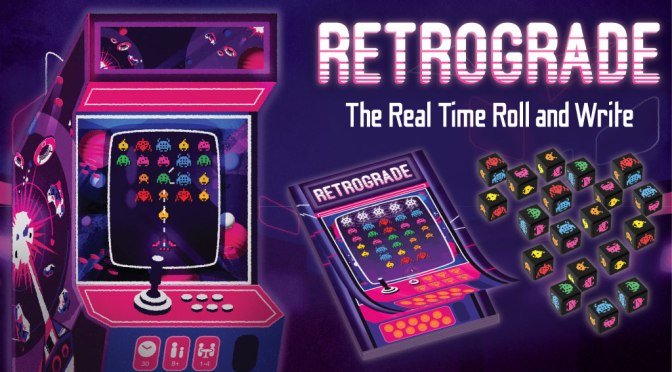
Ah, the soothing beeps and boops and flashing screens of blasting endless waves of pixelated bad guys from outer space. The realm of arcade shooters down through the ages like Galaga? Sure, absolutely, but you’re not likely to find an arcade machine while wandering the booths of a PAX Unplugged. You could, however, find a dice and card game that makes it feel like you did: Retrograde, the real time roll and write game of arcade blasting from Retronym!
Designed by Mary Flanagan and Max Seidman with art by Ann-Sophie De Steur and Spring Yu, Retrograde was successfully Kickstarted in February ’22, and went on to win Best Family Game at the Boston Festival of Indie Games that same year before fully releasing in January ’23.

Retrograde is, simply, a dice and card-based game that seeks to let you capture the experience of an arcade shooter tournament or challenge at the comfort of your own game table.
Each player gets a set of six dice, with each die’s faces being the six different types of AstroDroid – coincidentally, each AstroDroid has 1-6 eyes, so hey, a bunch of extra d6s! This also means that if you lose any dice, you can substitute regular d6s, although they won’t be as stylish obviously. Along with the dice, each player gets a marker and a sheet which looks like an arcade screen with your little ship and all the rows and columns of targets for you to blast. Notably, the sheets will always have the same number of targets, but the types of AstroDroid in any given spot will vary in color and placement depending on the sheet.
Next, Target Cards are dealt. Each Card has two different types/colors of AstroDroid, along with a third aspect that we’ll get into in a moment. When a round of play begins, everyone starts rolling their dice. The idea is to try and get pairs of the same type of AtroDroid. You can keep whichever dice you want to keep, and then keep rolling the rest. When you’re satisfied with your dice, you can then claim one of the Target Cards. Don’t think you can roll forever, though; if you’re the last player to claim a card, you get two more rolls of the dice, and then have to claim a card.
Then it’s time to blast some AstroDroids! You can cross off a ‘Droid for each pair of that ‘Droid type you have, with some rules. Most importantly, the type of ‘Droid you have a pair of has to match one of the two types pictured on your claimed Target Card in order to get blasted; this is why there’s such a rush to finish rolling your dice and claim a card. Secondly, if you want to blast multiple ‘Droids then they have to be adjacent to one another (diagonals count). Once you’re done blasting, you should check a few things. If you’ve cleared an entire column so that the Boss ‘Droid at the top is the only one left, you can cross it off. If you have dice that weren’t used to blast ‘Droids, you can use one of them to claim a trophy, provided the die you use has the same number (of eyes) as the trophy you’re checking off.
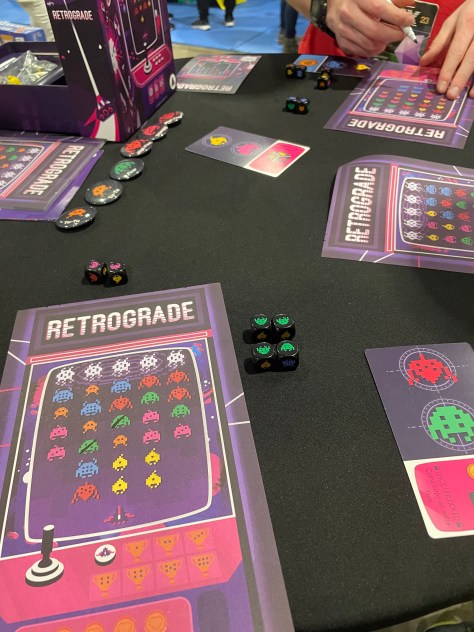
Now, as for that third aspect. Some Target Cards will have a Coin. You can mark them on your sheet, and in future turns during the blasting step you can spend them to duplicate one of the dice you have, potentially leading to extra blasting! Some will have a Comet, which will let you use three matching dice to blast a ‘Droid that’s not even on your claimed Card. Others will have a power up. If you clear an entire row of AstroDroids, you can unlock the power up and use it on all subsequent turns. Notably, you can unlock a power up later then when you cleared a row, so if you cleared a row before getting a power up you can use that as your unlock.
Power ups can range from getting yet another copied die when you spend a Coin to gaining an extra die for the rest of the game to getting extra rerolls if you’re the last to claim a card to using the 1 side of the dice (the one with the yellow, one-eyed ‘Flan Solo’ on it) as a kind of wild card. That’s only half of the power ups available, and if you happen to claim more than one of the same power up they do in fact stack.
Once all of that has been resolved the round is truly over: you draw more Target Cards from the deck to replace the ones that were claimed, and grab your dice for another round!
The game ends when the deck of undrawn Target Cards runs out, and then you can fold over the top end of the sheet to calculate your final score. Each AstroDroid is worth 1 point, each Boss is worth 3, each Trophy is worth 1, and if you got all of the Trophies you get an additional 3 points. In the case of a tie, the player with the largest number of unspent Coins wins! Type, er, write in your initials and then put in some more coins to play again – or rather just reshuffle the Target Card deck and pull out some more sheets.
Retrograde can be played by 1-4 players at a time, with the main difference between the different player counts being the card counts: the number of Target Cards that are discarded before play to leave enough for exactly eight rounds of play, and the number of Target Cards that are available to claim at the start of every round.
Single player mode has a few additional changes, most obvious of which is that you’re simply trying to get the highest score possible, maybe even the maximum of 51 points. There is also a 25 second timer on a device of your choosing to simulate the pressure of playing against others. If the timer runs out then you roll some dice from the box and discard some available Target Cards to simulate having other players having gotten to the Cards first, before making your final rolls and claiming what you can.
Now, of course you’re marking up these roll and write sheets every time you play, so one problem you might run into eventually is simply running out of said sheets. The good news is that your game won’t then become unplayable, because they have print and play sheets available on the resources tab of Retrograde’s website page. The bad news is that those sheets don’t have the neat little fold over bit to tally up your point total at the end of the game, but realistically if you’ve played the 25-100 games of Retrograde you’d need to in order to have to use the print and play sheets I feel you’ll probably know the scoring scheme by rote. One note that was important enough that the booth made sure to make it, though, is to remember not to just print out the first page multiple times, because you’ll lose the ‘everyone has a different screen’ aspect of handing out the original sheets.
—
Retrograde isn’t quite a ‘party’ game that you can play three drinks in, nor is it going to scratch the itch of those looking for a complex strategic challenge. It is, however, decidedly stylish and good, fast-paced fun that can find a home as a ‘with the kids’ game, a starter or side game for a larger game night (or convention), or for when you just want to roll some dice solo and blast some ‘Droids without getting into the arcade machine market. It has an estimated playtime of thirty minutes and recommended age of 8 and up, although realistically speaking I could see both of those being a bit lower depending on who’s playing.
You can buy a copy of Retrograde yourselves for $29.95 (before all that pesky tax and shipping), or you could play it online on Tabletopia.
Incoming AstroDroids! How many can you blast?
Thanks to Retronym for giving us a review copy to check out, and to the booth staff at PAX Unplugged for talking about the game!
 Cannibal Halfling Gaming
3 thoughts on “A Glimpse into the Unplugged Vault: Retrograde”