
Love is strange. Sometimes it finds you at the office. Sometimes it finds you over a cup of coffee.
Sometimes it finds you with a bomb strapped to your heart and an evil maniac forcing you to perform in a fucked-up romantic comedy.
This is that third kind of love. This is Rom Com Drama Bomb, the explosive romantic comedy roleplaying game for three players by Elliot Davis!
Davis has regularly been pinging on our Zine Month/ZineQuest radar for years now, and Rom Com Drama Bomb was actually this year’s entry, successfully fulfilled just recently. The basic premise is that two players are playing the Leads, two characters who should not be in love but who are well-placed for all kinds of romantic tropes to kick in. The third player takes on the roll of a Villain who, for one reason or another, has a hankering for a romantic comedy and has chosen the Leads to be, well, the Leads of their personal real-life version of one.
It’s important to note that the first thing that RCDB talks about after the “What is This” section and what materials you need to play in the first place is On Safety. Let’s be honest, romantic comedies can be… well, a little messed up. As we’ll see there are often weird power dynamics, bad relationship ideas, and other romantic chicanery at play, and Rom Com Drama Bomb adds a layer of the prospective partners being forced into a romance scenario by a big bad. As the game itself notes, “on its surface, it’s fucked up!”
To that end, safety tools like the X-Card, Lines & Veils and Script Change are mentioned, and as rule of thumb if it’s not something that would be in a romantic comedy movie than the Villains wouldn’t want the Leads to be doing it. The notion of assigning a rating (PG, PG-13, R) to the game is raised, and when it comes to tone the game notes that “Rom Com Drama Bomb is a joke that everyone is in on. At every point of play, go for the silly choice over the scary one.”
RCDB uses the playbook method of character sheet, but takes a unique stab at it. For the Leads, playbooks are presented as pairs that embody a specific romantic comedy trope: Just Friends, Meeting The Family, The Big Day, Climbing The Ladder, and The Bet. Each playbook will list out some touchstone rom-coms for reference purposes, what kind of time frame the game will taking place over, and then the two distinct characters. For instance, The Bet (10 Things I Hate About You, She’s All That, How to Lose a Guy in 10 Days over the course of a month, a semester, or a year) includes The Con who has made the eponymous bet (“for a friend, for a job, or because it’s the 90s”) that they can romance the Mark, who hasn’t been one for dating but is now suddenly getting a lot of attention! Just Friends (When Harry Met Sally, 13 Going on 30, Just Friends, No Strings Attached, over the course of weeks or months)? One player will be the Flirt (which you do, sure, but you’re just friends, right?), and the other will be the Hurt (suppressing feelings, big or small, but they must know how you feel, right?).
The third player (who, while not technically a GM, will be responsible for a certain amount of scene-setting) plays the Villain. While the Leads are only broadly defined, the Villains are all distinct characters with their own baggage and their own motivations for trapping the Leads in a rom-com scenario. A.C.O.D. (Anti-Christ of Divorce) is the unholy offspring of an angel and a demon who have just revealed that they’re getting a divorce, and A.C.O.D. isn’t handling it well. Neither is Dr. EVOL, although in their case it’s because they aren’t over their ex, and they’ve decided to use their mad science to make it everyone else’s problem.
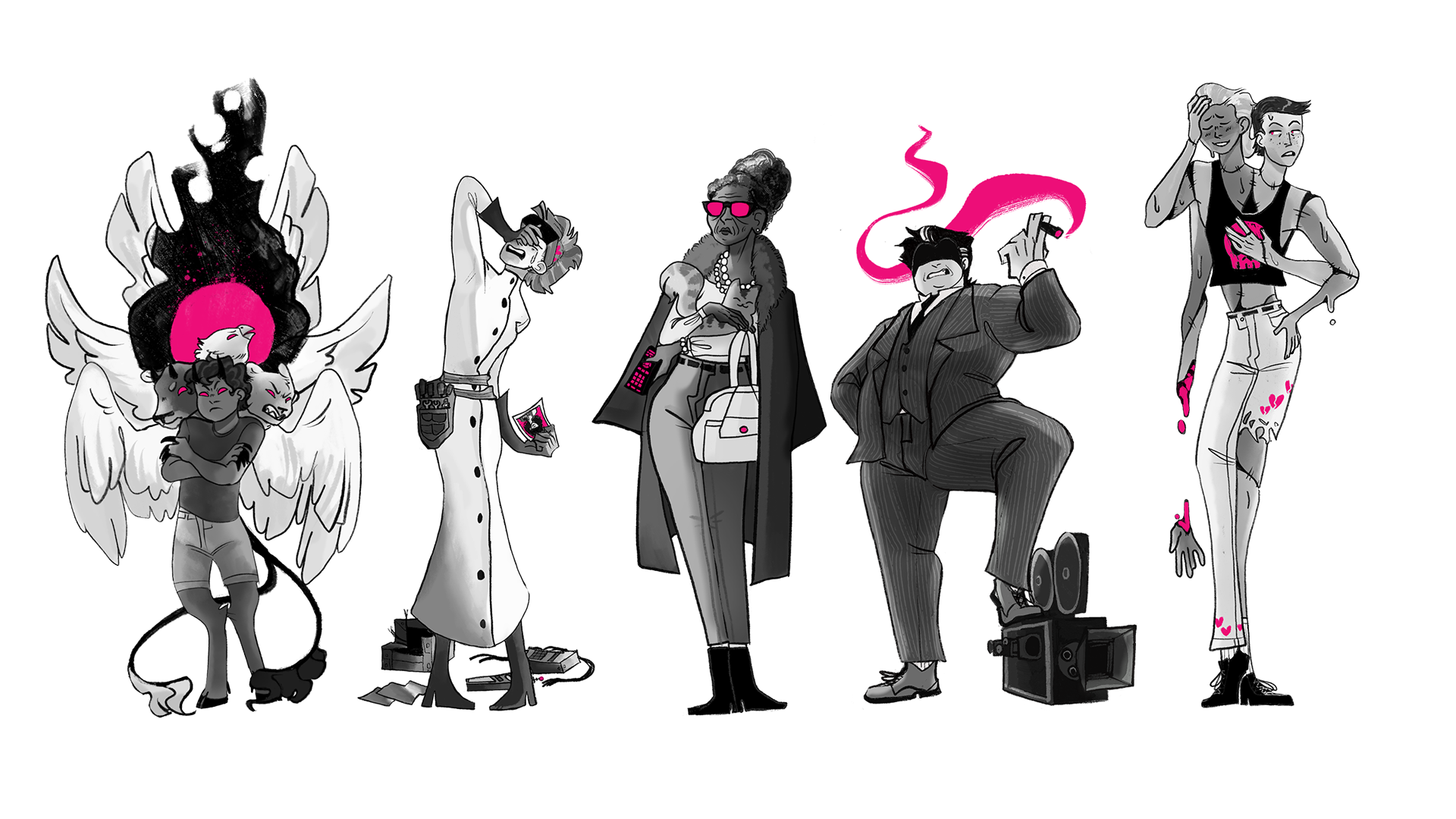
Citing No Dice, No Masters (aka Belonging Outside Belonging) and Yazeba’s Bed & Breakfast as mechanical inspirations, all of these characters share a few mechanical traits. From NDNM, Leads and Villains each have moves that either gain them tokens or require spending tokens in order to perform them in the narrative; in RCDB, these are referred to as ticks and BOOMS respectively. For example, The Big Day’s Betrothed could gain a token by distancing themselves from the other Lead and spend one to define a new detail about the wedding, while The Objection could gain a token by talking about the big day with feigned enthusiasm and spend one to let their feelings show. Meanwhile all Villains gain a token while ranting about their favorite rom-com and could spend two to change something about the setting. Villains then have more specific ones, like Dr. EVOL gaining a token by going into excessive detail about one of their inventions and spending one to give unwanted encouragement to the Leads, or A.C.O.D. gaining via whining and spending to share an awkward detail about their parents out of nowhere.
These examples aren’t even exhaustive within the boundaries of each playbook’s ‘basic’ moves, but we’ll cover a few more specific examples shortly.
From Yazeba’s, RCDM pulls the use of tracks, and there are quite a few of them. Each of the Leads has two tracks, one for Love and one for Freedom. The Villain, meanwhile, has one track for Entertainment and one for Evil. In broad strokes, these stand for the following: Love (one of the hardest to resolve) is for the Leads actually falling in love, Freedom is for the Leads breaking free of the Villain’s scenario, Entertainment is for the Villain enjoying the show the Leads are putting on for them, and Evil is for the Villain’s plan going wrong and them reacting… badly to how the Leads have been behaving. How these tracks get filled is pretty variable – there are playbook moves that will fill your own tracks, playbook moves that fill another character’s tracks, and then milestone points throughout the game that can fill tracks depending on what’s been happening.
Although it’s not called out as an inspiration, RCDB at least tapped into the same part of the Great Cosmic Creative Weave as Alice Is Missing, because this is all happening on the clock. Appropriately for a game with its protagonists rigged to die, RCDB operates on a timer. There’s no soundtrack (although there is a theme song), and it covers broader acts over specific card draws, but it does last 90 minutes. There is some advice in the book for ditching the timer or altering it, but by default the game is going to consist of three Acts, each with two scenes, each scene being at most 15 minutes long.
Act 1 consists of the Meet Cute/The Setup and a Turning Point, Act 2 Raises The Stakes or has characters Coming Together before a second Turning Point, and Act 3 sees a Crisis/the characters Coming Apart before resolving with either a Joyful Resolution or a Crushing Defeat in the last five minutes. Characters gain additional ticks and BOOMs depending on which Act they are. The Flirt can remind the Hurt that they’re just friends as a tick in Act 1. Dr. EVOL can perform a BOOM in Act 2 by using the MOOD-SETTERINATOR 9000. The Mark can use a tick in Act 3 to come out of their shell.
An additional interesting twist is that ‘Rom Com Drama Bomb’ isn’t just the game’s title. At the start of every Act each player will roll at least one four-sided die, the Mood Die, and the result will determine their character’s Mood for the Act. ‘Rom’ is open to love and possibility, ‘Com’ is leaning into the absurdity of the situation, ‘Drama’ is willing to fight/argue/speak your mind, and ‘Bomb’ is breaking free from the guise of the rom-com. These aren’t just prompts, either.
Characters will gain a final tick and BOOM depending on their Mood. The Con will gain a tick for pushing through their guilt and a BOOM for showing another side of themselves (which also fills a spot on the Mark’s Love track) if their Mood is Drama. Meanwhile the Mark will give cold stares as a tick and reveal some truth to the rumors about them as a BOOM (which also fills a spot on the Con’s Freedom track) if their Mood is Bomb. A.C.O.D. has a Rom tick for asking the Leads if A.C.O.D. ‘s mom and dad are getting back together, and a Com BOOM to perform the RITE OF SILLIES to make the Leads clumsy for the next minute (which also fills A.C.O.D.’s Entertainment track).
NPCs that are created by the players throughout the game will also be created with a static Mood, which determine their own tick and BOOM. A Rom NPC will gain a token by sharing with the Leads an anecdote of their own love life, sparing no details, while a Com NPC will gain one by putting themselves in harms way to bring the Leads closer. NPC BOOMs function by spending three tokens once they have them; a Drama one will explain to a Lead a big reason why they shouldn’t be with the other Lead, while a Bomb NPC will go BOOM to get taken out by the Villain right before saving the Leads.
Between each scene, the timer gets paused. This pause serves a couple of purposes (redistributing tokens, making sure everyone is still having a good time, giving the Villain player a chance to think up the next scene’s setting), but mechanically the biggest impact hits the tracks. All the characters have a checklist, basically, and can fill spots on tracks depending on what went down during the scene. Saying the words “I love you” during a scene will fill one spot on your Love track as a Lead, and will actually fill two spots if you meant it. On the other hand, forcing the Villain to break the fourth wall by intervening directly will mark a spot on your Freedom track, two spots if they still failed to stop you. One of the options for filling a Villain’s Entertainment track is if they said ‘awwwwww’, gasped, or laughed at something a Lead did during the scene. These between-scene track fillings are Villain-specific for Evil, though. Dr. EVOL will mark a spot if they learn something new about love, and A.C.O.D. can mark one if a Lead says ‘I’m not your mom/dad’.
These tracks all feed into the multiple endings that RCDB can have. There are a whopping six potential ones for each game session, each one tied to a specific character’s specific kind of track (so there are a total of 30 in the book). Once you’ve reached the final five minutes of the game, you should start eyeballing which tracks were completed, and talk about which ones you can/want to use. Each track that’s completely filled unlocks a Story Ending BOOM, and everyone should agree as to which of the available ones they want to go with, but they also cost tokens (usually 6). A.C.O.D.’s Entertainment ending BOOM has Mom and Dad possess the Leads to explain why everything is going to be okay, and the players give the story a bittersweet ending. Dr. EVOL’s Evil BOOM brings EVOL’s ex into the scene, and the Leads take turns playing them as everyone gives the story an awkward ending. The Flirt’s Freedom track will lead to them appealing to the Villain with a monologue about how friendship is more important than romantic love, leading to a dramatic ending; the Hurt’s Freedom BOOM goes off with them getting the Villain to focus on the other Lead so they can sneak up and strike in a triumphant ending.
The Love endings are the hardest to get; first, both Leads have to have completely filled their relevant track, and triggering the BOOM costs 8 tokens pooled between them, and even there the endings are varied. If the Con’s version of the Love BOOM is chosen, they give a monologue about how they only kept the bet going to be with the other Lead, and if the Mark reciprocates then the bombs deactivate and the Leads give the story a quick but happy ending. The Mark, in turn, would give a monologue for their BOOM about how they don’t care about the bet, they want to be with the other Lead anyway, and if the Con reciprocates the Leads give the story a lovesick ending.
Actually, I should note, you can also get a seventh non-standard game over if the timer runs out and none of the tracks have been filled and triggered, because the bombs (whether they are literal or not) will go off and the Villain will have to wrap things up in the messy aftermath.
Part of the RCDB package is a surprisingly plentiful amount of replayability and flexibility for a game that has such a focused premise. On top of all the different ending example above, none of the Villain playbooks are specifically tied to any of the Leads playbooks, so a game of Just Friends could play out completely differently if the first Villain you play is the mob boss Don Coppola (who is trying to give their daughter a good birthday present), and the second time you play it is Great Aunt Janice (who is holding an inheritance over the Leads), which will be completely differ from playing those same Villains with Meeting The Family.
The game’s biggest weakness, however, should be obvious because it is pretty much baked into the format. I have myself quite a few 3-or-more player board games, and if like me you were quarantined during the pandemic with only your partner and a two year old who is more likely to eat the pieces you figured out pretty quickly that three players is a fiendishly difficult/specific number to get around the table. Solo? You’re fine! Duet? Only need to find one more person! More than that? Groups tend to grow to four or more almost naturally, but a regular group only having three people is a comparative rarity.
Although if you’re part of a three person polycule, hey, perfect date night!
Essentially, though, this is the one part of the game where its overall very high flexibility is just as highly curtailed, presenting a specific kind of scheduling difficulty. The only dial to turn on this one is really the villain X1X2, a mutated combo of both Leads’ previous exes, who for a very chaotic game state could be split between two Villain players. So, at least there’s something!
Aside from a lot of replay value, Rom Com Drama Bomb is a great example of a game that commits fully to the bit and steeps itself in the tropes of the genre it is hoping to let players experience. It can be as over-the-top and ridiculous as any romantic comedy movie… with the same potential for serious confrontations and emotional moments.
Plus, Davis says that the Zine Month offering for 2025 will be a RCDB supplement with the working title of “Dramatically Bombastic“, which will “feature Villains by a number of indie TTRPG designers!” So, this one is going to blow up even more in the relative near future.
If you still need some convincing, you can hear it being played it played on My First Dungeon & queeRPG! You can wire yourself up with Rom Com Drama Bomb at DriveThruRPG, itch.io, and IPR in PDF form for $15; IPR also has a Print+PDF bundle for $25 while there is still time on the detonator (while supplies last).
Love, Freedom, Entertainment, or Evil, and Rom, Com, Drama, or Bomb; time’s ticking to find out what kind of BOOM it will be!
Thanks very much to Elliot Davis for sending us a PDF copy of Rom Com Drama Bomb to review!
 Cannibal Halfling Gaming
3 thoughts on “Rom Com Drama Bomb Review – Explosive Three Player Romantic Comedy”