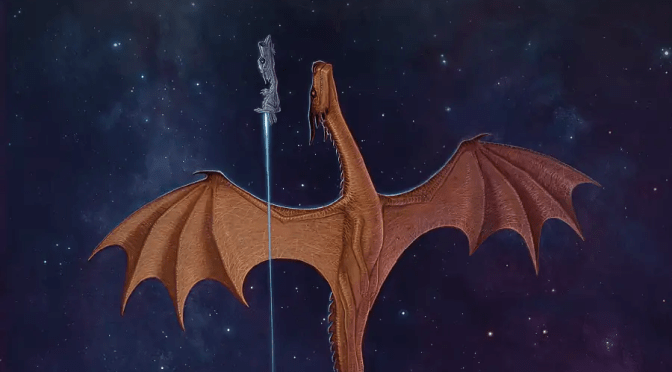
A world, and a mirror of worlds. Atop four giant elephants atop a giant turtle rests Sir Terry Pratchett’s Discworld – where the most dangerous barbarian is an old barbarian, where fleeing your destiny is the surest way to run into it, where a million-to-one chance always works out, where a single humble hero will always win while outnumbered, and where you have to practice believing in the little lies (stories) in order to make the big ones become true (justice, mercy, etc.. It’s been the subject of Roundworld-made roleplaying games before, but sometimes stories like to repeat themselves with a new twist, and this time there’s something of a primer. This is the Discworld Quickstart Guide from Modiphius Entertainment!
In an interesting twist, unlike every other licensed game that Modiphius gets their hands on their Discworld offering isn’t going to be using 2d20. It instead uses its own system, referred to as Narrativium. After all, on the Disc it’s well-known that Narrative Causality isn’t just a theory, it’s a Law. The system frames the player characters as trying to guide the Narrative in the direction they want, typically going against the otherwise unaltered story.
Essentially, everything on a player character sheet is a Trait – even the name is a Trait. Past the name each character has an Organization (The Watch), a Background (A troll raised by loving human parents), two Niches (Loose Siege Catapult, Curious Enough To Make Cats Nervous), a Core (People Aren’t Things), and two Quirks (Beloved by animals despite their best efforts, Two left feet but the heart of a lion). Whenever a player declares an action they need to justify which of their Traits is applicable. Once they’ve done so, the GM determines the Outcome die. If it’s something that’s usual for the character that can be justified by a trait, it’ll be a d10, and if the stars align and everything will be perfect it’ll be a d12. If it’s something unusual for the character but a trait can be justified, or if it’s something usual for them but a trait can’t, that’s a d6. The d4 is reserved for “When a character is so out of their depth the fish have lights on.” Whatever the size of the Outcome die, that’s the one the player will be rolling, and it’ll be going up against the GM’s d8, the Narrativium Die.
The d20 and d100 will also be used, says the Quickstart, but only for rolling on tables, and none feature within the Quickstart itself.
Simply put, If the Outcome die rolls higher, they succeed. If the Narrativium die rolls higher, then the character has failed and they’ll suffer some Consequences. If it’s a tie, then it’s both: the character achieves their goal but also suffers some consequences.
The only other mechanic that players can use is Luck – all of the pregenerated characters in the Guide start with 4 points in it. If a character fails a test, another player can spend a point of Luck to help, making their own Test against whatever number the GM already rolled. If they succeed, hurray! If they fail, though, then they share in the Consequences, which have actually become worse. A secondary use for Luck is lowering the degree of Consequence you’re about to suffer, but you can only do that if you didn’t receive any help – basically, only one Luck spend per declared action.

Now, about those Consequences. They come in four degrees (inconsequential, minor, major, and exceptional), and what sort of degree a character will be facing is decided by the GM at the same time as the Outcome die is chosen. These Consequences, if received, are then expressed as either twists and/or new Traits. Twists are purely narrative – in trying to convince someone you may simply fail to do so, in trying to get information from C.M.O.T. Dibbler you could be fast-talked into talking responsibility for his latest ‘business’, in trying to jump between rooftops you might have a near-Death experience (while he, in turn, has a near-you experience).
Twists are changes or additions to the story, easy enough! The only problem with Consequences is that there’s no advice for the GM on what to do with half of them when it comes to Traits. Some of the examples provided are easy to imagine as narrative prompts for the GM; if you’re Wanted by the Patrician it seems like that gives the GM permission to send Vetinari’s clerks after you whenever it might cause the most trouble. What to do about Headache from confusion or Struggle with only 3 dimensions, though? Personally I’m inclined to infer that a GM should take these Consequence-Traits into account when deciding the Outcome die for a Test, but there’s nothing written about that. I will say that Consequence-Traits offer some interesting opportunities for the players: since Traits in general are presented as not necessarily good or bad, clever players could use Traits that they get from Consequences to their advantage, and given the text I’d say that’s even encouraged.
Now, it wouldn’t be much of a Quickstart without letting you actually start playing, and quickly, and herein we get a reminder that the full name of this game is going to Discworld: Adventures in Ankh-Morpork. “Up In Smoke” indeed takes place in the city of Ankh-Morpork, and is a mystery, so I’ll avoid too many spoilers. In short, there’s been a break-in at Lady Ramkin’s Sunshine Sanctuary for Sick Dragons. This is a problem for several reasons. First of all, there’s been a Crime committed, obviously. Second of all, Lady Ramkin is the wife of Watch Commander Vimes, so he has a particular interest in the case. Third of all, these are swamp dragons, which have an alarming tendency to explode at the slightest provocation, gust of wind, or poorly chosen snack. As your characters are all members of the Watch, these are all now your problems.
The adventure is, in a lot of ways, a sandbox with guardrails. There is a whodunnit, a whydunnit, a whattheydunitwith, and a wheretheywilldoanotherit that you’ll have to stop. However, how you’ll get there is roughly up to the players – you start at the Sanctuary, you (probably) end at wheretheywilldoanotherit, but there is more than one way to puzzle out the path between the two. Multiple locations are available for you to pursue your inquiries, each with their own characters, clues, and potential Consequences. You might only need to visit a few to solve the mystery! You may end up visiting all of them, or even bothering Sergeant Angua on her day off for some help! As Quickstart adventures go I like it a lot; it has tons of character, and seems to strike a very good balance between needing to get people into the action to keep them focused and letting them play around and explore the setting.

Up In Smoke also typifies what the Quickstart describes as the normal method of playing this Discworld RPG; while there will be some rules in the final product for what we would consider campaign play, the game’s ideal is for a series of standalone stories that just so happen to feature a familiar cast of characters. It’s episodic, a series of one-shots that may influence one another and have some overarching character and world-building threads , but each will have its own plot to resolve. Like, for instance, a series of novels written by someone named Terry.
At the end of the day the Discworld Quickstart Guide is light on mechanics (quite the opposite from the last Discworld RPG; I sense a future System Split article) but heavy on intent. The basics of the Narrativium system seem to function just fine, but there are some things that could use some more advice for the GM, and it definitely feels stripped down. This is also not a Quickstart that gives you material or ‘what’s next’ prompts for continuing to play the game to gain further experience with it. However, it spends quite a bit of word count on setting expectations, discussing both what kind of game this wants to be and quite a bit of detail for the small slice of A-M that the adventure takes place in. Someone new to the Disc is likely to have a pretty good idea what kind of world they’re getting into, and what they’ll be doing in it.
One of the problems with licensed games, not the only one but in my opinion probably the most insidious, kicks in when it comes to answering the question “why does this game exist?” For far too many licensed games the first and sometimes only answer is ‘to maximize a property’s profits’. Making money with games obviously isn’t a problem, designers need to eat the same as anyone else, but when it’s the only reason that a game gets made… I don’t know, you can feel it, and it doesn’t feel good. That’s not the impression that the Quickstart gives me, though. The expository writing, the tone and details of the adventure and the characters, and the foot notes are conveying to me that this isn’t a cash-grab, but that the team behind it are enthusiastic and truly care.
You can get the Quickstart for yourself for free. The Kickstarter for the full game launched On Tuesday, and to the surprise of no one it’s already reached its funding goal and started chewing into stretch goals. It seems to be resisting the urge to engage in scope creep (the game is strictly about Ankh-Morpork, and other parts of Discworld are reserved for potential future projects), which is good. It started with a limited amount (who doesn’t like some custom dice, after all) of chaff and tchotchkes that would only serve to look pretty and drive up the price tag, although now that’s blown past a million dollars there are a few more frivolities being added like a Watch badge.
I’ve seen optimistic quickstarts lead to underwhelming final products before, and we’ll have to see which leg of the trousers of time this one truly falls down, but they’ve convinced me to be hopeful.
I DO HOPE THEY MANAGE IT.
 Cannibal Halfling Gaming
One thought on “Discworld: Adventures in Ankh-Morpork Quickstart Review”