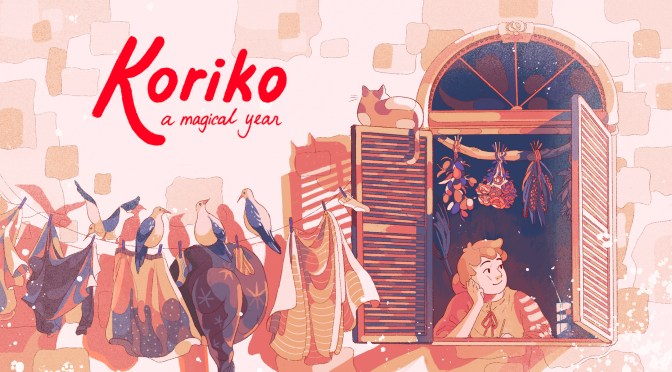
Check out part 1 of this Solitaire Storytelling here.
After more writing and more adventures, I’ve concluded my playthrough of Koriko: A Magical Year. The story I created, of Lapis, a witch-in-training who thinks she’s boring, ends up telling a pretty fascinating coming-of-age story. Lapis discovers how much bigger the world is than her village, how much deeper magic is than what her grandmother taught her, and how weird, wonderful, and sometimes terrible other people can be. All of those experiences and trials are filtered down from 65 pages of handwritten entries into seven letters home. Just like before, what the letters don’t tell is often as important as what they do…as the confession in the last letter so clearly broadcasts.
Autumn
Yarrow,
Autumn is a strange time. The youngest in the city go to school, but I am not one of them. I feel like a child, but society and the spirits know better.
I’m getting real opportunities to stay in Koriko, to hone my craft, to be a real witch. I wanted to tell you now because I haven’t made my mind up. I used to believe I was a boring kid, but I was in a quiet place. This new version of me is so different.
I still want to be a kid in some ways, but things here make me feel like I’m growing up. And I’m a different grown-up than I thought I would be. When I know what I need to do, I will let you know. For now, tell my parents and everyone at home that this is the best thing that ever happened to me.
Lapis
Winter
Yarrow,
As I’ve seen a full year in Koriko, I know I can’t really forget the city. It’s just like I couldn’t forget Brod either, but there’s so much more here. I couldn’t possibly imagine a place like this without all the people and the spirits. And no, not all the people are good…but you must take the good with the bad.
I always remember winter first being dark and cold. Here, I got to join hands with friends and light lights and scream into the darkness. It might not be unique to the city, but I feel less alone here. I feel like I’ve been here long enough to grow but also to stumble. I can’t lie, winter here was really hard for me. But, hard as it was, it seems closer to who I am. I will write you again soon to tell you of what I need to do.
Lapis
Year’s End
Yarrow,
I suppose it will not surprise you that I’m staying in Koriko.
This year has taught me so much. I’ve become a spirit caller, a tradition related to but not exactly what you taught me. The nature of spirits is so different here, if I were to return to Brod I’m not even sure what I’d do.
One of my friends is a boy named Francis, who had called a monstrous spirit to help him fight his bullies. Through my skills I helped calm the spirit and later helped rehome it, and now Francis is no longer monstrous. There are others. I was taken under the wing of an up-and-coming great bard named Aurora. We grew very close…
…Aurora is my girlfriend now. I know that’s not traditionally accepted in Brod, but it is still how we feel. While it’s not the only reason I don’t feel like I can come ‘home’…it’s a significant one.
The things that exist for me here in the city are unlike anything I’ve had the ability to experience anywhere else. The people, the spirits, the buildings, the institutions…this place has opened my eyes to what the world contains. I can’t go backwards, and as such I can’t go back.
Send everyone my love. If they can understand both what I want from life and who I love in that life, then I will be sure to visit soon.
Lapis
One reason that my letters are so relatively short (they’re still 250-300 words apiece) is that I handwrote my entire game of Koriko. I think journaling, like physically journaling, a game like this adds to the experience, but I haven’t written longform at length since college and my hands were hurting after most sessions of the game. If you want to get more longwinded, feel free to set everything up in a Google Doc. That said, given the length of the letters my volumes came out to somewhere between 800 and 1200 words apiece, so I handwrote somewhere on the order of 5-7000 words. Ow.
While the length is the primary reason I didn’t include the entire playthrough in these articles, my writing also became rather intimate as I played, as the final letter may imply. I enjoyed writing this story with an overt romance, and there was also a fae manifestation of the city which was a whole big allegory for Lapis discovering things about herself as she discovered things about the city. As much as themes of identity and sexual awakening are de rigueur in YA, I found myself not wanting to share mine. Although that means I share less writing about the game, it also means that I can tell you how the game wormed its way in my head so well that, like a personal journal, I didn’t want to share my fictional one either.
Last time we talked a bit about the mechanics, the Volume building, the dice tower and the Lessons mechanic. This time let’s talk about the prompts. As I mentioned before, in your tarot deck the suited cards will be prompts and the major arcana will be confidantes. The first time you meet a confidante, you complete an introductory prompt which also guides you to add elements to your map of the city. These aren’t locations, per se, more like sparks which shape your perception of different parts of the city. After meeting your confidante, their card isn’t discarded; rather, you take it and add it to your Circle, a separate pile just for confidantes. When you build later volumes, you will have the option to add confidante cards back into your Volume deck to encounter them again. Each confidante has a number of Hangout prompts, scenes that focus on your character and their confidante. After three such prompts, you trigger the Crossroads prompt, a final prompt where you make a decision that will cement the relationship you have with this confidante. This will also be the last time you can draw their card.
Now, the math of a playthrough shows that you have to be aggressive to get to Crossroads: There are six Volumes of play with confidantes in them (Departure doesn’t have a Volume deck), and Crossroads will always be the fifth draw. That means that reaching Crossroads for your confidantes is difficult, and reaching it for confidantes you meet after Arrival will be nearly impossible. There are ways, though, and that relates to some of the other mechanics around prompts.
The actual prompts tied to the suited cards are decent; while I did skip one for making little sense for the character (it was towards the end of the game and just contradicted too much of what I established), I generally thought each prompt provided something solid to work off of. It’s also interesting that the mood of the prompts is heavily dependent on the suits, so as you get to later Volumes and have one dominant suit, it’ll really color the season. The mechanic that I think really makes the prompts more interesting, though, are the Twists. Each Volume has a 4×4 grid of Twists, simple sparks/ideas for you to make the prompts more unique. You also pick a Twist for scenes with confidantes, and when you use a Twist you mark it off. Once you mark off a full row or column of Twists you get a bonus, as I mentioned last time. These bonuses include adding new confidantes, taking dice off of your tower (to make stacking easier), and, especially in later Volumes, the option to put a confidante from your circle on top of your Volume deck and play another card. If you take this option, having already played the confidante and returned them to your circle once that Volume, you could conceivably get two scenes with a confidante in one season. If it’s important to you to get that Crossroads with a key confidante, you may just do this. I reached a Crossroads with two of my confidantes, the two I mentioned in the last letter. Aurora (Major Arcana: The Star) was clearly becoming an intimate of Lapis early in their friendship, which is one reason the romance angle came up. Francis (Major Arcana: The Moon) ended up being a more straightforward tale of girl and werewolf, but it was fun to write and I wanted to get to that last scene where Lapis would cure him.
The last prompt modifier I want to mention is the dice tower. As I noted before, you’re stacking dice when ‘risky’ prompts or ‘risky’ Twists are selected, building the tower ever higher until it collapses. Every time you successfully stack you get a lesson, so between that and needing at least two risky Twists to get your bonus, there’s plenty of incentive to stack. You can even get a special confidante if you stack 21 dice, which…how? Maybe I needed larger dice. Clearly I had a few collapses in my playthrough. What happens then is rather neat. After your tower of dice collapses, you count up the faces of the collapsed dice, and modify your prompt with the one of the six Consequences that corresponds to your most common result. It’s the only ‘roll’ in this game but it means you don’t really know what’s going to happen in a prompt with a dice collapse until you get all the way through the mechanics.
I am very happy with the time I spent playing Koriko: A Magical Year (my right wrist is less so). The interplay between prompts and confidantes helped me write a story and inner world I would have never come up with on my own, and the recurring confidantes really enabled a few deeper relationships, even ones that didn’t always end well. While I think all journaling games require you to want to write, Koriko also stimulated my more typical RPG side, with the Twist, dice-stacking, and deck-building mechanics all creating significantly more engagement in how you steer the story. I’d highly recommend playing Koriko: A Magical Year, and even though my wrist kind of hates me for it, I’d even recommend playing it longhand.
Koriko: A Magical Year is available from Mousehole Press and on itch.io.
Like what Cannibal Halfling Gaming is doing and want to help us bring games and gamers together? First, you can follow me @LevelOneWonk@dice.camp for RPG commentary, relevant retweets, and maybe some rambling. You can also find our Discord channel and drop in to chat with our authors and get every new post as it comes out. You can travel to DriveThruRPG through one of our fine and elegantly-crafted links, which generates credit that lets us get more games to work with! Finally, you can support us directly on Patreon, which lets us cover costs, pay our contributors, and save up for projects. Thanks for reading!
 Cannibal Halfling Gaming
I really hope to get to Koriko this year. I also want to hand write out my letters and journals, just for that immersive experience and using the game to really step away from reality. Thanks for sharing your experience!
LikeLiked by 1 person