
Welcome to the Cannibal Halfling Weekend Update! Start your weekend with a chunk of RPG news from the past week. We have the week’s top sellers, industry news stories, something from the archives, and discussions from elsewhere online.
Monthly Archives: September 2025
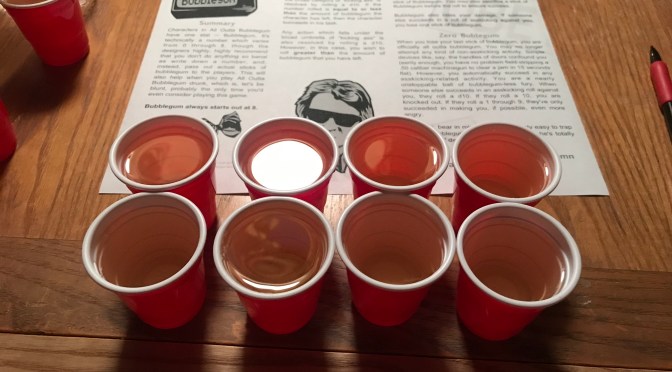
My gaming group: A twentieth anniversary review
September of 2025 marks the twentieth anniversary of my current gaming group. Yes, you read that correctly. While I’m not sure of the exact day, twenty years ago either this week or last week I met with five other nerds in the study room of Carnegie Mellon’s newest freshman dorm, New House (which has since been renamed). The organizer, my friend Dan, had swiped the mailing list from an event run by the university’s chapter of White Wolf’s Camarilla Society; he decided that while he wanted nothing to do with a Vampire LARP, he met some cool people at their D&D one-shot event and would want to play D&D with them. We all decided that yes, we’d like to play D&D, and from there we were off. Three more people joined over the next couple of semesters, a lot of games were played, and we were a close-knit group until graduation in May of 2009.
Continue reading My gaming group: A twentieth anniversary reviewWeekend Update: 9/20/2025
Welcome to the Cannibal Halfling Weekend Update! Start your weekend with a chunk of RPG news from the past week. We have the week’s top sellers, industry news stories, something from the archives, and discussions from elsewhere online.
Continue reading Weekend Update: 9/20/2025
System Hack: Colony Sim Cortex Characters
Characters are the key unit of play in any RPG, and our system hack is going to be no different. For a game modeled after RimWorld, though, we’re going to have to strike a balance between emulation and ease of use, especially considering how many characters may be at play.
Cortex Prime allows for a range of different options for modeling characters, collectively called Prime Sets. Different combinations of Prime Sets lend themselves to different genres, and each one has different rules mods that can be attached to it. Only one Prime Set is required, Distinctions, but luckily it works well for certain traits within the RimWorld framework.
After some consideration, the two core Prime Sets we’re going to use outside of Distinctions are basic ones, Attributes and Skills. Attributes may not be directly used in RimWorld, but giving each character a rating in Physical, Mental, and Social can also be used for stress tracks, recreation type preferences, and other underlying RimWorld properties that wouldn’t fit with other Prime Sets. We’re also going to look into Resources and Relationships, Prime Sets that will be important for the game but perhaps limited at character creation.
Continue reading System Hack: Colony Sim Cortex CharactersWeekend Update: 9/13/2025
Welcome to the Cannibal Halfling Weekend Update! Start your weekend with a chunk of RPG news from the past week. We have the week’s top sellers, industry news stories, something from the archives, and discussions from elsewhere online.

Big groups, small games
For the most part, the ideal size for a gaming group is five, four players and a GM. This is driven by group dynamics; researchers wrote in the Harvard Business Review back in 2018 that the ideal group size for meetings is between five and eight, at least if the point of that meeting is to have a productive discussion and get things done. Roleplaying games skew to the lower end of this mostly just due to the fact that in addition to the actual ‘meeting’ of a game, there is also the need to manage that many characters, their contributions, and their stories.
Ideal doesn’t mean only, and an experienced GM can run games anywhere in that 5-8 range without too many problems, at least as long as they’re realistic about how long things will take. More and more, though, games are being written towards a specific group size, usually a smaller one. In some cases it’s obvious, like Fiasco: the number of turns in the game, and therefore the amount of time the game will take, is directly proportional to the number of people playing, and even playing with five people, the maximum number recommended by the rules, the game begins to sprawl and the story begins to sag. In other cases, the restriction comes from a clear place, but the question hangs in the air about how to subvert it. A good example of this is DIE: There are six roles, six dice. That’s how many there were in the comic, therefore that’s how many there are in the game.
Continue reading Big groups, small gamesWeekend Update: 9/6/2025
Welcome to the Cannibal Halfling Weekend Update! Start your weekend with a chunk of RPG news from the past week. We have the week’s top sellers, industry news stories, something from the archives, and discussions from elsewhere online.
Continue reading Weekend Update: 9/6/2025
Crowdfunding Carnival: September, 2025
Welcome to the Crowdfunding Carnival for September! We’re seeing the post-GenCon movement begin, and several of the big publishers are starting their engines up again with new campaigns. At the same time, there are a number of good indies out there which are worthy of your attention. Let’s get to it.
Continue reading Crowdfunding Carnival: September, 2025 Cannibal Halfling Gaming