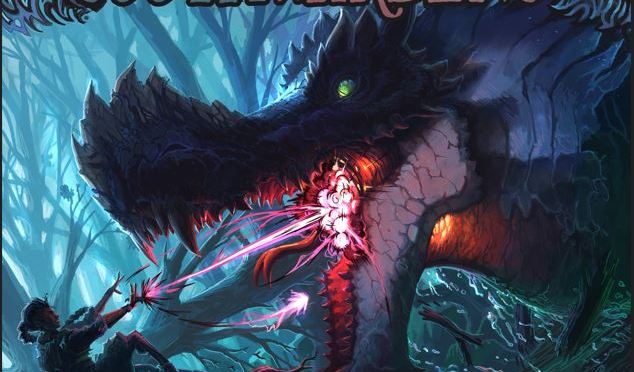
“A Warden with a Link is starkly aware of where their partner is at all times. It is like knowing your hand is at the end of your arm; there when you need it. But it is also the ache in your heart, the lump in your throat, and the tingle in your back as a fight approaches.” When monsters from beyond reality are hunting for human souls, you don’t need Luck. All you need is a partner, Linked heart and soul to you by powerful magic, and a willingness to risk it all knowing they have your back and you have theirs. This is Soothwardens by Navaar Seik-Jackson!
Published by Plus One Exp, Soothwardens has three overarching claims to greatness: there’s an interesting world to explore, there are epic fights and emotional connections, and there is no randomness.
The world of Nyobekeer is, by some definition, a post-apocalyptic one. Here, let me grab a quote to help with the worldbuilding.
“Three thousand years ago, the planet looked much different. Large continents spread across vast oceans, giving shape to a wide variety of peoples, wildlife, and landscapes. Then, the Cascade came. Vibrant green meteors crashed down in overwhelming numbers across land and water. Mages, and colossal planetary guardians, called Omirim rushed out in eight directions to save what they could. While tidal waves of earth and sea crashed against their magic, they pushed, driving the land from behind them out into a ring to combat the onslaught. The dust of the shattered and burned meteors drove through their barrier, mixing with the magic and washing over them. As their gigantic forms began to petrify, the Omirim sang out in a funeral song. This song, this dirge, reshaped the world to save the small humans that were left behind.”
That re-shaping left the known world as a ring of mountains that reach the clouds around a central ocean, with the inhabitable bits largely between the mountains and the water. As one might imagine that left the fauna of the world pretty different in the process, something humankind had to adapt to, but the more dangerous change was that monsters started getting in.
Entering the world from another reality through Breaks, the aptly-named Breakers stalked humans and devoured their souls before bringing them back to the Breaks, from which there is no return. For a while there was nothing that could be done – normal weapons had no effect and humans didn’t have any magic. However, eventually two people heard the Omirim. By visiting each of the massive statues and gathering pieces of them they were able to create form-shifting weapons known as dirges, and Link their souls together. So the first Wardens of Reality, the Soothwardens, were born. Using the dirges and their Link, the Soothwardens are able to fight the Breaker here in reality while sending one of their number into the Break to fight the enemy at the source.
Nyobekeer is explicitly a non-colonial world – nobody is building any empires or rampaging all over the place. You still have the day to day problems and issues of being a human being with emotions having to live with other human beings with emotions, sure, but for the most part people value life and community and don’t see the point of denying anyone of either. Soothwardens aren’t cutthroat adventurers in it for coin, they feel called to help people – there is a Reputation mechanic, but its effect is how well-known the Soothwardens are and how quickly and easily people will jump to help you, not how likely they are to stab you in the back or charge you extra (there’s no official currency anyways).
There are thirteen regions in Nyobekeer, mostly around the ring of mountains and Omirim with a few island regions in the internal ocean, each with a pretty distinct environment, culture, and language. One example is Cair, a region of forests and massive lakes with giant carnivores, the occasional dragon, and diverse settlements from stone domes to tree villages. Proalfa in the north is mostly former ocean floor with a lot of glacial ice, with nomadic civilizations hunting along its 2000 miles worth of tundra.
So, about that no-randomness bit. Soothwardens uses a system called Luckless which contains no dice, no cards, no bird entrails, nothing but resources to spend and choices to make. Your two biggest resources are Heart and Stamina. Paraphrasing, Heart is your ability to fight and stay in the fight, and Stamina is your overall capacity to remain on the hunt for the Breakers. Each starts with a track of 20 – Heart will primarily be marked in order to sustain supernatural effects, while Stamina will first get primarily marked during the investigation phase and then come further into play during the actual fight. If either track ever gets fully marked your Soothwarden goes down, and death becomes a very real possibility.
That’s right, the investigation phase – Soothwardens will typically arrive on the scene because they’ve heard that a Breaker is in the area and preying on people, but no two Breakers are alike and they’re always going back to the Break to turn in the souls they’ve devoured. So first you need to find the darn thing, and hopefully along the way learn more about it so you can prepare to fight it properly. To do so? Simply spend Stamina. How much you need to spend is determined by how much information you want (and how actually useful it is), with the cost possibly being modified by your Reputation.
Once you’ve found the Breaker that’s gotten through to reality, both Soothwardens mark a Heart, tethering each other via the Link; one Warden will fight the Breaker’s form that you’ve (hopefully) been studying so far, while the other will pass through the Break to fight the Breaker’s other unknown form. At the basic level you’ll be marking Heart to sustain effects in different styles. Power grants force in close combat, Speed can grant additional attacks, Fabrication channels Magick through your dirge, and Range enables long-distance fighting. Speed and Range also combine in a fight to determine your Pursuit Effectiveness (the Breaker wants to get away to find more prey, so if you can’t come to grips with it it’s going to turn the tables on you) and Power and Fabrication are added together to determine your Damage Effectiveness (they’re darn tough; if you don’t hit them hard enough, they’ll punish you for it). Each Warden will have a Paradigm Path, essentially determining their preferred style and which of these options cost more or less Heart to sustain levels of.
The amount of Heart you have left over after you’ve sustained whatever it is you’re sustaining is available to be spent on Battle Actions, both Basic and Specialty. Basic Actions include Attack, Evade, Trap, Pursue, Hopping (between Reality and the Break), Shift (changing the form of your dirge), and Restrain. These have a ‘Latent’ Cost of 2 Heart each, Latent because they don’t get marked, and you can stack as many of a given action as you’d like and have the Heart to spare for. You could also choose to have the Latent Cost only be 1, but that’s a Risky Action that will open you up to more actions from the Breaker. Specialty Actions tend to cost 8 Heart, and involve using magic in a way you didn’t plan for, using an Aspect of your dirge (gained in the first place from Breakers you’ve defeated), or even pulling your fallen partner through the veil so you can flee with them (there’s also a Teleport option, but it’s very expensive and not entirely safe).
So, you choose how much Heart to spend on sustaining, essentially wagering that you’ve committed enough to do the job, choose the actions that you’ll take against your opponent, and the GM lets you know how successful you’ve been. Then you get to describe exactly what that looks like! Then the GM lets you know what the Breaker tried to do (choosing actions for the Breaker to take) and what it actually managed to do (including if it dealt any Harm in the form of marking some of your Heart track). Then, onto the next turn – you can choose to Sustain more things if desired/needed, choose your Battle Actions again, and then on you go.
On top of all of that, you mark an additional Heart at the start of every turn after the first, so this is not a game where you can take your time in a battle of attrition. You need to go all out and defeat the Breakers fast.
The Link plays a pretty big part in the fight as well. Obviously, it lets you engage both forms of the Breaker at once in the first place. Second, it allows Wardens to heal one another across the veil – Stamina can be marked to recover Heart, but it costs less to heal your partner than to heal yourself. Also, since you’re in different realties when you’re fighting, the Link allows you to feel whatever your partner is feeling, both physical and emotional. If your partner is feeling Fear, or Melancholy, or Guilt, or any of the other Conditions they may be afflicted with, then you’re feeling it too. Those Conditions can cause problems during a fight, but by being Linked the two Wardens can encourage one another to Speak the Truth, unburdening themselves of what they’re going through.
As a Quickstart, Soothwardens does what I’d call an okay job. It’s not the kind of Quickstart that throws you right into the action and lets you learn as you go, and some concepts like Pursuit Effectiveness are mentioned in examples of play quite a few pages before they’re actually explained. Working towards Motivations and facing your Fears and succeeding are a way to increase your total Stamina, but no examples are provided. It admits outright that Wardens are a touch on the complex side. That being said, while the complexity and the way it is laid out means you have to put in the reading before play it does a good job of explaining things to you when you do. Did I feel compelled to do some page-flipping trying to find explanations? Yes. Did I find good explanations? Also yes!
It has to be mentioned that by its very nature, Soothwardens has a pair of barriers to entry. First is that like Rom Com Drama Bomb it has a specific (not just recommended) number of players. There is a bit more flexibility with the possible addition of a third member of the Link called a Hopper who can freely move back and forth in a fight, but open to larger groups than a GM and three players (or smaller than a GM and two players) it is not. The second one is that it seems dependent on everyone contributing to the descriptions of these epic fights, so if you’d balk at answering ‘How do you want to do this?’ on every turn I could see that being a problem.
These are, of course, the kind of ‘cons’ that are going to be ‘pros’ if you have a small group and if everyone likes describing cool battle scenes.
So, as an overall game I think Soothwardens is very exciting! It has mechanics that will help create awesome fight scenes with no small amount of tension, while centering character growth and emotional conversations. The world is delightfully unique and refreshing even with the small slice of it we see in these pages, and the lore is interesting with plenty of things to explore based on the basic concept alone.
You can get a PDF copy of the Quickstart here for free to see for yourself; physical versions (that also get you the PDF) will cost you $18 if you’re interested. Of more time-sensitive interest is that the full version of the game is on BackerKit as of this writing with mere hours to go – the full 200+ PDF is in a $20 pledge level, and the softcover+PDF pledge level comes in at $40. It’s managed to reach its funding goal in the final push, so it’s a safe bet!
The opening bars of the Omirim’s dirge are good ones – I think the full song is going to be even better.
Thanks to Tony from Plus One Exp for putting me on to Soothwardens at PAX East 2026!

