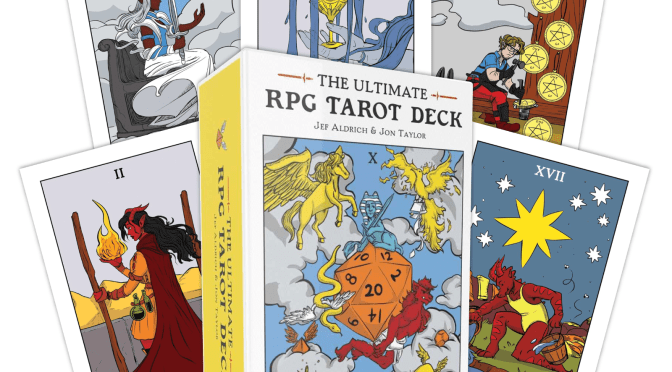
The cards, the cards, the cards can tell, the past, the present, and the future as well… provided you can actually read them. Tarot decks are seeing increasing use in tabletop roleplaying game design, from pure oracles like in Tangled Blessings to full-on challenge resolution like in To Change. In many cases the games provide pretty good prompts and details for what a given card means, but I’ve often seen them limited to just the major arcana, or suggest the players can be inspired by the card’s art to help interpret things. For those unfamiliar with tarot (it’s me, I’m talking about myself), that can be a bit of a challenge. Enter the Ultimate RPG Tarot Deck from Jon Taylor and Jef Aldrich!
Yup, those are the System Mastery guys again. Based on the Rider-Waite Tarot deck, the Ultimate RPG one has the full 78 cards, 22 Major Arcana (each one being unique) and 56 Minor Arcana divided equally between the suites of Wands, Cups, Swords, and Pentacles. Each card is illustrated by Zachary Bacus, with colors by Angueria “Hank” Jones.

In addition to the card’s art and traditional name, each also has a little epithet or concept at the bottom. Examples include the Three of Swords’s ‘Critical Damage’, the Four of Wands’s ‘Victorious Heroes’, and The Devil’s ‘The Grognard’. This gives each card an added bit of prompt material or just plain fun flavor text.
That’s all well and good, but for someone who doesn’t know what they’re doing with a tarot deck (me, again, it’s me), it pretty much leaves things at square one. Square one with some really good art and a small prompt, so I am better off, but not by too much. Enter the booklet, which is what really makes all the difference.

A small but robust little tome, pictured above surrounded by more cards from the deck for reference, the booklet assumes zero experience and starts off with the basics of using a tarot for things like readings: getting in the right head space, the different spreads you can deal tarot cards out into and what they’re useful for, that sort of thing. Doing things quickly? A single card will do. Want to consider the past, present, and future? Three card spread! Don’t have a specific question or situation in mind? Break out the ten-card celtic cross spread.
Then there is a short bit about how to bring tarot into your games for things like making decisions in and out of character, providing inspiration, and even resolving challenges. Ironically, there’s not really any mention of what I would consider the main use of Tarot in RPGs, that being the main prompt-based mechanic of a game. Finally, the rest of the booklet is about the cards themselves – every single one!

Each card has at least one page dedicated to it – Major Arcana get two, so one can focus in on the art – and each is packed with information on how to interpret the card. The Major Arcana include something of an overview of the card’s concept, and every card’s page includes a paragraph each for the meaning behind drawing the card Upright or Reversed, along with some one or two-word themes associated with the card in its given state. The card’s page will then end with RPG Keywords, anchor points for the card to attach to specific concepts or themes in the RPG world.

This is it! This is exactly what I needed to get a handle on using tarot, especially for those ‘main prompt-based mechanic’ games I’m interested in, even though the Deck never calls them out.
My single biggest critique of the Deck is a familiar one when it comes to other offerings from the Ultimate RPG line, like the Backstory Guide: the genre flavor is distinctly fantasy-based, and specifically the megacorp giant lizard and underground prison subgenre of fantasy. The back of the box is very honest about this! Aside from the art being in that genre, some of the card epithets and RPG Keywords are very specific, especially the spell ones like ‘Create Water’ for Temperance. If your game isn’t a fantasy one, or D&D-esque, then the vibes might be a tad off. However, none of that changes the effectiveness of the paragraphs providing guidance on the interpretation of a card, so the useability of the Deck remains quite high.
For the experienced tarot aficionado the Deck is ultimately (heh) ‘just’ a pretty good tarot deck with some good humor, worth the money if you like a giggle and particularly if you like the art or want something with a specific TTRPG flavor to it. For those who are just looking to draw their first card, or better understand what they’re doing as they dive into the increasingly deep pool of tarot-using games, the deck and specifically the booklet is an excellent resource and I highly recommend it.
The Ultimate RPG Tarot Deck is published by Simon & Schuster, at the list price of $24.99, and can be found directly from there and all over the place otherwise. If you happen to be in the Greater Boston Area though, might I suggest where I got mine, Side Quest Books and Games?
Suffice to say, you can expect some tarot-powered Solitaire Storytelling entries in the near future!

