For years I have served my Master faithfully. A loyal companion, I accompanied my Master through the difficult times, and the good times. Now, I am called in a moment of dire need: a Stranger has challenged my Master to a duel, alluding to time before me. My Master rises to the challenge, calling me forth. This is my moment. I have trained for this. It is time to do my Master proud.
My Master gives me the command:
I will, of course, obey. After all, I am a Good Dog.
Specifically, I am a Good Husky, and my name is Anvil. Master Roy works as a blacksmith, and keeps me by his side to guard him and his household. He walks with a cane, and I gladly slow my pace to walk beside him. He is often visited by a woman named Lyn, and they drink tea together. A retired swordsman, I know that he has never touched his blade since I came to live with him, although he has shown me where he keeps it for just such an occasion as this. He is a Good Master.
Depart – Site of Challenge
We were at my favorite place to spend time with Master Roy – a cliff above the village, letting us look down over it and the sea. It takes a long time to reach the bench here, with Master Roy’s limp, but the view of the sunset is always worth it.
The Stranger, dressed in odd robes I do not recognize and carrying an unfamiliar scent, came up the path not long after we had arrived. They drew their weapon, a straight single-edged blade with a sphere of obsidian for a pommel, and called out.
“Roy! I have come for the blade! Surrender it, or your life as well!”
Master Roy gave me the command, but before I could move to obey the Stranger said something else.
“Don’t think its magic will let you commit another murder here.”
Looking up, Master Roy looked discomfited. I nudged his empty palm, prompting him to scratch my ears absent-mindedly, before dropping down and rolling over and looking back up with a sharp bark. Master Roy looked down and smiled, before looking back at the Stranger and saying:
“If we cross blades, it will not be the magic that kills you, nor even I. You will be the architect of your own end.”
With another bark, this of agreement, I was off.
Depart – Site of Significance
The path that Master Roy and I take is a long, somewhat meandering one, but this is something of an emergency, so I choose to take a shortcut. It is not one I would usually be allowed to take, even if Master Roy moved quickly – I have sniffed at the edges of it before, curious, and been reprimanded.
There is an abandoned battlefield, somewhat tucked away between the rising earth that leads to the cliff and the village. Banners of a fallen empire, or so the villagers say, are strewn throughout.
As I pass through, stepping around shattered weapons and rusty armor and more than one set of bones mostly-hidden in the grass, I get a better look at some of the banners. Most are of the curling sea monster that they say is of the empire, but on one there is a different symbol. It depicts a running hound, on a pole that is stabbed into the ground – propped up against the pole is a suit of armor…
Just as I go to sniff the armor, however, one of my paws taps against its boot and the entire things collapses to the side – the pole rattles, and the sparse threads still holding the running-hound banner tear, sending it fluttering off into the distance. I watch it go with a small whine before looking back the armor.
I’ve seen that symbol before, on a piece of cloth tucked away between books on master Roy’s shelves. And the armor is empty, and about my master’s size, and one of the greaves looks like it was partly caved in, and… Master Roy walks with a cane?
Depart – Site of Connection
The first building I encounter upon reaching the village is the tavern that Master Roy always stop at on the way home from our walks, The Dredged Treasure. The bartender always has the latest gossip about both our fellow villagers and travelers from the road; he often talks more at Master Roy than with him, but he always has a few scraps for me.
“Ah, Anvil! Good to see you, boy. Here without your Master, eh?”
The bartender puts down a plate of scraps, and I start to wolf some of it down – I’ll probably need the strength to get the blade back up to the cliff. The bartender then nods to a patron sitting at the bar, one of the fishermen.
“That Roy has some sort of visitor, was asking after him. I think it’s some sort of warrior business, the visitor didn’t look like he needed anything forged. I wonder… the sword came out not that long ago. Wonder if it’s gonna-”
I look up and give a sharp bark, displeased that my Master is the one being gossiped about. The bartender looks back down at me and nods, looking chagrined.
“Sorry Anvil. Fair enough, I’ll ask him to his face next time he’s in.”
With a growl and a snort, I turn for the door, leaving most of the scraps behind – I need to be moving faster.
Obtain – Site of Protection
Master Roy told me where to find the blade before I left, but I have never actually accessed this part of our home before: a metal vault behind the painting of flowering grasses in the hallway, with three combination locks. I recall long hours watching my master work at the forge, and sitting besides him at the cliff as he idly tapped his cane on the ground. Three patterns, repeated over and over again, hummed along to like some sort of marching song. I try to remember them as best as I can, scratching away at the combinations with my paw to turn the numbers, but it’s difficult going.
I am loyal to Master Roy. I know he is loyal to me. But it occurs to me that the song he was humming is not one I know, not something he shared, and I am bothered by the knowledge that our mutual loyalty does not necessarily equal knowing and equal sharing. I think I will never forget that.
I do manage it eventually, though, and the vault swings open, and I reach for the blade. However, I cannot help but notice that there is no dust in the vault, nor upon the blade. And yet Master Roy has not touched the blade since I came into his service…?
I have reached the blade, my quest is halfway past… but just as I have changed, so too will my return journey.
Obtain – Site of Protection
My master’s blade is a claymore with an ironwood blade, with braided branches for a cross guard. This is my first time seeing it. The leather on the grip looks well worn with use, but the entire weapon is well-kept and the blade looks sharp. It smells of fresh forests, and I cannot help but think that Master Roy must have spent much of his time in places that smell like that.
As me teeth close around the grip, a presence suddenly meets my mind.
“I am the Petrichor Blade, reforged in the blood of tyrants! You are not Master Roy! Who are you, hound? Who are you to my Master?”
I respond with my name, that I am Master Roy’s faithful guardian, and ‘show’ the Blade all my long hours of watching over our Master, being there to protect him while the Blade was stuck in a vault.
“Hm. So we share a Master. Good. It is odd, however. Master Roy did not use this cane I see the last time I served him. He took an injury once, yes, but he healed well.”
I realize something; Master Roy has been pretending to need a cane to appear more frail, and by standing watch over him I have been helping him sell the illusion. This may even improve his odds against the Stranger! It is an odd way to guard one’s Master, but I am proud to have done it, and the Petrichor Blade agrees.
Obtain – Site of Protection
However, while the Blade has accepted that I am connected to our Master, it still decides to challenge my ability to carry it. Suddenly flowers begin to spring from its grip, and more spring up in my pawprints as I go to begin the journey back. Caught off guard I dash from the house, leaving a trail of flowers in my path and petals streaming from my mouth. I am certain that I make quite the sight for the villages. I try to play it off as a friendly hood simply doing something strange, but I can already hear the gossip dashing its way towards the bartender, so I spin about and begin charging out of the village. Let the village at least gossip about me charging to the aid of my Master.
“Hmph. Very well. I suppose you will do.”
The flowers stop blooming from the grip and into my mouth, much more comfortable – but they still bloom in my wake, marking as as partners in this quest.
Return – Site of Connection
As I rush onwards it appears I have just barely managed to do the impossible: I have beaten the gossip to the tavern. I know this because the bartender comes out as I approach confused and curious instead of knowing and wry.
He spots me, and more importantly spots the blade, and a look of shocked recognition comes onto his face. He makes some sort of gesture with his hands, threading his fingers together.
“Hail the return of the Knight of the Grass! Hail the Petrichor Blade! May the weeds be cut down!”
While he does not seem to have associated Master Roy with the Petrichor Blade or this ‘Knight of the Grass’ before now the devotion in his voice is clear – this is not the town’s alcohol-dispensing gossip, this is a true believer. I try to just charge past, but the change in the bartender’s demeanor is too much, and I falter for a moment and look his way.
Behind him are the patrons of the tavern, and among then I spot Lyn, but she is making the same threaded-fingers gesture as the bartender. Perhaps those cups of tea are not merely shared out of friendship?
Return – Site of Significance
I once again cross the abandoned battlefield, but something has changed here. While I had been the only living beast on my way to retrieve the blade, now a darting squirrel pursued by a predatory bird cross my path.
Instinctively I put myself between the squirrel and the bird – I say instinctively because it happens automatically, even though my first coherent thought upon seeing the squirrel was to join the bird in its hunt.
The flowers in my wake go rampant, bursting up behind me in a wall as I growl, and the bird shrieks and turns away to claw for the open sky. The squirrel chitters at me, I think thankfully, before vanishing back into the grass.
“An omen, perhaps. Or a test. You fit your role well, Hound of my Master.”
Return – Site of Challenge
I deliver the Petrichor Blade to Master Roy, who rises from the bench to take it from me and give me a treat! As I scarf it down he scratches me behind the ears, and I look up at him – we lock eyes, and there is a moment of understanding. I know more of him, and wonder yet more, than I did before I left on my fetch quest. As he glances at the flowers that now bloom around me, I think he does the same.
“Good boy. Now, you! You have had your chances to leave. Feel free to take another if you wish, I will not pursue you this time. On your head be it.”
The Stranger simply points his obsidian-sphere blade at Master Roy.
“Die.”
The Stranger leaps forward with an overhead slash that slams into the Petrichor Blade, and with a shock I see that the flowers that are now blooming in Master Roy’s footsteps suddenly wilt away. After a few such exchanges that drive Master Roy back towards the cliff’s edge, however, the Stranger loses momentum. The flowers, and now some vines, begin to grip at his ankles, and Master Roy begins to drive him back.
I feel a presence come up the path, and turn to see Lyn as she approaches, looking grim. She pats me on the head, once, as she looks over the duel.
“This Imperial got away from us. Roy had decided to leave well enough alone after so long, but it seems that mercy was not to be reciprocated.”
Ah, I think I understand now. Lyn and Master Roy often meet over tea, yes, but not just for friendship – they have been discussing the remnants of the fallen empire that they helped topple together. I also realize that, from time to time, Master Roy has been fetching the Petrichor Blade himself to deal with them. This Stranger is one such remnant, one that they had lost the scent of until now.
The duel turns to a stalemate, Master Roy’s cane tossed to the side and the limp vanished, as the duelists fight each other in place. Suddenly Master Roy reverse the Blade and stabs it into the ground – and thorny vines stab up from the ground. The Stranger cries out, the obsidian-sphere blade tumbles over the cliff, and Master Roy is victorious.
I let out a victorious howl that even the village hears, and I think I hear the Bartender and the others cheering back.
Created by Kelly Tran and Ethan Yen, Fetch My Blade is a solo game based on Lasers and Feelings, and as a result only needs a few d6s, a way to record your journey, and the book (a character sheet is in the back to make things handy). You are the loyal companion to your Master, a retired but legendary master of the sword, tasked with retrieving their weapon upon the arrival of a challenger!
You have a name bestowed upon you by your Master, a Breed (there’s no mechanical difference, and there’s a 1d6 table for options if you need them), and two Traits: Friendly and Fierce. Friendly represents your ‘good dog’ qualities, approaching problems with “charm, thoughtfulness, and empathy.” Fierce represents your primal nature, approaching problems with “toughness, drive, and aggression.” Like with any Lasers and Feeling-based game, whenever you’re called to make a roll you’ll be picking which of the Traits you’re using, using however many d6s and going against a Trait value from 2-5. In this case if you’re being Fierce you want to roll over your value, and if you are being Friendly you want to roll under it; you choose your starting Value yourself before starting the game.
You also have two Tricks picked or rolled from a list of six; Anvil had Roll Over which allows you to reroll a die and Spin which allows you to change which Trait you are going against after you roll the dice. You can only use each Trick once per game, however, so choosing when to use them will be a pretty big deal.
The most important narrative aspect of your character is that you have Truths that you know about your Master, three of them. These are chosen entirely by you – no list, no table, a few examples to give you an idea, and that’s it. They can cover activities, preferences, relationships, whatever, but they should all somehow link back to the Master’s guarded past.
The first nine pages of the book are about how to play the game, and then the rest cover the actual journey. Once you flip over into the journey’s beginning, though, you’ll notice that every other page is upside down. Those upside down pages are for the return journey – you get to the back of the book, reach a page that says “You have reached the blade, your quest is halfway past…” and then flip the book upside down to read “… but just as you have changed, so will your return journey.” You then go back through the book, technically upside down and backwards, to complete your journey, eventually reaching the same spread of pages where you started. It’s just a really neat formatting choice where the form meets the story function, I had to highlight it.
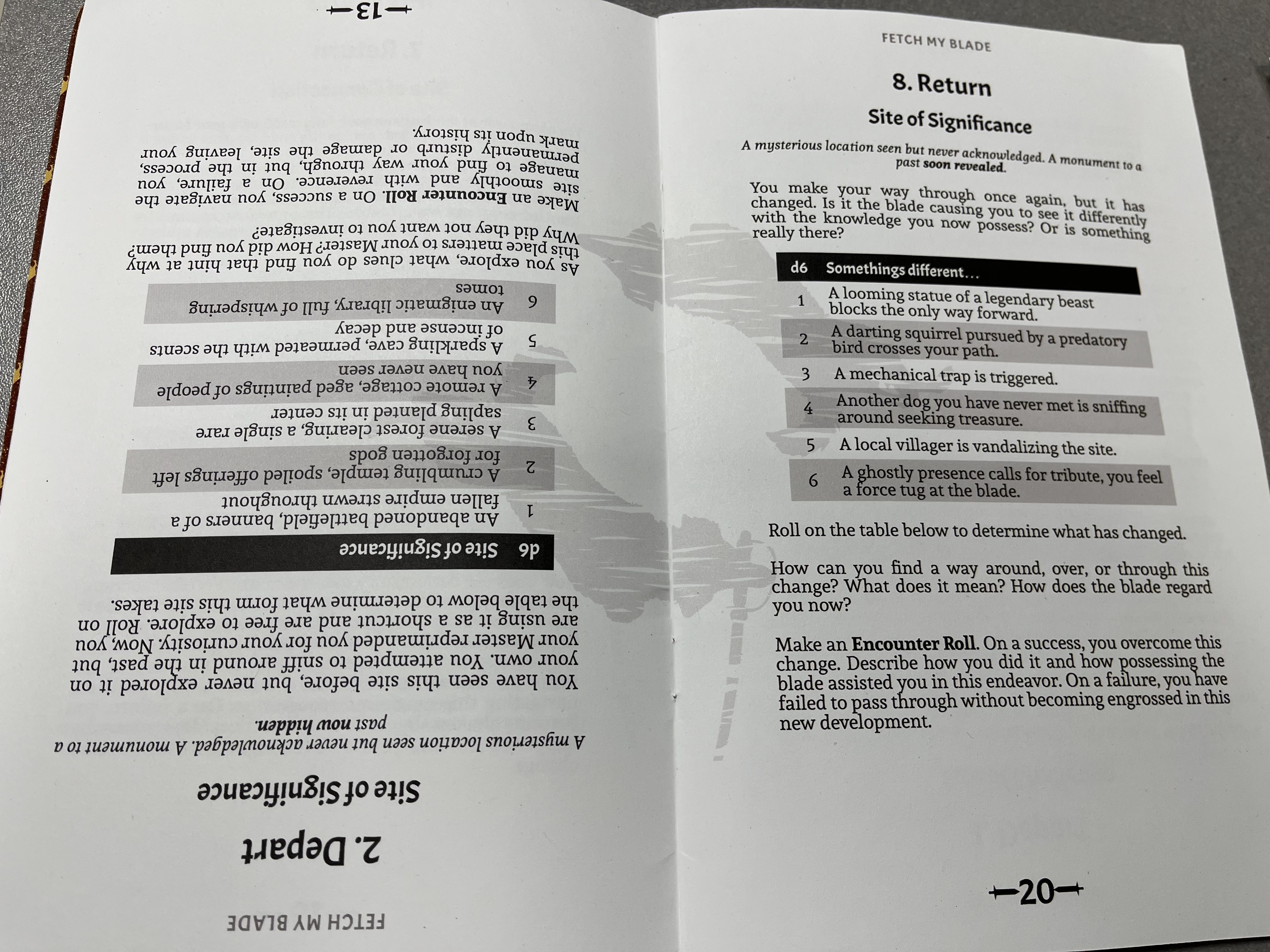
There are a total of nine steps along your quest to retrieve the blade and return it to your Master. All but the last one will provide exposition about what is or is going on there, along with a d6 table of example events/details/individuals you can roll on or choose from to flesh it out more. You’ll be asked questions about yourself, your Master, and the relationship between the two of and between your Master’s past and their present. Each site will also call for an Encounter Roll. At the base level you are rolling 1d6. You can add another d6 if your Training is relevant in some way. If you get at least one die on the right side of your Trait value you’ve succeeded. If all of your dice are on the wrong side of your Trait value, you’ve failed, and your Trait value which will change to make whichever Trait you just failed to use harder in the future. If the best you have is at least one die matching your Trait value than you succeed at whatever you were attempting, but with a consequence.
If you failed the roll then you resolve whatever was going on at that site in a way that makes you Question one of your Truths – simply add a ? to the end of it. If you were only able to roll your number exactly, then you Question a number of Truths equal to the number of dice that equaled that number as your actions ‘produce unintended consequences’. This has some immediate implications, because if all of your Truths are Unquestioned then you get a bonus +1d6 to all your Encounter Rolls, and if all three of your Truths are Questioned then you actually take -1d6 to all Encounter Rolls.
You’ll proceed along your quest, making your way through Encounters. If all of your Truths are Questioned and you are prompted to Question one again, you actually get to Unquestion a Truth, crossing out the old one and writing a new one based upon it that deepens your understanding and expanding on the relationship between you and your Master. You do this until you have three new Unquestioned Truths, at which point the Questioning may start anew. The book makes a point that even if everything about your Master is being questioned, your loyalty to them and their loyalty to you is not something that will change; this is a game of deepening understanding, not betrayal and abandonment.
Once you’ve arrived back at the Site of Challenge you deliver the Blade to your master, and you resolve the actual duel with a final Encounter Roll. The base is 0d6, first modified by whether not all of your Truths are Questioned or Unquestioned. You then add a die for every Truth that is currently Questioned. Finally, if you arrived back at the Site of Challenge without too much time having passed, your Master is inspired and gains an additional die.
You then choose which Trait you are going to use and roll the dice. This time each individual die’s result matters, as least when it comes to describing the duel: failures are setbacks during the fight, successes are displays of your Master’s skill, and ties count as successes while your Master unleashes a legendary technique from their past. You also Resolve every Questioned Truth until they are all Unquestioned over the course of the duel, describing what is said or done during the duel to do so. At last, the overall success or failure of the duel’s Encounter Roll combines with which Trait you chose to roll with, determining which of the four different options for the duel’s ending you witness.
Mechanically, Fetch My Blade is a bit strange, not in terms of the mechanics themselves – Lasers & Feelings dice rolls are pretty straightforward – but in how you’ll want to use them. You don’t really want to succeed on every roll, because aside from being suboptimal for the final conflict then you won’t be Questioning and learning things about your Master along the way. You don’t want to fail too much either though, because then you might end up with all your Truths back at Unquestioned; again suboptimal mechanically for the final duel but also suboptimal narratively because you won’t learn anything about your Master at the finish line, which sounds a bit anti-climactic even as the blades cross.
So it’s a game where you really want to thread the needle – deliberately choosing, at times, the Trait less likely to be successful without trapping yourself into failure when that Trait is the one that you really want to use for the encounter/story. In this, I’m not sure I like that failing with a Trait makes it more likely to fail in the future. The Tricks can have a pretty big impact here in avoiding failure at key points, and are a really good addition.
Narratively, Questioning and Unquestioning Truths is a really neat way to set up the world and the characters, subvert expectations, and then develop new understandings. The encounters and the examples provided for them are evocative, the questions in each are solid prompts for continuing to build on what you started with, and succeed or fail the encounters give you something interesting to write about.
Overall, it’s really nice to have a game that’s about questioning what you know of a character without worrying that it’s going to end in tragedy – granted, your Master may fall, but the relationship between the two of you that you’ll end up developing will always have been a good one.
The digital version of Fetch My Blade can be found on itch.io for $10, while IPR carries the print version (which comes with the PDF) for $15.

