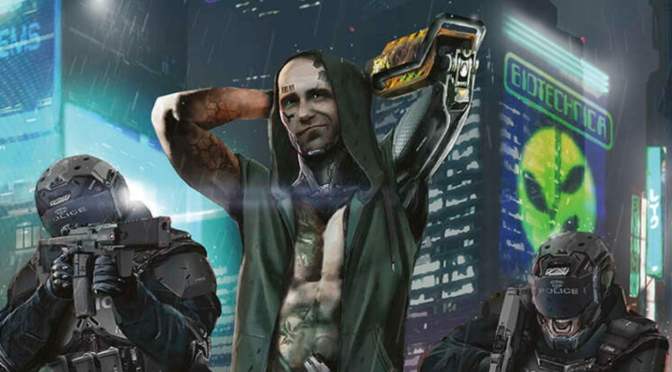
Cyberpunk Red has been going strong for around five years now. The game came out around the same time as the tie-in video game Cyberpunk 2077, and represented a return to form after 2005’s Cyberpunk v3 (and 2020 being over 30 years old). Now, R. Talsorian Games has kept the party going with continual Cyberpunk support both free (in the form of Monthly DLC) and for pay (in the form of the Interface Red collections as well as standalone supplements like Black Chrome). Single-Player Mode is the most recent standalone supplement, and your take on it will depend entirely on what you think a solo RPG is (or should be).
If you’re older than a certain age, when you think solo RPG you think something like Mythic GM Emulator, a set of rules that can act as a GM and let you play through modules or combats on your own. If you’re younger than a certain age (let’s say younger than me at least), your first thought of a solo RPG is probably more like a journaling game, or a hybrid narrative game like The Wretched. It’s important to state this because despite its 2025 release date Cyberpunk Red Single Player Mode is firmly the first of those two. There are no campaign framing tools, no narrative generation, and no character supplements. Cyberpunk Red Single Player Mode is built firmly on using an ‘oracle’ to answer questions which allow you to progress forward through your imagined narrative, and also provides tools to let you play out investigations, social interactions, combats, and netruns all on your lonesome. What it’s truly best at, though, is having a library of random tables which enable you to set up all sorts of premises, missions, and random encounters to make your Cyberpunk solo game more interesting. You may realize as I say this that random tables aren’t just for solo gaming. Not only is that true, it means that while I think Single Player Mode makes for an excellent GM aid and has some good rules additions…it just doesn’t work as an effective solo game.
This is not a solo game
Anything can be a solo game if you try hard enough, but there is a very limited use case for games that are about setting up the pins that you’ll then go and knock down. Let me explain. Cyberpunk Red: Single Player Mode has a few ‘core tools’: An oracle, a table that generates five different outcomes for yes/no questions; rules for structuring investigations, social challenges, combat, and neutrons, and a mechanic for using clocks in Cyberpunk Red. Then, there’s a mission generator, which boils down to rolling up a random person who hires you, rolling a mission type, ‘defining the focus’ (which has no mechanics other than ‘go roll on more random tables until you have what you need’), using rules from the core book to determine how much it pays, and then rolling on the plot twists table ‘if you want to’. There’s a little more detail in a procedure using Beat Charts from Cyberpunk Red, but those Beat Charts are in Cyberpunk Red and are neither reproduced nor expanded on here. Advice for turning your mission into a campaign is less than a page with nary a page reference or tool to help, just advice around how to find additional story hooks from a completed mission.
When you get into the details, combat and netruns, you’re given a procedure, kind of? The quick and dirty rules for all of the story procedures work, but you’re not given a whole lot of information on how to build out a satisfying encounter or make it appropriately challenging. The netrun section, as an example, has the only reference to difficulty value as a page reference back to Cyberpunk Red.
Ultimately the problem I have with Single Player Mode is that what I’m actually supposed to do with it just seems unsatisfying. So I roll up a mission, then by using a Beat Chart I get to come up with the mission (there’s a table to tell me what type), I get to come up with the opposition (I suppose I can roll on a table to see what group they’re from?), I set the difficulty levels (no help here), and I have to then think about what other plots this could imply. This is at best simply an oracle, and I wouldn’t even call it a GM emulator because there’s no encounter design or templates, no guidance on how to structure a mission of a given difficulty, really nothing in the way of actually providing a game at all. You can set up the pins as close or as far from you as you want, and then knock them down. As a counterexample, the (much shorter and not a standalone product) Twilight:2000 solo rules have much more meat on their bones because they implement the existing campaign material and encounter cards and can use existing motivations/behaviors on those encounter cards to make it easier for a solo player to actually play both sides of an encounter without it feeling like playing with action figures.
What I would have really wanted from something like this was a bit more substance and structure for playing a satisfying solo game with Cyberpunk. As an example, a page or two with mission prompts that are keyed to different lifepath choices or at least role-specific could have been really neat. In playing around with the mechanics with my Cyberpunk character of the moment, a rockerboy, I felt distinctly underserved by the mission generation and the tools, especially as I kind of wanted to tell a different story than just ‘missions’ for a ‘fixer’. Trying to solo game with this was disappointing. When I think about having this book as a bog-standard Cyberpunk GM, though, it still manages to be kind of exciting.
You may want to buy it anyway
Realistically, the biggest sin committed by this supplement is the title ‘Single Player Mode’. Call it something like ‘The Primitive Screwhead’s Guide to the RED’ and this review would have been glowing from start to finish. On page 7 under ‘Types of Solo Play’ the book lists single-player solo, multiplayer solo, and assistant GM. This book makes way more sense as a GM’s assistant or GM’s guide, and frankly would have been better if that was the focus and the solo part was either condensed based on how well it was executed (so to the back quarter of the book) or shoved off to another volume after it was actually built out a little. Now that my palpable disappointment is out of the way, let’s talk about what the book does provide.
First, the random tables are fantastic. Similar levels of detail as those in the core book but a lot more of them. Ironically I really, really enjoy the random encounter tables. Their details and division by time-of-day is great, and they make it easy for a GM to add flavor at any point of the game. To reference above, though, they are 0% mechanically actionable, making them great for a GM who uses them in addition to the encounter stat blocks in the core book or supplements like Danger Gal Dossier, but kind of a nothing-burger on their own. Speaking of nothing-burger, the kibble flavors table is a particular highlight of hilarious and horrifying worldbuilding, and having a fully illustrated random ads table was a stroke of genius.
As much as they aren’t enough to really support solo play, the rules are good. I’m so glad I have a morale mechanic now, and frankly there should have been one before. As much as it’s not really providing any structure to how to use it in a solo context, quick and dirty netrun rules make it that much easier to put a net architecture into any context in your game, which really is the least you can do to keep a PC netrunner busy and feeling appreciated. Clocks, as much as they betray my existing affection for PbtA, are a solid organizational tool for GMs of any system and the usage dice-like, Grimwild-like mechanic is just a solid one to use that gives more guidance than simply filling in segments of a little circle you drew. Also, having several pages of blank random tables with different probability distributions that use Cyberpunk dice is just a nice thing to have; I’d totally print out a few and fill them out when prepping a campaign. If I was running my first Cyberpunk Red campaign which was set in a completely different city than Night City, the combination of the blank random tables and the existing Night City tables for locations and NPCs would have been a great way to structure my prep. For ten bucks, Single Player Mode is full of inspiration, has some key new mechanics, and is going to make any GM’s life a bit easier.
Every problem I have with Single Player Mode has to do with what’s not in there, as opposed to anything that is. Mythic Game Master Emulator is nearly twenty years old, and back in 2006 it had its mechanics around Threads and Characters to help solo players pull their disparate elements, random rolls, and yes/no questions into a campaign, or at least a narrative with continuity. Since then, solo play has gotten even better, with games like Ironsworn upping the ante for how a single player can engage with rules. With all that context, ‘roll on these tables and come up with some challenges you think fit’ is incredibly underwhelming. Even combat is, at its core, just playing with yourself. The quick and dirty rules are decent but as I’ve said before, it’s up to you to put up the pins and then knock them down. There’s no game there.
To be realistic, Cyberpunk Red Single Player Mode is a solo game manual marketed to the sorts of solo gamers that designers knew in the late 80s and early 90s: Nerds with a vision for their character and their story who just wanted to play it out, groups and GMs be damned. Single Player Mode works for that. A five-outcome oracle is good, and the probabilities are a solid alternative to Mythic Game Master Emulator’s Fate Chart. When taken as a whole product, though, there’s just not a lot of ‘there’ there for actual solo gaming. Advising a player to consider the plot hooks generated by a mission is not the same as a Threads mechanic, and putting all of the levers in the hands of the player with no additional structure or randomness is straight-up violating the Czege Principle in the way Paul Czege was originally talking about it way back when.
So yeah. For the price, “Single Player Mode” is a pretty solid collection of GM tools, tables, and play aids. If you’ve played any solo game newer than 2006, though, it may be in your best interest to just forget about the title.
Cyberpunk Red Single Player Mode is available at DriveThruRPG.
Like what Cannibal Halfling Gaming is doing and want to help us bring games and gamers together? First, you can follow me @LevelOneWonk@dice.camp for RPG commentary, relevant retweets, and maybe some rambling. You can also find our Discord channel and drop in to chat with our authors and get every new post as it comes out. You can travel to DriveThruRPG through one of our fine and elegantly-crafted links, which generates credit that lets us get more games to work with (which is eactly what we did here)! Finally, you can support us directly on Patreon, which lets us cover costs, pay our contributors, and save up for projects. Thanks for reading!
 Cannibal Halfling Gaming
8 thoughts on “It shouldn’t have been called Single Player Mode”