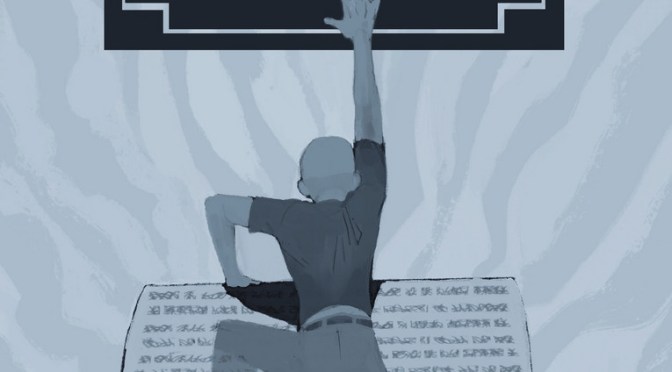
Every life is a story, but as it turns out you’re not in control of yours. Your victories, your failures, your friends, your foes, every aspect of your life is being written by someone else. You are written by someone else, and you don’t have one iota of agency when it comes to your own fate.
To hell with that. Let’s see if you can bring about the Death of the Author.
Designed by Sam Leigh/Blinking Birch Games, Death of the Author is a hack of their own Anamnesis. Playable as both a solo game or as a duet game, it focuses on “a character fighting for agency within their own story.” The ‘fictional’ Character becomes very much aware that they are being written by an Author, and will have to attempt to take control of the narrative despite the Author’s best efforts, all leading up to a confrontation between the two. All you need to play is the game’s text, a deck of tarot cards, and 2-4 hours of free time.
Setup begins by dividing your tarot cards into five decks, one for the Major Arcana and one each for the Pentacles, Swords, Cups, and Wands (or whatever Minor Arcana suits your deck happens to have). Each deck is shuffled, not just to randomize card order but also so that some cards are Upright and some are Reversed (upside-down). Then, three Major Arcana cards are drawn to create the Character Spread, with each card representing a character written by the Author.
The first card is You, the focus Character of the game, who might be a protagonist, antagonist, or side character. The second card represents Your Friend, a lover, family member, or other ally. The third card brings in Your Foe, a rival, sworn enemy, or other opponent. Which card you’ve drawn and its Upright v. Reversed status will inform who these characters are and what role they have in the story (at least before things start to go off the rails). Still, while the characters might change quite a bit over the course of the game, the Character Spread stays in front of you for the duration of it, keeping these cards out of the deck and out of future draws.
Before you go further into playing, though, there is an Author’s Note – some kind of message that the Author left for the Character – that you draw another Major Arcana to get inspiration for. This one, once you’ve figured out what the message was and what your first impression of the author was, gets shuffled back into the deck.
The actual playing of Death of the Author is broken up into five chapters. Chapters 1-4 – titled The Prologue, The Exposition, The Rising Action, and The Climax – correspond with the decks of Minor Arcana in the order of Pentacles, Swords, Cup, and finally Wands. For each Chapter you’ll draw three cards from the corresponding deck, each of which represents a Scene. Luckily, there’s no need to consult any sort of guide as to the meaning of each card, because two have been provided for each one depending on whether it’s Upright or Reversed. Generally speaking the story point will be the same, but the specifics can be pretty different. For some examples, the Six of Pentacles Upright means you “walk away from a fight with a life-changing injury” but Reversed means you “walk away from a fight with a death on your conscience.” The prompt for the King of Cups is “you tend to your Friend after a brutal injury” if Upright and “you tend to your Foe after a brutal injury.”
Note the underlining! This is done right in the book, and plugs into the main way your character can choose to forge their own path – after all, while you’re writing this journal from the perspective of the Character, it’s the Author who is doing the actual ‘in-universe’ writing, and they have a plan. For each chapter you the Character have one Reversal and one Defiance: the Reversal flips a card from Upright to Reversed or vice versa, flipping the script and changing what the underlined text will be, while Defiance allows you to replace the underlined text with whatever you want. Of course, the Author doesn’t miss this happening; after using a Reversal or Defiance you draw a Major Arcana to see how the Author reacts – either written out by a solo player or detailed by the second player taking on the role of the Author – provided they stay within the bounds of the Character’s edits.
There is a really cool mirroring here between You the Character and You the Player – because you’re not the Author/the prompts are randomly drawn, neither of You really know what’s going to be coming next. Both of You spend most of the game not being in control of what’s going on, but the Reversal and Defiance are both the character and the player temporarily grabbing the wheel and yanking it away from what the Author/the cards intended for you.
Once the three Scenes of a Chapter are completed, the Author leaves the character a message: you draw once from the Major Arcana deck to determine the nature of the message, but each Chapter also has a specific prompt like “What part of themself does the author show you?” Finishing the message and its details also finishes the Chapter: you shuffle all of the Major Arcana cards that have been aside from the Character Spread back into the deck, set the cards you drew to determine the Scenes aside, and discard the rest of the Chapter’s deck before moving onto the next one. Unused Reversals and Defiances don’t carry over, and as you might imagine the prompts get more and more intense the closer you get to the end.
Chapter 5 – The Resolution plays out quite differently, as the Character’s story has come to an end and it is time for them to confront the Author. Whether they meant to or not the Author has written parts of themselves into the story, and this is what all the non-discarded cards – the Character spread and the four sets of three Minor Arcana that made up the scenes – are now used to discuss. You are told to examine the Spread and asked what parts of yourself, your Friend, and your Foe you see in the Author. You are told to examine the Scene Cards, and are asked which parts of each Chapter hid your Author’s “hopes and fears, passions and regrets, beliefs, and insecurities.” You are asked what this story meant to your Author – this is another spot where having a second player to be the Author can have a lot of impact on how the game goes.
Once those topics are covered you discard the Major Arcana desk as well – “Your author cannot use it here.” Finally, you are presented with four lines of text, with two separate sections that are underlined, and are told that you have one, and only one, Defiance.
“You meet your author.
They are no longer in control.
You say your piece.
You act without mercy.”
Death of the Author is a delightfully meta game that will resonate with anyone who has ever struggled to get a character to do what they wanted while writing/playing them, or who wished a character’s author didn’t get away with all the things they did to them. For that matter, it will also land with those who want to explore a more positive bond between a character and their Author; while there’s a certain lean towards their relationship being adversarial – I mean, just look at the title – the second option for your final Defiance means it doesn’t have to end in death. However you want it to end, the Character and the player being presented essentially the same situations and the same options is going to do a great job at making sure you’re invested by the time The Resolution comes around.
You can find yourself a PDF copy of Death of the Author on itch.io for $10. You can find the print version in a good number of places from Indie Press Revolution to The Lost Bay, from $16 to $18, but if you’re okay with a damaged copy that might have “bent corners, scratches on the front or back cover, odd coloration, and/or ink smudges” then you can get one of those for only $10 on the Blinking Birch Games site.
With both the character and the player being at the whims of the game, how will you take control of your own story?
 Cannibal Halfling Gaming