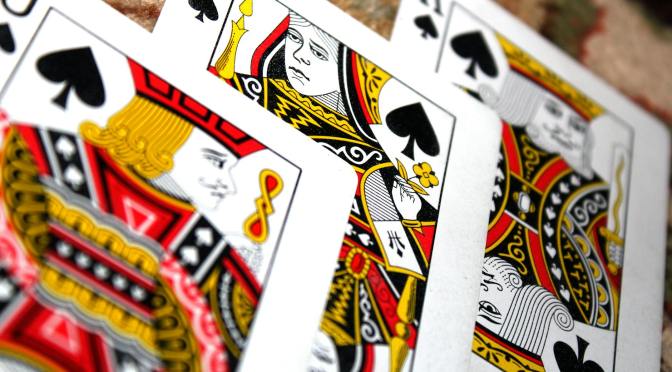
Welcome to another System Hack! Way back when I gave an intro to how to use dice and dice statistics in your game designs. This is in some ways a sequel to that article, but given the design assumptions of RPGs it also plays a very different tune. We use dice in RPGs because large swathes of our game mechanics are predicated on the probability of something happening. Success, failure, or something in between is determined by odds that reflect the internal consistency of the setting. This, like so many norms in gaming, comes from wargames and isn’t particularly necessary in many game designs. We have gotten through the checkpoint of ‘you don’t have to use dice’ but the result has been, merely, diceless games. What if we play differently, and steal a deck of cards from the poker set instead of stealing dice from Monopoly?
Playing cards are not designed to model probability, they’re designed to distribute numerical outcomes to players who must then use those outcomes in an optimal way to win the game they’re playing. This may involve building the best possible hand of cards (poker) or it may involve playing those cards in a specific order to win the most rounds (euchre). When you consider the variety of layouts used in popular card games (consider Texas Hold ‘Em on one end and Klondike on the other for a stark difference), it’s almost surprising we haven’t had more attempts to make interesting role-playing mechanics from cards.
The problem with designing RPGs with playing cards is that the game isn’t going to work like an RPG with dice. The result is that many games that ‘use cards’ either use them for very constrained parts of the mechanics or just treat the card deck like an oracle, little more than a 52 entry random table. We have seen designers do a whole lot more, though, and with a little consideration you can join them.
Intro to playing cards
For the purposes of this article, we’re going to examine two widely available playing card decks which have been seen in RPG mechanics. The “standard” playing card deck, more specifically the French-suited playing card deck, contains 52 cards suited into clubs, diamonds, hearts, and spades. Each suit contains an ace, numbered cards from two to ten, and then three ‘face’ cards, the jack, queen, and king. There may also be jokers included in the deck, unsuited cards which are considered ‘wild’ in games which use them. Also widely available are tarot card decks. The most common tarot format available today is the Rider-Waite tarot deck; like most tarot decks this started as an Italian-suited (wands, cups, swords, pentacles) 56 playing card deck with 21 ‘trump cards’ and a card called The Fool which played a similar (though somewhat more powerful if you read into tarot games) role to a joker. Tarot deck designers, including the two members of the Hermetic Order of the Golden Dawn (yes, seriously) who designed the Rider-Waite deck, codified the designs on each trump card and from there we got what are now known as the Major Arcana, numbered from zero to 21 (The Fool, given its original role in tarot games, is numbered zero).
There are a few parameters which make playing cards interesting for games. In terms of simple results, a playing card contains more information than a conventional die. The number and suit mean that there are two parameters that are immediately readable, and the fact that suits may be subdivided into color gives more optionality. This increased information also increases the complexity that can be attained when combining multiple results. If you consider a mechanic that requires you to build a result from a number of existing rolls or card draws, it’s clear that the cards make this more granular. Poker is built on this mechanic (building the highest scoring hand from a combination of private and public cards), and having both suits and values in play is what makes poker complex enough to be interesting.
The other primary parameter of playing cards that makes them interesting and different from dice is the format. While you could theoretically do this with dice, cards make it very easy to work with a results set instead of discrete results; this would be the difference between having a deck of cards that is drawn from and exhausted through the course of play and drawing a card and then shuffling it back into the deck. This also allows a player to utilize a hand of cards, giving them information about and control over what their next play is going to be. Needless to say, picking a card or two cards to play in the face of a challenge is very different than rolling a die and not knowing what’s going to happen.
When it comes to designing with cards, giving a player a hand of cards and a deck that will not be refreshed are two ways to give that player more information and control compared to rolling dice. This is one of the design elements we’ll want to consider to make the most of a deck of cards. The other is uniqueness. Not only does a tarot deck have 22 unique major arcana, but in fact all cards are unique tokens which can be edited much more easily than faces on a die. Both deck and hand mechanics as well as card uniqueness mechanics are going to be key approaches to designs that make the most out of playing cards.
Designing with playing cards
Playing cards, like dice, are an implement, and few mechanics require playing cards. While marking playing cards is easier than marking dice, DIE has a dice-marking mechanic for one of the Paragon types, the Fool. Similarly, while using a hand of playing cards is much less unwieldy than having a ‘hand’ of dice, there are games which use ‘hand of dice’ mechanics, like the video game Citizen Sleeper (which, as a video game, doesn’t have to worry about the pre-rolled dice rolling around). That all said, playing cards lend themselves to certain use cases, and the cultural understanding of card games can often make a complex mechanic much easier to parse when it uses a hand of cards.
As mentioned above, you can make a deck of cards emulate a “13-sided” or “52-sided” die by drawing a card and using the value of the card, then shuffling the card back into the deck. 13 is not a statistically useful number compared to 20 or 100 (or 10, or 12 even), so there isn’t much gained by using a deck of cards like a die. However, once you do something as simple as discard the card into a separate pile, you’ve changed the mechanic significantly. Now, the cards which have already been played can’t come up again, so the probability of getting a certain value changes every draw. To go even further, if you let every player draw a hand of 5 cards, now they know which values they can distribute among the next five actions. These two mechanics change the workings of a card deck dramatically compared to dice and they are arguably the most straightforward changes to make.
Once you give a player a hand of cards from which they can play, you’ve changed the fundamental meaning and purpose of ‘taking an action’ when compared to rolling dice. Rolling a die is at its core part of a statistical model; it’s designed to accommodate a ruleset which is built around simulating the setting by assigning probabilities to certain things occurring. From a design perspective, then, it’s important to note that choosing a play from a hand of cards is, in essence, incompatible with the traditional view of rules as world/setting simulation. Unbound, a relatively traditional game that uses playing cards, does not use face-up hands, instead making the player choose what card to play with no additional information (the hand, which has other mechanical effects, is dealt and played face-down). The aim of good design is not merely to emulate what’s already been done, so the fact that using a hand of cards won’t easily create a traditional ruleset is, in my view at least, a good thing.
If we’re going towards designing a card-driven game where players get hands and we aren’t just flipping cards for random number generation, then there’s two directions we can go. The gamist direction (apologize for the GNS shorthand but it’s effective vocabulary here) is to rebuild the strategy and play of the game into card plays, and give the card mechanics as much richness as a combat system would have in a trad game like D&D. There are a lot of examples of this, because I just described a hobby card game, be that a closed deck-building game like Dominion or a trading card game like Magic: the Gathering. The limitation here is that making the card mechanics complex and interesting enough on their own requires either moving beyond the deck-and-hands paradigm or it requires writing new cards, which is beyond the scope of an article about playing cards. There are some good examples of new card paradigms out there; the card array of The Wretched uses both a fixed results set (a smaller subset of the entire card deck even) and random results (i.e. face-down cards) to excellent effect. One could also imagine, say, a mecha game where you place cards face down on mecha body segments or subsystems and then play them during combat.
The difficulty with using the gamist approach to playing card design is that there are limits to making this beneficial for roleplay. One narrative perspective that is enforced upon gamers when using dice is that things are happening to their character, as opposed to them having full control. In the mecha example above, you could just write the mecha game, and the roleplay elements wouldn’t have to touch the card mechanics at all. In the example of The Wretched (and a different mecha game – Ed.), though, the card draws provide information that help tell a story. That makes the game better aligned with the second direction of integrating deck-and-hand card mechanics.
A narrativist approach to deck-and-hand card mechanics implies that each play from a hand of cards is going to represent an event that is part of the story of that session. This can mean specific events, somewhat like the cards in The Quiet Year. It can also align to something like Unbound where the cards are still tied to numerical results. If we want the game to feel like a roleplaying game is expected to feel, that is to say to feel like there’s freedom for the player to make choices on behalf of the character, we should avoid defining specific events with the cards (or at least avoid that for every card). In The Quiet Year, the card events are drawn blind and are events for the players/characters to react to, as opposed to events that define what the players/characters can do.
This is where tarot cards add an interesting bit of hybridization. If we’re using a tarot deck, the numbered/faced cards can be for resolution, while the major arcana represent specific events that the players have control over. The trick here is to make sure that the events are big enough to be interesting but yet scaled appropriately for their frequency; the probability of any one card coming up in a session (assuming four players with hands of seven drawing from one deck) is around 44%, and the probability of a player having any major arcana during a session is of course much higher.
It should also go without saying that there are many lighter ways to use cards. Both Savage Worlds and the Year Zero Engine use cards for initiative; this both provides a visual reminder of where you are in the turn order as well as mitigates the possibility of ties by using cards as unique tokens. There’s also nothing wrong with drawing cards as just a random number generator; combine this mechanic with tarot cards and you can have the 28% probability of a major arcana card coming up for a draw trigger some neat effects (and up to 22 unique effects as well). These lighter touch mechanics are easier to design and will still add some flavor and differentiation to your game. That all said, though, for writing an entire article on using playing cards it makes a lot more sense to push on what can make a design using playing cards distinct from a design using dice. I did some work using Powered by the Apocalypse as a basis to illustrate what playing cards can do to change a game.
A worked example
Powered by the Apocalypse is a great example of a ruleset which has stated aims that can be accomplished by using playing card mechanics. Powered by the Apocalypse is more concerned with the events that happen than the specific actions characters take, so curating character events from a hand of cards won’t be as counterproductive as it would be in a more traditional game. On the other hand, Powered by the Apocalypse is still about defining characters and giving them freedom to act within the setting, so we want to provide resolution mechanics as opposed to a deck of random events. This example is going to discuss using playing cards to create an experience that’s aligned with (but not the same as) the PbtA experience, using design choices that don’t impose too much of an extra lift on either players or GMs. In this case, that means a deck-and-hand mechanic that may employ deck editing (removing or adding cards to change the deck composition) and card marking (assigning specific cards specific effects on a per-campaign basis, either from a set list or uniquely).
Let’s start by setting a baseline. The standard PbtA dice mechanic uses 2d6, with three possible results. For a 10 and above, the roll is a complete hit, for a 7-9 the roll is a partial or mixed hit, and for a 6 and below, the roll is a miss. We’re going to start with a setup that will emulate the PbtA probabilities, but with a twist. For the beginning of this setup we’re subdividing our cards into aces, faces, and digits. For the resolution mechanic we’re going to start with the digits (which means that this will work equally well with conventional playing cards and tarot cards for the moment), and start with six of each of the suits. Let’s start our deck with the digits 3 through 8 in all four suits. In this card-based PbtA, each “roll” will consist of pulling two cards and adding together the values. Anything below 10 is a miss, anything 11 through 13 is a partial or mixed hit, and anything 14 or above is a complete hit. These probabilities line up exactly with the PbtA probabilities if you assume you have two suits of cards as opposed to four; I’ll get back to why in a moment. If you are to shift which six cards you start with in a suit by one (assuming you only shift that suit), you will change your probabilities in the exact same manner as you would by adding a +1 to a PBtA stat; shift by two cards and it works the same as a +2. In other words, a 3-8 start would be a +0, a 4–9 start a +1, and a 5–10 start a +2. A 2–7 start works out as a -1.
Here’s where everything gets interesting, and why I calculated those probabilities based on two suits as opposed to 4. Imagine for a moment that the four suits are representative of four attributes for your character. Now consider a ruleset where, instead of adding bonuses to a die roll, you assign a specific attribute or attributes to each move in the ruleset, both basic moves and moves in a playbook. All of a sudden your hand is telling you a whole lot more about what you’re going to contribute to the story and how during the next phase of the game. Considering how Apocalypse World is designed, we could create Basic Moves with a root attribute, and then slightly different effects depending on which secondary attribute you use. Playbook-specific moves, which are supposed to be more, well, specific, may lock you into two attributes every time. Now you’re worrying about two different probabilities: the probability you’ll have two appropriate cards in your hand (which would be dependent on what size hand we choose to use), and then the probability that those cards will show a result you want.
Even though independent probabilities will match those in Apocalypse World, having a hand of cards will tend to drive the probabilities of better results up. The way that we make the distribution of results matter is by making sure that every card will get played. This is one of the major liabilities of card-based mechanics when it comes to games with an implied level of failure: Forced failure isn’t fun. If this game used only one card for resolution, that would mean that every 2 you have would just be a card that sucks. With two card resolution, low cards are still bad, but now you have to be strategic and combine them with higher cards, trading away stronger successes for mitigating potential failures. If we want these sorts of play decisions to feel important, it may end up that we want to tune the probabilities for each result in order to ensure that arranging a hand feels like strategizing, like it makes a difference. We may also want to include a mitigating mechanic for failure. Making XP for failure the sole mode of advancement in this game would feel punishing, but something to make misses actually hit the table will be needed to make this game continue to feel like a PbtA game.
Advancement would work differently than starting setup. If you want to increase an attribute, you don’t shift the cards you have, you add a card. So, if you started with the standard 3–8 suit spread and then advance that suit/attribute, you’d add the 9 back into your deck. This both adds a bump in potential outcomes for that suit but also makes the suit come up more frequently. There’s also the possibility for the Ace to come in as an ‘advanced’ version of this. In the higher tier advances you’d have the option to add the Ace of a given suit into your deck, and have it count as an 11, which would be a very big bump indeed. This double role of the Ace as 1 and 11 from blackjack will also come in handy for a mechanic out of Apocalypse World, debilities. If your character is about to die in Apocalypse World you can take a debility, a permanent attribute penalty. For this game, the debility mechanic will still be used, but instead of a numerical penalty, you add the Ace for the appropriate stat into your deck, but set as a 1.
Face cards present a lot of opportunities for definition. While in many card games the face cards have values of ten each, that sort of assignment throws all the probabilities out of whack. What I am considering instead is abilities that can be triggered with face cards when they’re played from a hand. One obvious possibility would be some sort of equivalent of the ‘roll with Hard instead of Hot’ type move where the face card allows you to use a different stat, though that’s not all that interesting. Another consideration is to modify moves that have frequency components to them. Consider for a minute the Maestro D’ move Fingers in Every Pie, which allows them to call for a piece of gear, person, or other resource at their establishment. Whether the move hits completely, partially, or misses, the character gets the thing they’re looking for in some form. Consider, now, that our playing card Maestro D’ takes the equivalent move, and puts the jack, queen, and king of one suit into the deck. If the king comes up and we play it from the hand, the character gets what they want, no questions asked. If it’s the queen, they get something close to what they want. If it’s the jack, they get what they want but there are strings attached. If you’re in a tough spot you may still play the jack if the other two faces are buried deep in the deck. These sorts of playbook-specific abilities make for a much more interesting use of face cards than just card manipulation.
For the final element of this worked example, let’s consider resource management. The reason I built the probabilities off of independent measurements is because I was building around a hand of cards, making the actual dependent probabilities harder to calculate. There’s also the element of resource management; if each phase of play only gives you access to a limited number of cards it’s not necessarily useful to know that you’re all but guaranteed 1-2 pairings that will make a complete hit. Considering how we’ve set up the beginning, let’s make some round assumptions as a starting point. A starting character will have 24 digits (6 from each suit), so let’s say that each playbook starts with one of those face card abilities we theorized earlier. This will bring their starting deck up to either 27 (playing cards) or 28 (tarot cards, they have four face cards per suit). Let’s go ahead and start with a hand of 7. That sounds like a nice number; each character would be able to build three pairs with which to make moves. To me, that sounds like a reasonable number of dice rolls per character for a PbtA-style game where a lot of the game moves forward without dice, but this is definitely something we’d want to playtest. We can also use this as a pacing and spotlight mechanic; once no one can make a move, the phase of play ends and everyone draws back up to seven cards. We can then imagine a day of three phases, with two daytime and one nighttime phases if we’re going day-by-day. After a full day, everyone shuffles their deck and begins anew. This is just one hypothetical way to manage card inventories, but it does play nicely with the other mechanics we’ve outlined so far. Hand size defines how many actions everyone gets, but characters with more advancements will on average have higher valued cards and be less at risk of exhausting their higher valued cards by the end of the day.
There’s one other floating card type here: If we were building this with tarot cards, we’d have a whole bunch of major arcana to contend with. To be honest, for this example I don’t see an additive use for the major arcana; the idea that everyone (including me) eventually comes to is to have them trigger random events or plot connections, but as I noted above that means that these cards are doing little more than a random table. There’s also the fact that the hypothetical game we’re designing requires everyone to have a deck of cards. You can buy playing cards at $3 a deck (sometimes less if you buy bulk packs, even), but even the cheapest tarot decks are hard to find below $10. While that’s not prohibitive, depending on how the GM is running the game and how many materials they can expect their players to actually bring on their own, that could be the difference between $15 out of the GM’s pocket and $50. That said, the major arcana can bring an additional dimension to your card mechanics; just know that you’ll be writing for 22 unsuited and (numerically at least) unrelated cards, which can be more difficult to do effectively than you would think. I can and have named some interesting playing card mechanics, but I am personally zero for zero when it comes to reading tarot-based RPGs that I actually want to play.
Cards don’t act like dice. We can draw single cards and just look at the number to make them act like dice, just like we can pre-roll our dice and set them in a “hand” in front of us to make dice act like cards. Instead of doing that, designing a game that plays to the strengths of its peripherals is key to making that design successful. I gave an example that split the difference between using card mechanics and using existing dice roll mechanics, but you can definitely go harder. The playing card array of The Wretched is one example. A game using poker hands as a resolution mechanic could be another. You can even mark up your cards, permanently changing them like in Unbound. While cards provide a different set of assumptions to work with, they also twist our brain a bit and remind us that the norms of RPG design may not actually exist for a reason, or may exist for a reason that doesn’t apply to your game at all.
While not an RPG, this article was inspired in part by Balatro.
Like what Cannibal Halfling Gaming is doing and want to help us bring games and gamers together? First, you can follow me @LevelOneWonk@dice.camp for RPG commentary, relevant retweets, and maybe some rambling. You can also find our Discord channel and drop in to chat with our authors and get every new post as it comes out. You can travel to DriveThruRPG through one of our fine and elegantly-crafted links, which generates credit that lets us get more games to work with! Finally, you can support us directly on Patreon, which lets us cover costs, pay our contributors, and save up for projects. Thanks for reading!
 Cannibal Halfling Gaming
I really like the idea of cards as possible actions you can take. Some of the fun of Slay The Spire and Griftlands is that you’re given options that you can use this round, and have to make the most of them. You can have cards only be usable a few times per combat, to get a similar vibe of the “you only have x spell slots” thing, which I think hews closer to D&D — not sure how playing cards will allow that (unless you maybe write on them?).
One of the aspects I am designing for is that you don’t have all your options every round, because combat is chaotic. There simply isn’t time within a 6 second round to barf out your masterful checkmate move, and that makes it more dynamic. A limited pool of cards versus an infinitely rolling pile o’ dice narrows your focus.
LikeLike