Victoriana Third Edition: Last Chance Review

I’m not going to hide that I have a dim view of games made using D&D Fifth Edition as their base system. D&D has always been a more specific game than Wizards of the Coast makes it out to be; even TSR made separate games instead of a unified ruleset. When I see a game made for 5e my first question is always if the designers had any thought to what rules would best suit the game they’re making rather than what rules more people are already playing.

If there’s a company that has a chance to make me eat my words, though, it’s Cubicle 7. My review of Doctors and Daleks detailed how impressed I was at what they did to make a good Doctor Who RPG out of 5e, including some massive changes to how the game works. Cubicle 7 is now campaigning another 5e game on Kickstarter, the fourth edition to their Steampunk game Victoriana. Victoriana has already seen some ruleset changes over the years; the game started out using Fuzion, a revision of the rules to Cyberpunk 2020 co-developed by R. Talsorian and Hero Games. By the third edition, though, Victoriana is built out using a d6 dice pool system and a wholly custom ruleset.

My questions about 5e Victoriana run rampant. Beyond my ruleset partisanship, this version of the game has been limping along for years, first announced in 2021, re-announced in 2023 using a custom 5e modification that was being called C7d20, and finally making it to Kickstarter earlier this month with the C7d20 nomenclature absent, simply called “Victoriana for 5th Edition”. The campaign is ongoing, and though it’s met its funding goal it’s currently sitting below $75k, a tough number to swallow for a campaign that has stretch goals out to the $200k mark.

What is this new edition of Victoriana going to get us? To attempt to answer that question, I’m going to crack open my copy of Victoriana third edition. Released in 2013, the game has the polish of a title both released by a major design house as well as one from late in the ‘big book’ era of trad games. The question is, given the sort of game Victoriana is, will it work using 5e rules? And in the pantheon of Steampunk RPGs, is it one worth saving, 5e or not?

Continue reading Victoriana Third Edition: Last Chance Review
The TTRPG Fleet

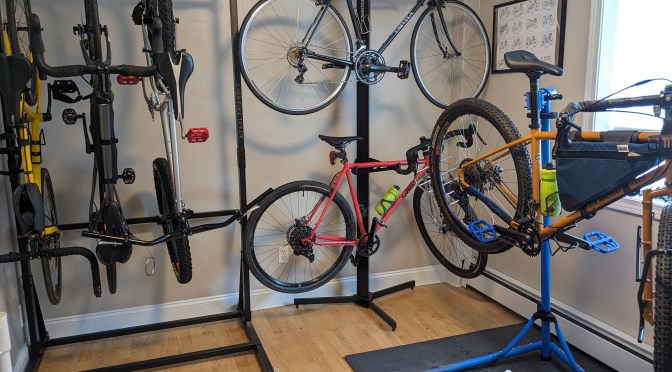
If you hang around in bicycle spaces long enough, you’re going to hear someone say ‘n+1’. This is a joke among the cycling community: “The correct amount of bikes to own is n+1, where n is equal to the number of bikes you currently have.” Needless to say the collector’s impulse in the cycling hobby runs strong, and even if you aren’t interested in trying all the brands or vintage frames or anything like that, you still may find yourself in the throes of n+1. After all, you start with a mountain bike, want to try a road bike, then you need a gravel bike, and a cross bike, and an endurance road bike, a climbing bike, a pub bike, a fixie…

It’s no wonder the collector’s impulse is even stronger within RPGs; you can get twenty hardcover sourcebooks for the price of a relatively cheap bike. And yet, collecting RPGs comes with a stronger risk of missing something. There are many, many bikes out there to enjoy, but at the end of the day you’re still going to be riding bikes, and the forty miles you put down on one bike will still help your legs when you pull out the next bike. The TTRPG hobby is a bit different; playing Masks and playing Pathfinder aren’t going to be similar experiences or pull in the same direction.

While RPG reviewers such as myself are often the ones most liable to try and catch all the RPGs like so many Pokemon, there is another way to consider approaching RPGs and actually playing them, and it comes right from bicycling. N+1 may be a joking mantra, but most cyclists have neither the money to acquire a collection of bikes nor the time to ride them. Instead, most cyclists end up with their ‘fleet’, a group of two to eight bicycles that cover the range of disciplines and experiences they want to have. While having twenty Italian road bikes may not amplify your understanding of cycling, having both a road bike and a mountain bike is something that pretty much every cyclist can understand, collector or not.

Continue reading The TTRPG Fleet

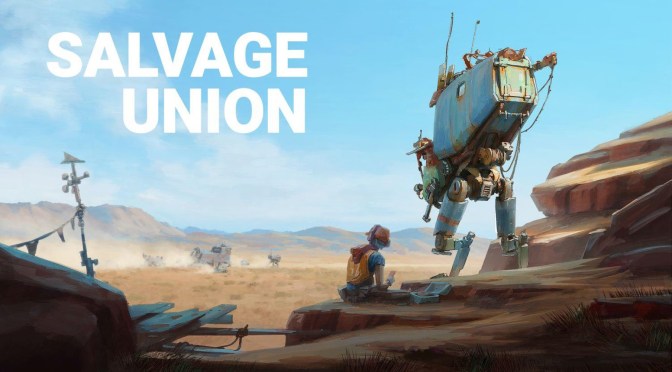
Salvage Union Review

Mecha runs through the history of Cannibal Halfling Gaming; the core contributors would have never met if not for a Gundam play-by-post back in the late aughts. Mecha in RPGs has been popular more broadly as well, though usually best represented by the idiosyncratic and crunchy Robotech and Mekton as well as the more grounded (and also crunchy) Heavy Gear. Salvage Union is the latest in a line of mecha games to aim for the narrative side of the genre, though instead of the high-flying high-drama settings of mecha anime, it’s aiming for a more grounded approach couched in the post-apocalypse.

In Salvage Union your mech pilots are living on the outskirts of a society that has been sequestered in arcologies due to environmental devastation. You make your way through the world by gathering scrap to trade, modify your mechs, and maintain your Union Crawler, a large moving settlement that is your home. Like any good mecha game, Salvage Union is built on interesting decisions: Where to go looking for scrap, what systems to attach your mech, how to manage your energy and heat in mech combat. While the mechanical bones are solid (if light), the supporting setting that explains what happened to the world and what your place is in it are left a bit sketchy for a book with so many specific mech chassis contained within.

Continue reading Salvage Union Review

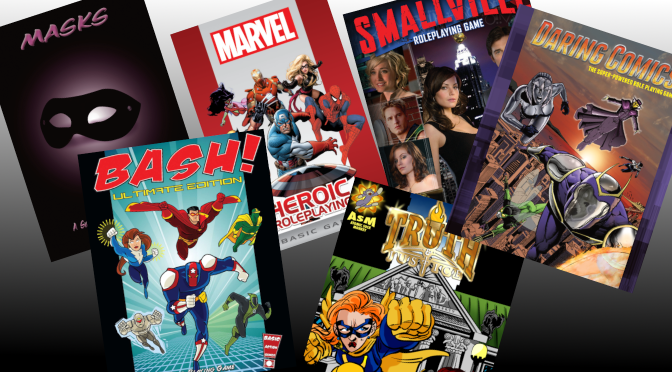
Rules-Lite Superhero RPGs Revisited: Part 6 (Conclusion)

A few months ago I wrote a survey of Superhero RPGs, and more recently I began looking into the best games from that survey in more detail. Here are links to Part 1, Part 2, Part 3, Part 4, and Part 5; since everything I say here supersedes what I said in my original post, I recommend looking at that one after reading this one, if at all [you probably shouldn’t].

Continue reading Rules-Lite Superhero RPGs Revisited: Part 6 (Conclusion)

Nostalgia, consumption, and D&D

I am not too proud to admit I’ve watched every episode of Netflix’s That 90’s Show. Unlike the first attempt at a spinoff, That 90’s Show is nakedly and obviously a sequel to That 70’s Show while also fishing in the shallow pool of 90s nostalgia, including groaningly obvious musical numbers and cameos specifically meant to induce memories of going to high school in the 90s. I’m technically a bit too young for the target market, as well as someone who thought themselves too aware of tropes and psychological ploys to get sucked into this kind of TV. And yet, get sucked in I did. It’s a blatant comfort-watch, calling back to the original series, the magical time before social networking, and also the bygone era when multi-camera sitcoms were still the bulk of network TV programming (remember network TV?).

Nostalgia plays aren’t limited to TV, and of course in the TTRPG world we see them all over. There’s arguably two angles to nostalgia within TTRPGs: The RPG as nostalgia tendril, where the game is simply the marketing device used to exploit the audience’s existing love for Star Wars, or Marvel, or My Little Pony. These games can be good or bad, but they’re built around their existing property and serve that property (and its licensors) first. There’s also nostalgia for the TTRPG itself. While a cynic may call the OSR solely a nostalgia play, there’s much more obvious examples at play here; Goodman Games is clearing half a million dollars in crowdfunding for what is effectively a reprint of a module from 1979. They’re making a t-shirt as part of this campaign, so it’s definitely at least a little bit for the money. That said, I don’t think the Caverns of Thracia reprint is entirely indefensible. Goodman is doing a service by taking a great old module and keeping it available, including updating it for new rulesets; it’s still arguable whether that’s worth half a million dollars and t-shirt sales. And that’s the primary issue with nostalgia: Where do we draw the line between archiving and reviewing the past, and wallowing in it?

Continue reading Nostalgia, consumption, and D&D

Crowdfunding Carnival: July, 2024

Welcome to Crowdfunding Carnival for July! July is the summer doldrums in the RPG world, no doubt about that. With GenCon in early August, a large portion of the design world shifts the timelines of their games so that they have either announcements for GenCon, or something to sell at GenCon. As a result, product announcements, be those releases or crowdfunding, rarely if ever happen in July; the potential benefits of waiting just a few weeks are too much. As a result, this article will not hit the target of ten campaigns; the designers aiming to put forth original RPGs are exactly the ones who would benefit the most by using GenCon as a platform.

Continue reading Crowdfunding Carnival: July, 2024