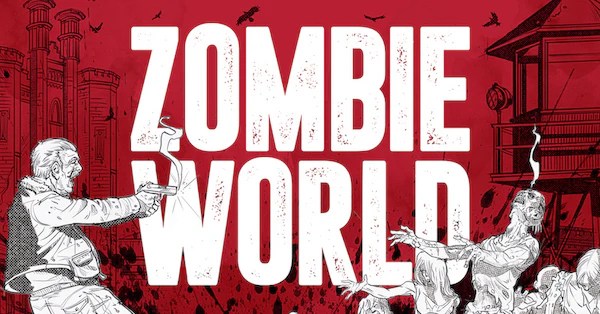
Apocalypse World won accolades due to its design, but Powered by the Apocalypse won sales thanks to its handling of genre. The minute that someone took a stylized post-apocalyptic soap opera and ran D&D with it, everyone wanted to see what they could do with the framework. Horror is no different; PbtA has proven adept as a basis for monster hunting, urban fantasy, and Victorian Penny Dreadful, among others. Naturally, someone turned to zombies.
Zombie World is a Magpie Games production, primarily designed by Brendan Conway (of Masks fame). Given coverage of their current licensed games, one could easily surmise I have a chip on my shoulder regarding Magpie’s output. Luckily, Zombie World is a great example to show that this is not the case; the game is both intensely innovative and intense to play. There are some problems with the game but the biggest one affects how well the game has sold, not the quality of the play experience. What is that problem? The game is card-based, and for all of the (positive) impacts it has on the play and packaging, it has made the game difficult to translate into a digital counterpart, affecting sales and availability.
As a card-based game, Zombie World threads the needle of using tried and true PbtA mechanics while making the best use of its unique form factor. In my opinion this is accomplished well; the game reads and plays fast and the 32 page rulebook included really is all you need. To really test how this all worked, I picked up a copy of Zombie World and took it to my online gaming group’s in-person gaming weekend for a one-shot. While the players were going harder than normal given the vibe of the weekend, I was still surprised at how quickly and easily Zombie World devolved into Walking Dead-like drama; our game involved backstabbings, double-dealing factions, and, of course, overrunning both the harbor and city hall of a large city with zombies.
In the box
Taking cues from the board game world, Zombie World breaks out into several smaller ‘decks’ in order to provide a range of game mechanics without needing much of a book to explain them. These decks present information and mechanics about the Enclave, information and mechanics about characters, and several ‘engine decks’ which drive play. Both the experience of the game and the game pieces can be divided into three basic parts: Enclave creation, Character creation, and ongoing play. For Enclave creation, players start with one of a couple Enclave locations, the place where the characters and others have walled up against the zombies. The boxed game includes Prison and Hospital, and there are expansions including Mall and Farm as well. Each Enclave is described with two cards; one card has the Enclave’s specific Moves on it, while the other has a summary of options selected during Enclave creation. These options, Surroundings, Scarcity, Population, and Advantages, are mostly descriptive, though the Advantages in particular also confer specific special Moves which are located on the (oddly enough) Advantage cards. Enclave creation is simple: Pick an Enclave, then pass the options card around the table and let each player pick options until the Enclave has two each of Surroundings, Scarcity, Population, and Advantages.
Character creation is similarly templated and here the game departs from the PbtA norm to great effect. Players are given an array of four values to choose from for the four stats of the game: Survival, Savagery, Steel, and Soul. Instead of a playbook, though, players draw cards from three decks: Past, Present, and Trauma. The card for the Present is played face up and gives the character a Move and some equipment. Cards for Past and Trauma, though, are played facedown. These cards also give Moves, but they can’t be used until the player reveals the card to the table. Revealing cards has some interesting implications that I’ll go over in the next section. As character creation really comes down to four stats and three cards, it’s very quick. The last bit of setup is Relationships. Here, cards from the Population Deck come out, representing NPCs also in the Enclave. For our four player game each character got an ally, as well as Relationships that described something they shared with each other player character.
When getting into play, it becomes clearer how Zombie World’s mechanics differ from most PbtA games. While the standard Move resolution still has three outcomes (a Triumph, or complete success, an Edge, or partial success, and a Miss), how you determine the outcome is different. The game has several engine decks, the main one of which is the Survivor Deck. Drawing from the Survivor Deck gets you cards labeled either Miss, Edge, Triumph, or Opportunity. An Opportunity is a special result that can be either a Miss or a Triumph depending on whether you spend Stress (more on Stress in a bit). Your stats equal the number of cards you can draw from the deck, and your result is the best card in your draw.
Zombie World takes a different approach to Harm than most PbtA games. Each character has a Stress track, and you may need to mark Stress to use an Opportunity card or trigger other special abilities; you may also mark stress as part of an Edge result. Each character can take five Stress; mark five and then you take a new Trauma and clear your track. If you ever get four Traumas (including the one you start with) the character is retired and becomes an NPC. That’s all fine and good you say, but what about Harm itself? Harm is modeled one of two ways. When characters exchange harm as per the Turn To Violence move, fictional positioning and the nature of the harm in-game tells the GM whether or not a character is suffering serious harm. There are no weapon stats, but a few examples are given regarding how the choices in the Turn To Violence move go. In any case, if a character suffers serious Harm, they draw a number of cards dictated by the nature of the harm. On a Triumph they’ll live, on an Edge there’s a complication, and on a Miss they straight-up die. No Harm track to insulate you here.
There’s one more form of ‘harm’ in the game, and that’s the Bite Deck. When dealing with zombies, Edges and Misses on Moves may have the player draw from the Bite Deck. On some cards, nothing happens, and on others, there may be a complication, like something breaking. There is one ‘Bite’ card, and once it’s drawn, the character’s fate is sealed. To make this even more fun, the Bite deck isn’t reshuffled after each draw, only after a character gets bitten. Every subsequent draw from the Bite deck makes getting that Bite card more likely for the next player.
The final engine deck to note is the Fate deck. Each Fate card has two sides: First are relationships, which are used in character creation to define how the characters know each other and their NPC allies. The second is called ‘Time Passes’, and is meant as a supplement to the game’s GM Moves. When there’s any amount of time where the characters and/or Enclave isn’t under threat, the GM draws a card from the Fate deck and sees what new complication arises. The complications are strong and immediate but the prompts are left broad; instead of specifying what happens they directly reference elements that the group put together in character creation, like the NPC population and the Enclave scarcities and surroundings. This results in cards like ‘a personal conflict boils over’ and ‘the surroundings breed opposition’.
At the table
How do all these rules come together at the table? Really well, as it turns out. My group set up their hospital Enclave, located near the harbor and a police station, in a busy downtown. Character creation provided everyone with one ally, and me, the GM, with a problem statement: There’s a new group coming in from the surroundings. Given the harbor, I decided this would be a Navy vessel trying to establish an anti-zombie beachhead, and it was off to the races. The group broke into City Hall to get some sewer maps in order to move around the city more safely, heading off a zombie threat with ingenuity and distraction. Once they were back, they found themselves between two competing plans: Use the sewers to get to the harbor was the obvious first step. When they were there, though, the leader of the hospital Enclave, a no-nonsense head nurse, wanted the team to just figure out what was going on and report back. The head of the police station Enclave, a county prosecutor, wanted them to use harborside klaxons to attract zombies to the site and trap the ship’s crew. Of course, things started getting heated before either mission was enacted.
Now is a great time to revisit the character mechanics, those Past, Present, and Trauma cards. The Present cards, which for our team were things like ‘Archivist’ and ‘Cook’, had certain Moves they opened up. The Past cards were more interesting, but more risky. One of the players had ‘Contract Killer’ for a Past, and ended up showing the card when they tried to kill one of the NPC allies. Why? Well, they had a relationship with another PC that determined that both PCs knew someone in the Enclave ‘had to go’. When the would-be victim was alerted to the former Contract Killer’s presence, that PC tried to escape…and that’s where one of the dynamics of the Past, Present, and Trauma cards became incredibly clear.
Like many PbtA games, Zombie World has a Help and Interfere move. Instead of being based on character relationships, the number of cards you can draw for Help and Interfere is based on the number of Background cards the player has face up. This meant that the characters who had all their cards revealed always got three cards drawn against them if someone wanted to Help or Interfere. The impact, though, is much more significant in Zombie World than in most games. Instead of a flat penalty, Help/Interfere lets you swap out one card for another. Help means you give them a good card and Interfere a bad card; the actual mechanics are otherwise identical. Given the number of cards in the deck, though, it is more likely than not that an Interfere would be able to convert a Hit to a Miss. Indeed, in our game that happened several times.
Our one-shot ended with a character sabotaging the recon mission to ring the klaxon, and then another character Taking Point to make sure the whole party got out alive. Thanks to some lucky pulls from the Bite Deck, everyone did make it out…only to have the guns start waving the minute they were back at the hospital. It was a tense and dramatic game, and I cut it off at the hospital before any characters tried to off each other. If this had been a longer game, I think the dynamics of the Help/Interfere Move would have likely made for some more pronounced, more tense alliances. This would be even better with more players…the NPCs just don’t contribute the same way to this sort of storyline, but that’s to be expected.
Although elements like the Bite Deck were mostly on our side this game, it was still clear that the game pushes you to consume resources. Stress was taken frequently, and even in the short span of the one-shot players were looking at their Moves to relieve Stress. Since several of the Zombie Moves (Moves specifically pertaining to the undead as opposed to human PCs and NPCs) offer a choice between taking Stress and either taking Harm or drawing from the Bite Deck, having Stress as an option can be the difference between life and death.
Overall, the game built up a tense situation very quickly, and started driving characters towards tough choices. A one-shot doesn’t necessarily exhaust resources in the same way a longer game would, but even so, both the game’s ability to support the GM and keep the tension high left me very impressed.
Zombie World is only a physical game in all the ways it counts. There actually is a Roll20 version of the game, available at the same level of discount you’d expect when moving from print to PDF, but it hasn’t really moved the needle in a way a widely-available PDF would. For one, it’s stuck in the Roll20 environment, which is both losing ground to newer VTT options and generally leaves a bad taste in people’s mouths in terms of locking them in to the platform. Besides all that, Roll20 owns Demiplane and Magpie, while prominently marketing the Demiplane nexus for Avatar Legends, hasn’t given Zombie World the same treatment or the same exposure. Digital seems like a missed opportunity here.
The physical package of the game is pretty slick, though there is room for improvement. The game comes with dry-erase boards for both characters and enclaves, and I didn’t find them particularly useful. Such small boards require dainty handwriting, and while my handwriting simply isn’t good enough in most cases the cheap dry-erase marker packaged with the game isn’t fine enough to make the most of the boards either. We made do with scratch paper, but if the game really needed to include sheets for those elements, rip-off pads are almost as cheap as the laminated boards and significantly more usable thanks to the wide availability of 0.5mm mechanical pencils. On another perhaps very nitpicky note, I bought the Zombie World bundle, which includes two expansions. The game box is barely large enough to fit one expansion. It’s not a huge deal, but a slightly deeper box so I can actually carry everything together would be great.
Physical nits aside, Zombie World is a fantastic game. It rolls up fast but cuts deep, and could easily support both one-shots and PbtA-length campaigns. I think that things like the Population deck are going to be of limited usefulness once a game really starts stretching on, but their ability to get you started fast while keeping things interesting still makes the implementation worth it overall. Not everyone is going to want to play a game with no intrinsic advancement mechanic past a couple of sessions (the only way to ‘advance’ is to gain more Traumas, which is pitch-perfect for the genre), but given the nature of the Enclave and the zombie threat, there’s more than enough material to let the game continue until it collapses under the weight of its own plotlines, much like The Walking Dead. Zombie World is both flexible and fast, and from my experience playing I can say it handily takes the zombie horror crown away from incumbents like All Flesh Must Be Eaten. Even if the physical copy is required, Zombie World provides both smart game design and an intense game experience that will make many horror fans very happy.
Zombie World is available from Magpie Games.
Like what Cannibal Halfling Gaming is doing and want to help us bring games and gamers together? First, you can follow me @LevelOneWonk@dice.camp for RPG commentary, relevant retweets, and maybe some rambling. You can also find our Discord channel and drop in to chat with our authors and get every new post as it comes out. You can travel to DriveThruRPG through one of our fine and elegantly-crafted links, which generates credit that lets us get more games to work with! Finally, you can support us directly on Patreon, which lets us cover costs, pay our contributors, and save up for projects. Thanks for reading!
 Cannibal Halfling Gaming
There has been a digital version since the kickstarter: https://marketplace.roll20.net/browse/module/4355/zombie-world-deluxe
LikeLiked by 1 person
Oversight on my part, to be sure. I will make some corrections.
LikeLike