It is in some ways perfect timing that only a month ago I was comparing Fate and Apocalypse World, and looking at their respective destinies. In 2013 the fourth edition of Fate, Fate Core, went from its Kickstarter to legitimately outstanding commercial success. Around the same time, Apocalypse World had just started on its inexorable upward trajectory not due to its own sales numbers but rather the adoption of its underpinnings, Powered by the Apocalypse. Fate would peak in the lead-up to D&D Fifth Edition while PbtA would continue to soar, eventually powering what was at the time the largest TTRPG Kickstarter ever.
Both games were successful enough to spawn not only hacks but also derivatives, mechanical cousins of the original game which kept the underlying ideas but altered the core mechanics. Blades in the Dark is the notable one for Powered by the Apocalypse, but there were of course others. For Fate, the same thing happened, even if much of the hacking was further under the radar than what John Harper pulled off on the PbtA side. There is one Fate hack of note which is coming back into the limelight, the Mist Engine from Son of Oak Game Studio.
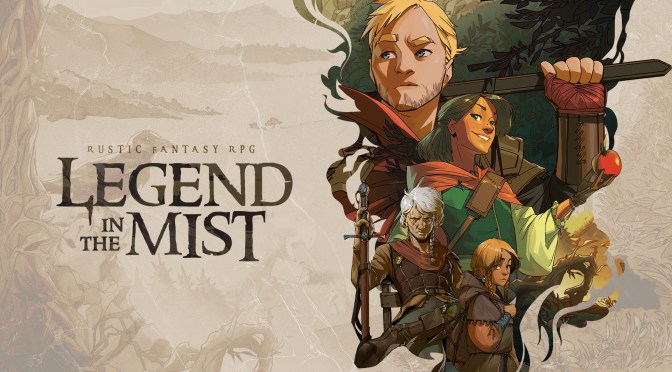
Son of Oak started with City of Mist, which saw a successful Kickstarter back in 2016 and came out in 2018. City of Mist, as Aki covered in his review, is an urban fantasy game focusing on individuals with legendary power; think more Dresden Files than Urban Shadows. It was also the first time gamers had a chance to see the Mist Engine’s unique blend of Fate-derived “Aspects and Agents” gameplay tied together with the classic PbtA three-result 2d6. From there Son of Oak released a number of other games, most notably a “mythic cyberpunk” game called Metro:Otherscape. Earlier this year came Son of Oak’s most recent game, their attempt at classic fantasy called Legend in the Mist.
For me personally, the Mist Engine suffered from the same issue that Apocalypse World: Burned Over did; someone gave me a one sentence description that immediately turned me off. For Apocalypse World: Burned Over that was “Toned Down Apocalypse World”, and for City of Mist it was “A blend of Fate and PbtA”. The thing about blending Fate and PbtA is that, from maybe 2015 to 2018, it was a really popular idea and it was usually done badly. Fate and PbtA are very different games and I’d go so far as to say that they shouldn’t be blended, at least not on a fundamental level. That said, City of Mist did very well and I simply assumed it was the exception that proved the rule. With all the games in the world I didn’t actually read a Mist Engine game until I got my hands on Legend in the Mist, and when I did I immediately realized my mistake in overlooking these games. The Mist Engine is not a combination of Fate and PbtA, though seeing how it adopts Otherkind dice from PbtA you could certainly think otherwise. The Mist Engine is the Blades in the Dark to Fate’s Apocalypse World, the hack of Fate that could get it to a whole new audience.
How the Mist Engine does Fate
Let’s quickly review the basic mechanics of a Fate die roll. When a character wants to do something, they are going to invoke Aspects, either of their character or of the environment, to add bonuses to their roll, typically a +2 for each Aspect. The GM may use a ‘hostile invoke’ to add that same +2 to the difficulty of the roll if an Aspect of the environment or the character is a hindrance to them accomplishing the goal. They then roll four Fate dice, special dice marked with two plusses, two minuses, and two blank faces. The dice roll is added to the character’s relevant Skill or Approach and any bonuses from Aspects, and compared to a target number. From there, either the roll succeeds and the action is performed, or for a more complex sequence like combat, the result of the roll adds marks to a Stress track, which determines when a Threat can be overcome.
In the Mist Engine, when a character wants to do something they determine the Power of their roll by adding +1 for each relevant beneficial tag and -1 for each relevant detrimental tag. They then roll 2d6 and add the total Power to the roll. If the roll is a six or less, the action doesn’t succeed and the character takes Consequences, if the roll is a seven to nine the action does succeed but the character still takes Consequences, and if the roll is a ten or higher the action succeeds and the character need not take Consequences. The action can outright succeed for a simple action, or add to a Status taken by a threat or obstacle which, when it exceeds a Limit that the threat/obstacle has, will indicate that the threat/obstacle has been overcome.
While I obviously massaged my descriptions to get them closer to each other, the meaning should be clear: The Mist Engine is derived from Fate. Like Fate, characters are described with Aspects (Tags) and threats are modeled as characters (at least numerically). Like Fate, each roll involves stacking Tags for or against the player, and then rolling from there. And, like Fate, the die roll sits neutrally between success and failure, with the Fate dice having a median of zero and the PbtA roll having a slight bias towards success with a mean of 7. Unlike Fate, though, Legend in the Mist is not built on an underlying metacurrency economy; every relevant tag counts every time they’re relevant. This, as well as the more linguistic shift from ‘Aspect’ to ‘Tag’, are key differences that make the Mist Engine different from, more accessible than, and arguably more complex than Fate.
Aspects are the core mechanical language of Fate, and speaking the language of Aspects is the most difficult part of learning how to play Fate. In Fate Core, characters are described by five Aspects, short phrases which are meant to describe who the character is and what they can do. Rules-as-written, Aspects are flat; every Aspect has the exact same magnitude as every other Aspect. This inevitably means that your ability to write Aspects that come up in as many situations as possible is advantageous, and that when you write supernatural or otherwise non-realistic Aspects, the actual implementation of those Aspects falls back to negotiation between player and GM as well as a degree of fiat. The Mist Engine does away with these problems by doing away with high-level Aspects. Kind of. Instead of five Aspects, each character is described by four Themes, and Themes have the same intent as Aspects. Instead of being simple phrases, though, Themes are containers for the Tags that players can actually use when their character does something, and they are bound by firm rules when it comes to what they can be and what they must contain.
Themes benefit both from structure and having a significant amount of guidance in the rulebook. Each Theme has a name which is a tag, two other positive tags, and a negative tag. This means every character is going to start with sixteen tags, a large number compared to what Fate has you working with. This works because the tags are straightforward; it also helps that the book is full of ‘Theme Kits’ which give you examples and ‘Themebooks’ which have questionnaires to help you develop your own. Each Theme also has a Quest, and these are interesting. Quests fall somewhere between Drives from Cortex Prime and Beliefs from Burning Wheel, with the breadth of Drives but the finality of Beliefs. Most importantly, Quests are intended to replace the controversial ‘Compel’ from Fate Core. In Fate, the GM could ‘compel’ one of a character’s Aspects to get them to act against their interest and in line with their Aspect. The player is rewarded for taking the Compel and punished for not, which many see as heavy-handed. For the Quests in Legend of the Mist, instead of getting or losing Fate Points, each time you go against or neglect a Quest, you mark the ‘Abandon’ track in the Quest. Each time you lean into the Quest and do something challenging in service of the Quest, you mark ‘Milestone’. If you fill the ‘Abandon’ track, you have to get rid of the Theme and replace it with something else. Meanwhile, if you fill the ‘Milestone’ track you get to “evolve” the Theme, changing tags and potentially the power level (more on this later). These two tracks in concert provide not only rewards for following your Quests (evolving a Theme is the primary way to make your character more powerful, while replacing a Theme if you abandon it makes it temporarily weaker), but also allow the character to organically shift into a shape that aligns with how you’re playing them. It is a powerful way to build a character narrative that compares very well against the fantasy narrative baseline, D&D.
How Legend in the Mist does D&D
One small but very important detail in Legend in the Mist’s mechanics is that Themes have Might. There are three levels of Might in the game: Origin, Adventure, and Greatness. These could potentially be seen as comparing to, oh I don’t know, Heroic, Paragon, and Epic, though the ‘rustic fantasy’ underpinnings of Legend in the Mist don’t exactly align with the larger-than-life ambitions of D&D 4e’s 30-level arc. Still, Might provides evolution, and allows characters to feel much more powerful (or conversely much more outmatched) when facing threats of disparate Might levels. The mechanics are simple but potent: Each level of disparity in Might gives either a +3 or -3 to all rolls. That means a Theme at the Greatness level, when used against an Origin threat, will get +6 to everything. For the typical PbtA 2d6, that’s an astounding bonus.
The combination of Might and evolving Themes mean that Legend in the Mist is well-positioned to provide the zero-to-hero D&D fantasy and also do it in a tactile way; Quests and Improvements (marked when you use a weakness tag but still succeed) are both more granular but also more reactive than Milestones in Fate, and while they’re nowhere near as specific as levels in D&D they still give that sense that you’re advancing in line with your character concept, which is absolutely a good thing.
Legend in the Mist has a ton of examples across its two books; in addition to the Theme Kits and Tropes for players, GMs get over a hundred pages of scenarios and challenges, including a mix of simple challenges and consequences and more complex ones, typically taking the form of creatures or traps. The place where I feel that Legend in the Mist secures its status as a high fantasy game, though, is in the sections on Magic. The Player’s Guide has eight different magical disciplines for you to add into your game via Themes or Challenges, and the Narrator’s Guide has further rules for coming up with your own magic systems and aligning them with key tropes from fantasy (e.g. Magic Requires Gathering Power, or Magic is in Short Supply). Magic runs a massive gamut in terms of how it can be expressed and how powerful it is, but is also created in a way that is narratively consistent (and therefore, narratively satisfying to me).
Beyond the examples given and the fantasy themes employed, Legend in the Mist also helps its GMs (or Narrators) run an effective fantasy campaign. While Dungeons and Dragons started as mostly a dungeon crawling game, the shift to grand heroic fantasy began back with the Dragonlance setting for AD&D and was cemented in the rules of 3e, 4e, and 5e (albeit in different ways each time). Legend in the Mist is going straight for the heroic fantasy arc, and provides GMs with a strong non-linear schema that aligns with this trope. While the book gives multiple campaign archetypes (fantastic, most games don’t even provide one), ‘The Mountain’ is a graphic organizer for what pretty much all fantasy campaigns (including most modern D&D campaigns) look like. Starting with the characters’ world being in peril, they ‘climb the mountain’ and face Dangers of increasing intensity as they make their way to the Great Danger which has put the world in peril. Eventually they will face the Agents of this Great Danger, and the Great Danger itself. What makes this good is that everything in this schema is defined. What makes a “Great Danger”? What makes an Agent? How are things changing, both literally and metaphorically, as characters ascend the “slope” of the mountain? And of course, what happens when the characters fall down? I appreciate that this is a definitively non-linear way to organize a fantasy adventure, but it’s also shown in contrast to another schema, The Crossroads. The Crossroads more represents an Apocalypse World game, or Game of Thrones, or many other fantasy works where the intent is not to follow a single protagonist or protagonists as they grow and change. Instead, The Crossroads uses the Apocalypse World language of ‘Fronts’ to show how to build a setting where different conflicting forces are working against the characters and each other, and how to make this setting reactive to the characters’ action or inaction. Both of these schemas are the sort of overarching prep guides that D&D would benefit from, but are even more important in a game like Legend in the Mist where the trajectories of advancement for characters are so much more flexible and more likely to be reactive to what’s going on in the world. As much as the Mist Engine provides good modifications to Fate, Legend in the Mist is much more than the mechanics when it comes to being a flexible and usable fantasy game.
I slept on the Mist Engine, and I know many other people did too. My hope is that by attacking fantasy, the baseline genre of the 21st century TTRPG, Son of Oak gets more recognition for what they’ve accomplished here. Tag-based games require a degree of granularity and complexity to be satisfying, and the reason the Mist Engine succeeds is that it aims to be more granular than Fate. Just like how crunchier games can often be easier to wrap your head around than very oblique rules-light systems, the Mist Engine’s use of more tags with less inherent meaning per tag is just easier to think through and deal with than Fate Core. At the same time, tags represent the sort of thinking many gaming groups, including mine, do in games, about what they can bring to bear or what’s important in a scene rather than doing statistical analysis.
While City of Mist wasn’t really aligned with a preferred genre for me, Legend of the Mist is, making it a compelling D&D alternative for future games. At the same time, Metro: Otherscape looks like it could be an intriguing Not-Shadowrun for me to play and run. The Mist Engine broke cover nearly a decade ago, but I’m only now reading into it, unfortunately for me. And while I do agree with Aki that the volume of tags and mechanics can be a lot compared to Fate, I think it’s the right level to keep things interesting and narratively satisfying. If all you want for Christmas this year is a fantasy game that’s not D&D, I think I have a good recommendation for you.
Legend in the Mist is available from Son of Oak and on DriveThruRPG.
Thanks to Coleman Gailloreto and Son of Oak for reaching out and offering us a review copy to check out!
Like what Cannibal Halfling Gaming is doing and want to help us bring games and gamers together? First, you can follow me @levelonewonk.bsky.social for RPG commentary, relevant retweets, and maybe some rambling. You can also find our Discord channel and drop in to chat with our authors and get every new post as it comes out. You can travel to DriveThruRPG through one of our fine and elegantly-crafted links, which generates credit that lets us get more games to work with! Finally, you can support us directly on Patreon, which lets us cover costs, pay our contributors, and save up for projects. Thanks for reading!
 Cannibal Halfling Gaming
3 thoughts on “Legend in the Mist: Mist Engine may be Fate’s Forged in the Dark”