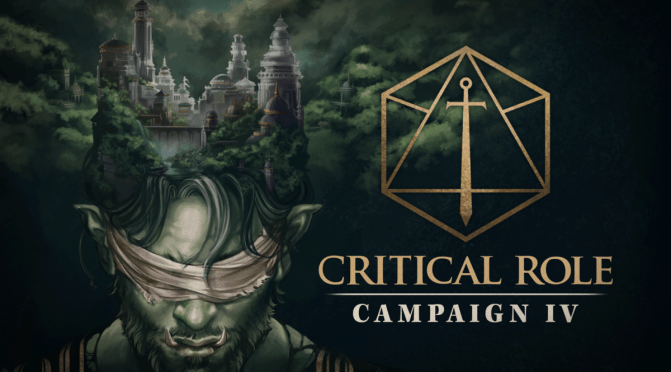
Well, it happened: I got hooked into arguably the most gaming table in the community. And…it’s kind of hard to write about.
Let’s be honest: at this point, Critical Role has long since left behind the status of “home game” and is more a monolithic cultural force. We here at Cannibal Halfling Gaming have a let’s-call-it complicated relationship to both D&D (and Hasbro). I won’t speak for anyone else, but I enjoy D&D but have never actually seen anyone play it “out of the box” with no alterations. Every iteration of it I have seen has changed the rules to some extent, and there are systems that do the parts that I enjoy a better way. But I really can’t ignore the cultural significance that it holds and Critical Role timed itself well, riding the then newly-released 5th edition and captured the zeitgeist. And yet, for all that I couldn’t ignore the memes and an animated series being released I never actually sat down to watch it. There was just so much both with lore and a sheer crushing number of hours that made sitting down to catch up on a campaign seemed an insurmountable wall.
And then, the team decided to do something completely different: they reset the lore, brought in a new GM, fleshed out the cast to double its original size and adopted a West Marches inspired campaign design. And credit to them for making that choice. I can imagine the temptation to stick with the winning formula until the golden goose was dead (although they did stick with D&D instead of, say, Daggerheart, but that’s another topic altogether).
We don’t play like the cast at Critical Role at our table, and to be honest very few do. And that’s great. The way your table plays that has everyone having fun is the right way for your table. So while I like some of the new houserules and quirks that new GM Brennan Lee Mulligan has introduced, I think they’re less interesting than the story tools the team are using to structure an engaging story. These are the things that you can try at any table to engage your players or as a play work with your GM to craft things in a setting that will both make their job easier and give you more of a stake in the outcome.
The “In Medias Res” Exposition Dump (Without the Dump)
The campaign opening that Brennan Lee Mulligan started with was so good that I expect it to eventually be beaten to death along the lines of “you all meet in a tavern” or “let’s do a Skyrim prison break”. Without giving too much away, the Campaign opens on the approaching execution of a former-revolutionary turned folk hero by the name of Thjazi Fang. This figure is scheduled for a date with the noose today:
Doing this offers an instant slew of latch points the GM can offer:
Who is the condemned to you?
What do you feel as the hour of this execution draws near?
Were you a part of this revolution, on one side or the other? What part was it?
If you have a plan to stop this, why is it falling apart?
The story prompt is in a way a subliminal version of the Twenty Questions of Legend of the Five Rings. Are they necessarily part of optimizing a build? No. But each time you hit that question, it’s making a decision on what your character would be at that moment. Each answer is a bit more of who your character is. Even better: nothing about this setup is D&D specific. I could fairly easily port it over to Star Wars, framing it as a Clone Wars hero facing charges of treason from the Empire, or a Legend of the Five Rings game where a former diamyo under house arrest after a war who’d been given amnesty is now imprisoned by the new Emerald Magistrate. Our mission at Cannibal Halfling has been putting games and gamers together, so how can I not get stoked at something that lights a spark in a lot of new games?
The Balance Myth
I will say that one of the parts of GMing that I find trickiest is combat design. Generally speaking, it’s tough to narrow in on a specific point where a fight is challenging to players but not a death sentence. It’s something that steers me away from crunchier systems but that’s been tough for me to manage with me making the finale less about how terrifying the bad guys was as much as what cool stuff the players would do in the aftermath.
Except…maybe balanced encounters are less important than I thought. Without spoilers, Brennen Lee Mulligan has made a point to repeatedly state that the world of Arman is emphatically not balanced and I don’t think it’s a bad thing for a game.
First off, what is character death? I know we grow attached to them, and we don’t want to lose a character we’ve invested our time, attention and selves into, but that impulse can prevent characters from hitting their pinnacle and sometimes a backup character even winds up being a better fit.
Second, defeat in general is not a bad thing for players. Setbacks are a basic part of the Three Act Structure, and a hero who never loses or never has to challenge themselves more is quite frankly strictly wish fulfillment. Give the players the chance to run into something really nasty: not a railroad, but offer the chance. Have something lurking deeper if players want to venture past where they need to go, if they want to press their luck. Have a “Wham Moment”. Even just failing a mission because there was someone better prepared and equipped offers a rival. A GM can massage the mechanics if they feel they have been overly harsh so it’s ok to make a mistake.
The Gut Punch: Targeting What They Love
Let’s be honest: players typically go into a combat-focused TTRPG with the understanding, if not the expectation, that their character will be hurt or perish. It’s kind of built into our understanding that there may be trouble but most systems I know typically make damage temporary. Being hit is something that will get healed up at the next downtime. Even curses or long term injuries are something that the player can now work toward addressing. It’s not something that typically rattles you.
No, what rattles most players is the idea of losing the stakes of what they’ve placed in the world: What is important to the players characters and what can be taken away? Is there a beloved mentor? A family member? As much as we’ve joked about the intended plot becoming the sidequest on the mission of “get the old inn up and running”, that’s the players investing theirs and their character’s attention and energy.
If you want to rattle your players, go for these things. One of the nicknames I’ve seen for the assorted tables were “The Mourners” and it’s true in more ways than one. By the end of the initial four episode overture every character is mourning the loss of something: family, a partner, a cause, your place in the world, a relationship, a past that was and the future that can never be, and that’s what truly sets off the plot.
Up, Down, and Sideways: Weaponized Edition
Back I first started trying to write gaming articles I was chatting with Aaron about how I was starting to notice the different ways each player would go about playing and he broke it down to succinct terminology:
Up, where players want to advance the plot, Down, where players try to deepen their character’s relationship to the world, or Sideways, where they want to push the world on the angle so that something breaks.
I’ve thought about this off and on ever since but as I’ve watched Campaign Four move into its first arc(s) I never saw both a clearer example of this at work and also how the DM can actively utilize those tendencies. For those unfamiliar with the campaign setup, Campaign 4 expanded its table to a slew of returning guests made full time to bring a staggering 13 players as part of the campaign. As that is absolute crazytalk to most GMs, the characters were subdivided into “Tables”, named after their function: “Soldiers”, “Seekers”, and “Schemers”, each reflecting what the characters were doing, and by extension what the player envisioned the way they wanted to play and suddenly was struck that this is a nearly perfect matchup with Aaron’s definition. The Soldiers arc begins with them chasing a target out of the city. They are literally advancing after the plot. The Seekers journey to parts of the world considered lost based on a vision and are described as seekers of lore. What else is deeper to the world? Finally, the Schemers see the events through the lens of what it does to the institutions they are tied to as all the guardrails to prevent a seizure of power fail, and the only path they see is to steer former power bases in a mad dash of who can take what, and has used the friction between these visions of the future to create their own power base. Each arc plays to those impulses and the result is that play focuses on those attributes. Now, the arc shape seems to be bringing everyone back to the central location and there’s heavy speculation that groups will swap out, which is good: character motivations change and that’s one of the coolest ways they grow. I highly doubt that many of us will ever manage a group that size (for long anyway) but I think noticing those motivations helps a good GM craft something that engages players more.
As much as I am an eager convert to the show itself, I wanted to make a point to not discuss the events of the campaign in any detail. The show has plenty of love, and there’s a ton of outlets who can go over the events and characters in detail. This isn’t one of them. The tools stand on their own and I think dwelling on what you can take is more valuable than having anything that you would compare your own game to. This hobby is not a race, and the best thing for a table to do is what makes it happy, but maybe this helps you try a new thing, or gets someone else interested in trying.

