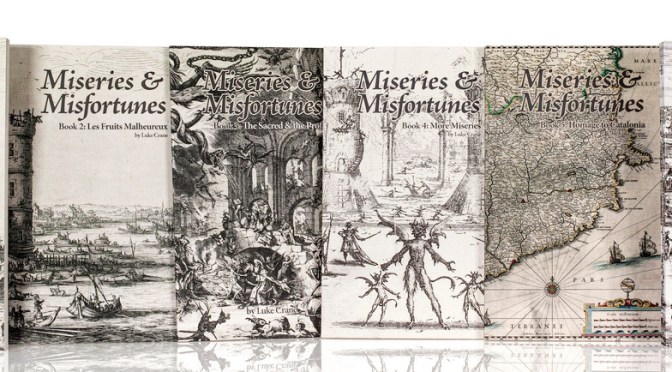
Luke Crane is best known as the designer of The Burning Wheel, an intensely detailed medieval fantasy/Tolkien RPG which aims for a very different fantasy experience than what you find in Dungeons and Dragons and its contemporaries. The Burning Wheel has more and more complex rules than D&D, but it’s also a game with a strong sense of time and place; Crane’s inspiration for the fantasy side of the game was Tolkien outright (which is not the case with D&D), and the rest of the setting was inspired by history nonfiction by the likes of Barbara Tuchman, Desmond Seward, and others. The result is a game heavily steeped in 12th-13th century medievalism, but with the historicity sanded off with some genericization and, oh right, wizards and elves and giant talking rats.
The next biggest non-licensed game from BWHQ (both Mouse Guard and Burning Empires are licensed) is Torchbearer, which is more than anything a direct shot at D&D. While it uses somewhat similar mechanics to Burning Wheel, it is much more focused on dungeon crawling, taking some of the more structured procedures of 0e and Basic D&D and extending them to everything, including not only the dungeons and wilderness exploration but also town visits and social interactions. Torchbearer is a distinct game from Burning Wheel, and while Burning Wheel is known for its complexity Torchbearer is known for being fiendishly difficult due to its constant Grind and aggressive resource management.
Luke Crane designed another game, more similar to Burning Wheel than the others in BWHQ’s portfolio. What’s truly strange about this game, though, is that it is a hack of Basic D&D. That in itself isn’t that weird, plenty of designers hack D&D for many purposes good and ill. What is weird, though, is that this hack of Basic D&D looks at the trajectory that Torchbearer plots from Burning Wheel and runs straight and fast in the opposite direction, aiming for more intrigue, more historical accuracy, and not a single dungeon to bother with. This game is called Miseries and Misfortunes.
Miseries and Misfortunes doesn’t take place in a century or era, it takes place in 1648. It doesn’t take place in a region, it takes place specifically in France. While the game was originally written as a hack of Basic D&D, the second edition dispenses with many of the D&D norms, using a Burning Wheel-like combat system, lifepaths, and a skill system which, while not the Burning Wheel dice pool, is still a completely custom setup. The only things which you would recognize from D&D are the core stats, the notion of saving throws (though D&D never had ‘save vs. artillery’), and some random character generation. And starting with this randomness is where the game’s weirdness and Burning Wheel-ness collide to make it oddly delightful. Thanks to the game’s tightness of concept, many of the excesses of Burning Wheel are reined in to make a set of mechanics that is much easier to use while providing the same amount of natural conflict and self-reinforcing conflicts and story beats. Just don’t expect this to work as well if you leave the seventeenth century. Or France.
When you create a character in Miseries and Misfortunes, the very first thing you roll is your upbringing. Not attributes, but whether you were born into nobility or at least some money. From there you determine your source of income, any property you own, and what sort of obligations you may have, most notably any potential debts and dependents. You’re still not going to get into any of the classic ‘D&D stuff’ until after you also roll your political and religious affiliations, and once you do it will be a straight 3d6 line roll, with the chance to shift stats at a 2-to-1 conversion rate. One interesting wrinkle here is that, rules as written, the group is supposed to come up with their ‘motif’ first. This ordering is likely a holdover from Burning Wheel, where it was much easier to deal with as Burning Wheel has essentially no randomness in character creation. The randomness in Miseries and Misfortunes transcends that of typical D&D: Knowing that you could have a street urchin, a nobleman, and a merchant all together in one group makes many of the typical motifs for 17th century France kind of difficult. After all, the setting is defined by stratification of the classes, even more so than the earlier medieval implied setting of Burning Wheel. Choosing the motif forces players to really think about how their characters fit together, and also may push players on their choice of lifepaths.
Lifepaths are back for Miseries and Misfortunes, and they push the game further from D&D-adjacent and closer to Burning Wheel-adjacent by throwing out how you’d normally think about both classes and advancement. There are 13 lifepaths listed, mostly limited to character types which are influential or adventurous (that is to say slightly more aligned with the idea of a character class than the much broader scope in Burning Wheel). While about half of these lifepaths are restricted by upbringing (both in terms of low and high birth), there’s enough both overlap and flexibility to fill out most motifs; admittedly if you were trying to create a noble family as your motif it would likely look more like Arrested Development than Bridgerton, but some see that as a feature instead of a bug. Unlike Burning Wheel a typical starting character has one lifepath and you are expected to advance that lifepath multiple times. Each lifepath has six levels, and as you advance through the lifepath you gain additional ranks in that lifepath’s skills, albeit narrowing from advancing all of the skills to just one as you progress. Like in Burning Wheel having many different lifepaths will gain you breadth of ability, but unlike Burning Wheel there’s a distinct and potent benefit for filling out all six levels of a lifepath which I’ll go into in a little bit. There is a short list of core skills and a much longer list of lifepath-specific skills, some of which act like skills while others are somewhat more akin to traits, giving specific bonuses or abilities. These skills advance by increasing the number of faces on a die which will indicate success; a bad skill rating would be 1/10 (a 1 on a 10-sided die is a success) or ⅙ (a one on a six-sided die is a success) while significantly better would be a ⅚ (anything five or below on a six-sided die is a success) or ⅞ (anything seven or below on an eight-sided die is a success). Skill ratings can go all the way up to 19/20, and in classic D&D fashion these are typically modified by their governing attribute.
Miseries and Misfortunes eschews the granular advancement mechanics of Burning Wheel for ‘levelling up’ in a lifepath, akin more to WFRP Careers than D&D Classes. That said, the way this is done in Miseries and Misfortunes is unique and rather clever. Each lifepath has six ‘experience conditions’, and each level requires that you fulfill a subset of these to advance. These are pretty neat…for the Clerk lifepath one is ‘copy an important document’, while for the Petty Noble there’s ‘fight a duel to defend your honor’. They’re structured like Bonds in Dungeon World or Cortex Prime, but clearly serve a similar function that Beliefs do in Burning Wheel. At any point, the GM can look at what lifepath level the characters are trying to achieve and know what tasks they need to get there. Like Beliefs, the intent is to broadcast to the GM how to align mechanical progression with events that are happening in the campaign.
There are a few other mechanics to track characters that are of note. The Reputation system is mechanically typical, giving each character a base reputation score depending on their wealth and station, but it has some fascinating implications. For one, cost of living ties directly into reputation, and skimping on cost of living penalizes it. This makes maintaining a reputation (and having a certain base reputation is required to gain entry into certain places and social circles) that much more difficult if you aren’t able to maintain at least a ‘respectable’ level of consumption. Also of note is that having a high reputation begets a better reputation, and having a low reputation penalizes your existing reputation. Another interesting part of this is that while certain actions benefit your reputation and some penalize it, your character must act quickly to either prevent or enshrine these reputation bonuses. Positive actions only increase your reputation if acknowledged, and insults can be resolved by demanding satisfaction (which, yes, does occasionally mean challenging the person to a duel). Beyond that, the Duel of Wits system, while largely adapted from Burning Wheel, has been expanded to allow competitors to trade barbs in the press, an often-overlooked element of intrigue from the Renaissance era.
Perhaps most intriguing among the character attributes is Mortal Coil. Mortal Coil is derived by subtracting your character’s age from their life expectancy, but the GM tracks each character’s Mortal Coil, keeping the number a secret. As the game progresses, characters have the option to spend Exertion to gain rerolls; each reroll also adds a significant bonus (first +5, then +10, up to +20). This can also be used for forcing opponents to reroll, but adding significant penalties (-5, then -10, and so on). This does mean that many otherwise impossible things could be possible with an exertion spend, but there is of course a cost. At the end of a scene or combat encounter, any character who spent any Exertion must roll on the Mortal Coil table, 3d6 minus the number of Exertion spent (minus one). Characters must also roll on the table any time they are reduced to zero hit points. While high results may see the character gaining wisdom from their travails, low results get increasingly worse, bottoming out with (literally) ‘drops dead right there’. To make things worse, being forced to roll on the Mortal Coil at all also reduces your Mortal Coil by one. The other element is that the GM subtracts any Exertion spent from the character’s Mortal Coil, not revealing how many points they have remaining until they run out. Once that’s the case the character can no longer spend Exertion to get or force rerolls, and every year they continue living they must roll on the Mortal Coil table, adding an additional -1 penalty for every year they’ve been alive since running out of Mortal Coil. Eventually, time comes for us all. The one way to get more Mortal Coil, though, is to fully level up a Lifepath. Once a character successfully earns all six levels in a Lifepath, they add a certain number of years to their Mortal Coil, which can stave off inevitable death. Of course, given the sort of life needed to be accomplishing all of those experience conditions, outrunning death for any long amount of time is a profoundly difficult task indeed.
Let’s review. Characters in Miseries and Misfortunes are adventurous sorts in 17th century France, bound by some higher virtue like family, love, or friendship, and fighting constantly against the threat of dying tragically or fading into ignominy. While these characters are defined by Strength, Constitution, Dexterity, Intelligence, Wisdom, and Charisma, they’re also defined by their wealth, their family name, and their political and religious affiliations. There are levels, but ‘levelling up’ happens within lifepaths. There are hit points, but conflicts are equally as likely to involve insulting your enemies in the press as they are a duel with pistols. There’s a D&D candy shell, but the chocolate in this M&M is all Burning Wheel.
I think the most interesting thing about Miseries and Misfortunes are the elements that are clearly inspired by Burning Wheel but heavily cut down. The version of the lifepath system in this game is intriguing because it marries a fairly specific class-like system of character differentiation with the same sort of diegetic advancement that both Beliefs and the Skill Testing systems are supposed to represent in Burning Wheel. The versions in Burning Wheel are clearly more flexible, but the versions here are so much easier to use and easier for players to engage with. It is clear that this game is a lot newer than Burning Wheel, but also that the mission is a bit different. Elements like ‘experience conditions’ are a bit more D&D-like, but they also depend on the game’s paradigm being narrow. It is reflective of the time period, given how much of your life was chosen for you by your station or your family. That said, even if the character choices are obviously narrower, even if the arc of play is going to be more predetermined than in Burning Wheel, the accessibility is so, so much better. It even shows in the game itself, with the core rules, two conflict systems included, coming in at around 170 pages as opposed to Burning Wheel’s 600 or so.
That is a caveat worth noting: I have the first two books which are the core rules, but that means I don’t have the third book, which covers magic. I don’t necessarily think the magic system would change my assessment of the game, though if I were running I would want magic in play. It’s that somewhat ahistorical bit which makes things a bit more fun and chaotic, even if the reputational damage ends up being significant. The other books are more setting and adventure material, which while useful, wouldn’t necessarily factor into a review of this scope.
I appreciate Miseries and Misfortunes as a game, and I think if you’re the sort who enjoys reading Burning Wheel and at least wants to enjoy playing it (if you actually do all the better), you’ll enjoy this game. I’m also fairly convinced that calling this game a hack of Basic D&D at this point is tantamount to false advertising. To be clear, I don’t take issue with how the game is described on the back cover (discussing all the things added to ‘the foundation of the Dungeons and Dragons Basic Set’). That said, if you thought this was ‘BWHQ does D&D’, you have been misled. Rather, this was ‘BWHQ wrote a D&D hack, it didn’t work, so they rewrote it so extensively that it’s now a D&D/Burning Wheel hybrid’. I’m not complaining, mind you. Just like Doctors and Daleks, Miseries and Misfortunes is a perfect illustration that D&D can in fact do anything…so long as you have no upper bound on how much D&D you need to amputate first.
Miseries and Misfortunes is available from Burning Wheel HQ and on DriveThruRPG.
Like what Cannibal Halfling Gaming is doing and want to help us bring games and gamers together? First, you can follow me @LevelOneWonk@dice.camp for RPG commentary, relevant retweets, and maybe some rambling. You can also find our Discord channel and drop in to chat with our authors and get every new post as it comes out. You can travel to DriveThruRPG through one of our fine and elegantly-crafted links, which generates credit that lets us get more games to work with (which is eactly what we did here)! Finally, you can support us directly on Patreon, which lets us cover costs, pay our contributors, and save up for projects. Thanks for reading!


One thought on “Miseries and Misfortunes: When D&D stands for Dauphins and Defamation”