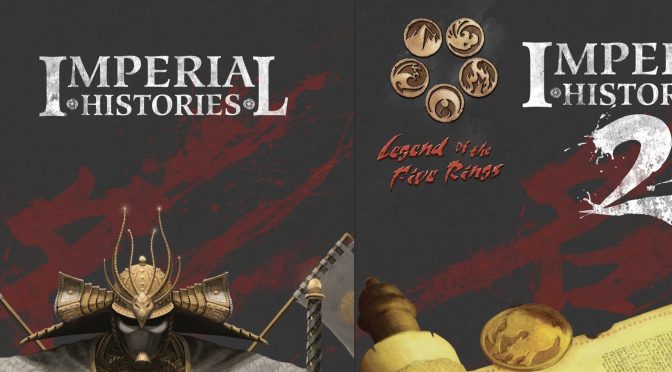
We tend to look at new things here at Cannibal Halfling Gaming. Our mission of putting games and gamers together often takes the form of introducing something that might be unknown in front of someone who may be interested. But what about sharing new things to love about something you already love, something that provides ideas for play that had not been considered before? I didn’t know it when I first encountered it but these two volumes, Imperial Histories I & II, had been powerful influences on games I played and still remember fondly.
There was a stretch of time when Fantasy Flight Games dominated my playtime. Over a course of time between 2014 and 2020, I believe I was almost continually involved with a campaign involving one of their games, whether it be Dark Heresy or their version of the Star Wars RPG and the core system of Genesys that they spun out of it. And bluntly, I love the more dynamic storytelling that comes from the novel dice systems that FFG developed. So when a Beginner’s Box of Legend of the Five Rings came out for a oneshot, and I saw a Phoenix character sheet I was immediately back to that teenager in the comic store and I knew I had to play it. And right around that time, I was introduced to a play by post group that was playing in a setting I hadn’t heard of, and that has now been six plus years of playing in different shortform L5R campaigns.
But all things come to an end: Fantasy Flight was acquired by Asmodee during this venture and found its RPG team reshuffled to Edge Studios. I won’t belabor the point, but the Edge Studios team has had very different priorities in regards to content. While I was unable to attend PAX Unplugged this year, I scouted the schedule and was delighted to see that Edge was running sessions, only to then be disappointed to see that focus had shifted entirely to new releases.
Some of these systems, I don’t worry about: Genesys was designed to be a basic core system. I have seen it tailored to two major fantasy book series franchises, not to mention multiple genre specific games run on the engine and it keeps getting updated material.
The Star Wars RPG is from a property that is a massive cultural icon, with iterations in nearly every form of media that cover a staggering number of setting options, and more importantly are generally known to casual fans. I’ve seen Star Wars campaigns set in a variety of themes, tone and place on the timeline. But the Legend of the Five Rings has always been niche. The card game it originated from never reached the heights of some of the others, and even from there the Fantasy Flight edition reset the timeline and changed the dice mechanics in a way that turned off some of the preexisting fanbase. The choice by FFG to reset the setting timeline also cascades into a gamer issue instead of a mechanical one: it limits the potential reasons for a party consisting of rival clans to play together. It’s unrealistic to expect players to choose to all play within the same Clan without a prompt, which means that the GM needs to have a reason for all of these potentially warring groups to work together, or at least in parallel. The 5th Edition Beginner’s Box has a great opening, which then leads into the training of PCs as magistrates, but that is one story to tell and some potential players just might not be interested in it. But circling back to the example of Star Wars, the timeline reset created another setting which suddenly had an absolute bevy of story material suddenly made obsolete. And yet, even as Star Wars embraced the new timeline, it certainly didn’t stop GMs and players from taking inspiration from and sometimes directly setting games in non-canon territory and in doing so has increased the longevity of the game. And the funny thing is, that’s exactly what you get in these two volumes: Imperial Histories Part One and Two.
I’m usually not in general crazy about flavor text supplements, as I usually only delve deep after I’ve already been told part of the setting lore. In this case, I think that these two books have set the bar. They key into an important conceit of the story which is that the creation myth of Rokugan is literal. Cosmologically confusing at times, but in setting literal gods descended to the ground from another realm, wandered the land for a few years and decided who among them would be chief god via tournament arc. As fantastical the setting is, it takes itself completely seriously. As the timeline winds through the eras, Rokugan’s isolationism results in the nature of each Clan remaining roughly the same, with the biggest changes being that of the political situation, and each gives new opportunities. For groups that enjoy political and social play, the Gozoku era was a time of peace but incredible corruption where three Clans conspired to consolidate power on their own and restructured the balance of power. The Battle of White Stag acts as a turning point when Rokugan is first introduced to the outside world and a little something called “gunpowder” and perhaps a turn to the outside world. These are inflection points of the setting as much as the Clone Wars or Yavin 4 might be to Star Wars, and here players have the opportunity to steer these moments. And yet even more than that, Imperial Histories proposes two alternate futures: what would normally be a short lived dynasty continues and shows a realm eroded that players are encouraged to take grander roles in, and that during the Second Day of Thunder (the grand apocalyptic event in setting) sees the forgotten God that was empowered by the Realm of Evil faces that best the Clans have to offer…and wins. What happens when all truly is lost?
The concept of an alternate history is supercharged in the sequel, Imperial Histories 2. There are histories. The Era of Genji is effectively placing players as the companions of the gods and their children, to become the heroes who would form the families of each Clan. The Steel Chrysanthemum asks the question of a malevolent Emperor. What do you do when the supreme authority in the land can end you whenever he sees fit?
There are also settings that draw fairly direct historical parallels to Japanese history. The Shattered Empire envisions a moment where the Emerald Throne is truly up for grabs for anyone who can hold it, one that mirrors the Sengoku era. It’s about the closest thing to Game of Thrones in the era of the Samurai, a time when everyone starts to get a bit more pragmatic when courtiers are unsure whether they’ll be killed delivering the message. Next is the Iron Empire, adding to the mutual feedback of samurai films and space opera with the Western. While keeping to the aesthetic, the plot mirrors the last days of the samurai: having the outside world thrown into their face and reveal just far behind you’d fallen. The Clans begin to realize that as they hurry to catch up, that they are birthing the weapons and tactics that will render them obsolete. What do warriors do when the clock is ticking not on the end of the world, but the end of their way of life?
I’m honestly doing these books a disservice because there is so much lore that I don’t know how to keep it all interesting writing them.
The books are fairly system-agnostic as well to transition to 5th edition if desired. While there are some stat blocks for certain NPCs or items, they are often so fantastical that there is no direct equivalent in 5th edition so they would have needed to be houseruled anyway. While I love both 4th and 5th edition, each is for a wildly different reason. That 4th edition books spend far more time on narrative than mechanics means that the vast majority easily cross over with 5th, which prides itself on fusing narrative in with the mechanics.
There is some value to this system agnosticism in the direction of where I predict future publisher support will go: D&D based formatting. Adventures in Rokugan was distinctly different enough from Legend of the Five Rings that one of my hesitations in recommending AoR is that change of game focus. When I play Legend of the Five rings, I want to play a game where combat is brutal and often partly won by how well social play went, and that feeling is distinctly at odds with my experiences in D&D. When I want to play D&D, it’s because I want to play higher fantasy and that’s what a lot of these places and times are. In Rokugan, the myths of creation are literal, which means that players could be walking alongside literal gods, who actually have story reasons to be statted out, in that some are canonically killed. The Era of Genji is the birth of a mythic kingdom, akin to placing players as Knights of the Round, or Alexander the Great. In my mind, that’s the perfect place for the D&D level power scaling.
With the relative lack of support for L5R recently, I am sincerely worried that this might be a dead game with a very uncertain future. I would consider that to be a true shame because developers took big swings that resulted in a game I love to play, and I know others do. I know that these settings can work because I’ve seen them play out, one holding up to five short-run campaigns: Rokugan in the Stars, closing the loop again to space opera. An Age of Sail game merged with another setting spin off with the Unicorn potentially inheriting not-Istanbul. The beginning of the Shiba dynasty, with so much creative control handed over to players that were given freedom to write the forming of social norms, or create their own player classes, with the first starting everyone as ronin and slowly passing on our collective achievements to the next generation. I have seen people have tons of fun with these settings, and it provides a great jumping off point for choices players may have never known were available. So yes, I know this is a bit outside the norm to recommend two splatbooks from a dead system, but I see a value: you never know when an idea gives you the spark for a campaign, but a spark needs to catch for it to keep going. So why not keep generating sparks?
–
You can find Imperial Histories and Imperial Histories 2 on DriveThru RPG under Edge Studios.

