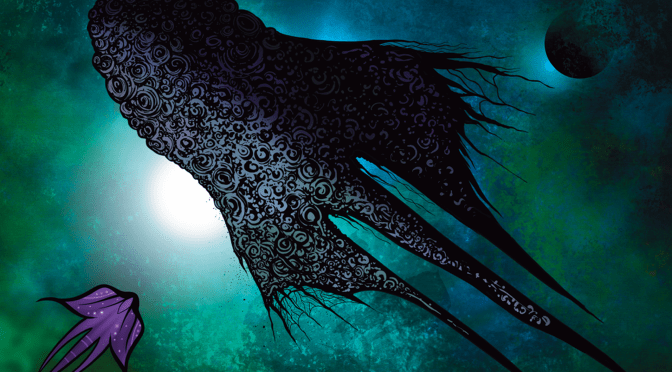
As I’ve been consuming more cosmic horror, I find that my relationship with games set in Lovecraft’s Cthulhu Mythos mirrors my relationship with licensed games. I think there is so much room for them to be great, and then I’m inevitably disappointed nearly every time I read one. In the case of licensed games, this is often because they’re pretty bad; the relationship between licensed games and money is inextricable, and the best licensed games borne out of love and fandom are often from a time in the hobby’s history that’s long gone. In the case of H.P. Lovecraft, it’s a bit more complicated. Lovecraft is a divisive figure, both having essentially invented cosmic horror and changed science fiction forever while also being a known racist, even beyond the conventions of his time. The biggest problem I have with the Cthulhu Mythos in pop culture is twofold: First, the xenophobic roots of Lovecraft’s works are rarely examined or critiqued in games, an omission made even more galling by designers’ desires to hew to a 1920s setting for their games without asking more serious questions about it. Second, the continued sanitization of Lovecraft creations in pop culture (the ‘Cthulhu plushie’ phenomenon) makes it that much more difficult to have conversations about xenophobia, cosmicism, and even New England folklore and dissect how these factors all influenced Lovecraft and his work.
Continue reading Lovecraftesque: Shadows Over Story GamesAll posts by Aaron Marks
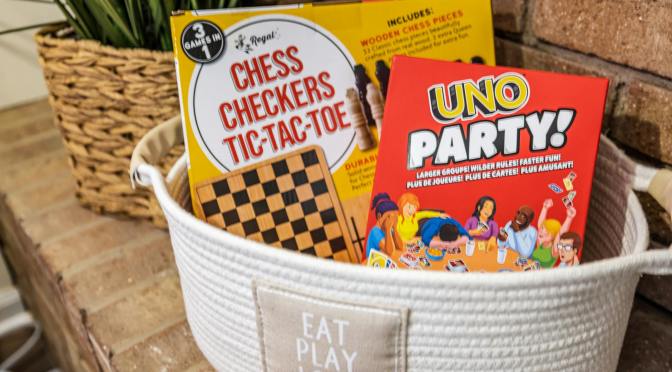
What actually happens when your group switches games?
It’s known that table dynamics affect play as much as (and some argue more than) what game you’re sitting down to play. And although both game and player are important, player aims often get talked about less or even disparaged through ‘taxonomies’ which typically valorize the playstyle of the author instead of providing objective analysis. Games are simply easier to discuss and critique; even movements which seemingly downplay the primacy of mechanics end up spending a lot of time discussing written material in the form of modules and settings which rarely if ever lead to the best gaming experience (because of, once again, player dynamics).
I started puzzling over this a few weeks ago, and wanted to return to the discussion at hand because I think it’s an important part of figuring out what you actually want to play. Needless to say, the ‘what’ in this sentence must necessarily be broader than what book you aim to pick up and puzzle through, but that’s always been the case: Even within a single game, editions, supplements, and pre-written material would always enter consideration before a single person sat down at the table. And, of course, the play outcome is still wholly dependent on the group even after the material choices are made.
Continue reading What actually happens when your group switches games?
Crowdfunding Carnival: March, 2025
Welcome to Crowdfunding Carnival for March! We’re in the post-zine nowhere zone, where backers and creators alike have a little bit of a hangover. Even so, there are still some interesting games to talk about. March and April have become a key campaign window for larger publishers after zine enthusiasts put them on blast for trying to campaign during Zine Quest (even if such campaigning may have been a net positive), so even in the early part of the month I have a number of campaigns and early campaign notices that all seemed to show up in my inbox exactly on February 28th. This means that even though there’s a smaller number of campaigns this month, we’re still seeing at least two major licensed campaign pushes. It’s even possible one of the two might be worth backing!
Continue reading Crowdfunding Carnival: March, 2025
Gaming groups and the social ‘system’
Moreau Vazh wrote an excellent post on their blog Taskerland, entitled “System Matters, Explicit Mechanics Less So”. Framing the debate on rules density historically, the post points out that gaming groups end up behaving in patterns similarly seen in many groups of people who have come together to do something creative. Of course, given that the norms of roleplaying are a great deal younger than, say, the social conventions of playing music in a group (an activity which is highly delineated and has many, many titles associated with said groups), there’s still a lot of push and pull in terms of figuring out how everyone actually wants to roleplay. Many of the norms we do have were developed either from prior art (often wargames) or came up simply because they were written into D&D back in 1974 (or perhaps a few years later, depending on the actual rule). Either way, these norms are still evolving, and as Vazh correctly points out, the hobby spends way more time agonizing over mechanics than attempting to understand the social dynamics which lead to game preferences and styles of play. And this leads to the core thesis of the Taskerland post, that ‘system’ is so wrapped up in the social norms and conflict resolution approaches of a group that the way a group plays games often transcends mechanics.
Continue reading Gaming groups and the social ‘system’
Crowdfunding Carnival: Zine Quest 2025
Welcome back to the Crowdfunding Carnival! Zine Quest this year has been very active, so we’ve got more zines to look at in the usual categories. In addition, I’ve done a brief look back at February of 2020, which in addition to having some mainline games was the inaugural year of Cannibal Halfling’s Zine Quest coverage.
Continue reading Crowdfunding Carnival: Zine Quest 2025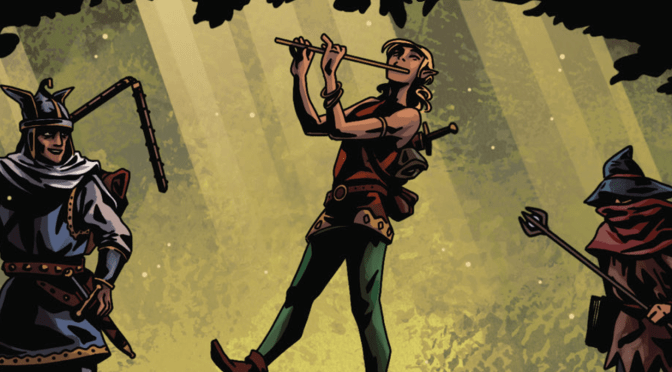
Is Grimwild the next Dungeon World?
When Dungeon World was released in 2012, it slammed the door to Powered by the Apocalypse open so hard it broke the hinges. By taking the recipe crafted in the Baker House and mating it to the memetic power of Dungeons and Dragons, suddenly everyone could see what was so powerful about PbtA. Of course, Dungeon World was hardly a perfect recipe. Using the architecture of ‘moves’ established in PbtA but keeping both the stats and classes of D&D made for an incomplete match, and some of the mechanical choices made to get the two to pair up have received more significant criticism now that the design community has had a good decade and a half to really figure out what PbtA is. Still, the combination of a solid foundation and a lot of good ideas made Dungeon World into a rare specimen: The commercially successful fantasy heartbreaker.
Continue reading Is Grimwild the next Dungeon World?Crowdfunding Carnival: February, 2025
Welcome to the Crowdfunding Carnival for February! You know what time it is…it’s ZineQuest time! Kickstarter’s celebration of small-format RPGs is settling back into a regular cadence, with 2025 being the second ‘normal’ year after two relatively abnormal ones given scheduling and, well, Web3. Just like last year I’m going to do a quick overview of the full-sized campaigns running and then dive headlong into the zines, categorizing them into full games, supplements, and RPG-adjacent or system-agnostic materials. In two weeks time we’ll do it all again, covering the zines we don’t get to or that haven’t started campaigning this week, and instead of covering major campaigns we’ll go over the five-year retrospective, looking at ZineQuest 2020.
Continue reading Crowdfunding Carnival: February, 2025
Diegesis, Mimesis, and You
The term ‘diegesis’ (and derived adjectives ‘diegetic’ and ‘non-diegetic’) comes from film criticism, but has been used recently in RPG critique. In essence, diegesis defines the narrated world relative to the viewer (or in our case, the player). This is somewhat of a heady, academic definition, so let me give an example. In a movie, the soundtrack is typically non-diegetic. That means that the music playing that the audience hears does not interact with the narrative, with what’s going on on the screen. In some cases, though, the soundtrack is diegetic, meaning that the events of the narrative do interact with the music. The perfect example of that would be musicals: The soundtrack you hear is in fact the characters breaking into song, that is part of the narrative and the world.
And just like musicals, roleplaying games are creating assumptions about their worlds that do not align with the real world. You are never going to suddenly hear a musical cue and break into song while waiting for a bus; similarly you will never find yourself suddenly able to rebuild an engine or speak Mandarin because you were able to invest ‘skill points’. These aren’t bad things: both dramatic works and games are designed in service to their goals as art and entertainment, not to be ‘realistic’ or ‘grounded’. On the other hand, there is a vast world of critical opinion around how much the conceits of both films and games live in either diegesis or exegesis (the realms of the narrative and the audience, respectively); calling musicals divisive would be putting it mildly, and the same can be said about RPG mechanics which treat the characters more like narrative game tokens than extensions of the player.
Continue reading Diegesis, Mimesis, and You
The three layers of Triangle Agency
Depending on how you look at it I either chose the best or the worst time to read Triangle Agency. Over winter break I finally beat Control, and found I absolutely loved its setting and vibe. The whole reason I picked it back up again (after getting stuck with it many months ago) was that I had also finished reading all four books in Jason Pargin’s John Dies At The End series, and in doing so discovered that I actually love cosmic horror so long as that schmuck named Lovecraft isn’t involved. When Triangle Agency, a game I thought looked kind of interesting when it was funding on Kickstarter, started picking up some end-of-year momentum, it seemed like a perfect complement to all the other horror/conspiracy media I had been consuming.
In fact, Triangle Agency followed so closely in the footsteps of Control that by the time I finished the player section, I was unclear on how it was going to differentiate itself. Cute-but-horrific is the artstyle of the book, and I wasn’t loving it compared to Control’s “dead serious but yet so absurd you’ll still laugh”. However, as I finished reading the GM’s section, my opinion of the book had picked up dramatically. This is, in part, because Triangle Agency is not Control, but in part because the most interesting ideas in the setting are back there in the GM’s section, telling you how to turn a light and kind of goofy monster-of-the-week game into the conspiracy horror game Triangle Agency actually wants to be.
Continue reading The three layers of Triangle Agency
The intent of RPG reviews
It’s another new year, and I am once again asking, in one form or another, the same question I’ve asked myself in January for several years now: Why am I here? Why do I want to be here, writing about roleplaying games? Now, I’m not asking this question because the spark is gone or it feels futile (it does some of the time, but hell if that’s going to stop me). Instead, I’m checking in on myself. What am I trying to do? Am I succeeding in that?
This year, I’m also asking: Why are you here? I don’t necessarily mean at this site specifically, but why are you reading about RPGs online? More specifically, why are you reading RPG reviews? I know for a fact that the reason many go to read reviews is not exactly aligned with the reason I write them, and that’s likely why I felt the need to discuss the intent of RPG reviews.
Continue reading The intent of RPG reviews Cannibal Halfling Gaming