Genesys was released in late 2017, and supported with four major supplements from 2018 through 2020. At that point, the generic RPG went dark. The Covid pandemic was certainly part of this, but it was first a symptom of the broader issues for the RPG business at Fantasy Flight Games (FFG). In the mid 2010s, Fantasy Flight was (excuse me) flying high; as both the licensor of Star Wars and several enormously popular RPGs based on Games Workshop properties, Fantasy Flight was one of the biggest players in the RPG space, but that turned around quickly and badly. When FFG lost the Games Workshop license in 2017 they had nothing left in the portfolio outside of Star Wars; their biggest other game, Anima: Beyond Fantasy had been discontinued the year before. The company wasn’t ready to give up on RPGs, though. They had bought the rights to Legend of the Five Rings two years before, and whether in an effort to maximize their investment or simply because of the sunk cost fallacy, they also invested in a new game based on the ruleset they used for Star Wars. Genesys came out first, while Legend of the Five Rings was ultimately released over three years after FFG bought the property.
Embers of the Imperium comes into the picture after several upheavals, only one of which was a pandemic. In late 2019 FFG divested themselves of their RPG business, shuttling it over to another division of their parent company, Asmodee. Edge Studios, a Spanish company which originally published The End of the World, was the new brand for Asmodee’s RPG line. How did it work? Hard to say. The company does have two 5e-based games now (Midnight: Legacy of Darkness and Adventures in Rokugan), so they might be making money. That said, they did not give up on Genesys. After being announced in April of 2021, Embers of the Imperium has finally been released.
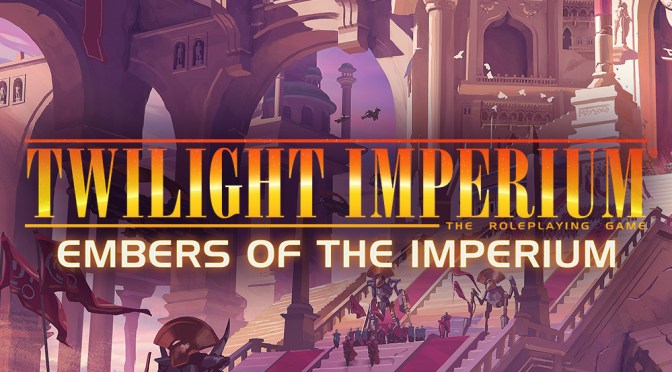
Twilight Imperium, an award-winning space opera board game, is an odd choice for a Genesys supplement, at least from a product perspective. Genesys is a child of the Star Wars RPGs, so one could question why writing another space adventure setting into Genesys makes sense. After reading this book, you may still be asking that question. Embers of the Imperium, mechanically, takes the groundwork laid by Star Wars and adds almost nothing to it. Fictionally, though, the game leans hard into the setting, placing an impressive number of species, planets, ships, and plot hooks into what is a highly effective companion to the board game.
Genesys What?
One of the most consistent criticisms leveled at my reviews of previous Genesys supplements has been, essentially, that I was too harsh and didn’t see the games for their own merit. This is both true and not true; none of the Genesys supplements are particularly compelling on their own merits. At the same time, no one was buying the supplements just to be a good cyberpunk game (Shadow of the Beanstalk) or a good pulp game (Secrets of the Crucible), they were buying them because they enjoyed the board and card games the settings were connected to and enjoyed seeing them fleshed out. Embers of the Imperium is much the same. While there are little additions (like Agendas), the bulk of this book from a mechanical perspective is character options and gear written out the same way you’d expect from any other Genesys book. Some of the Talents are duplicates (as they have been in previous setting books), and space combat is likely to feel exactly the same as it is in Star Wars because the rules are nearly the same. The pretense of Genesys being a generic system with wide mix-and-match capabilities has been slipping since Realms of Terrinoth, but in this book it is arguably gone. To the point above, though, this is a review of Embers of the Imperium, not Genesys. I’m still disappointed in where Genesys is, no doubt, but this book has more going for it than just rules, especially given some of the interesting stuff that happened in the board game alongside its development. That all said, if this review seems light on mechanics, it’s because they’re the same Genesys as before, with even less addition and adaptation than the other Genesys settings. So be it.
The Actual Review
This is not the first Twilight Imperium roleplaying game. Fantasy Flight tried to make an RPG version of the game back in 1999, which sputtered along for two years before being shuttered. In Designers and Dragons Shannon Appelcline attributes this to the mish-mash setting being unable to “support the increased scrutiny required for a roleplaying setting.” Well, the first thing I noticed about this setting was a 20,000 year period of peace in the timeline, and let’s just say committing a big timeline crime is a great way to have me assume that all the writing is as bad as that. Luckily, it mostly gets better from there. Due in no small part to the three editions of the game that have been released since that first attempt at an RPG, Embers of the Imperium does a significantly better job of pulling together a lot of material and making it coherent at first glance. One way it does this, though, is by throwing the mechanical dynamics of the board game completely aside and casting the player characters into a Galaxy-wide spy agency.
The Council Keleres was founded recently (in-game) as a paramilitary organization designed to eliminate existential threats to the Galactic Council. Now, in what is honestly an impressive piece of transmedia coordination, the Council Keleres was released as a faction for the board game in April of 2022 as part of the Codex, a collection of online content. I appreciate that level of support and alignment, and I’m sure many players do too, but it’s still hard to see the Keleres as something other than a contrivance to make the RPG easier to write. I instantly draw a line between Embers of the Imperium and Eclipse Phase, which had Firewall written to do much the same thing. All that’s to say that while using the Keleres as a campaign start point is a completely workable and understandable conceit (not to mention very well executed with the Codex tie-in), it’s not a particularly creative one.
As much as I can say the ‘galactic peacekeeper’ plot is an overused device, I can’t necessarily say that it or something like it isn’t warranted, because the game is trying to pull a whole lot of material in. There are 25 factions in the fourth edition of Twilight Imperium, including the Keleres themselves. Every faction in the game shows up, either as a playable species (15 in total) or as a threat. The implied fiction of the game does force the players away from some of the flexibility of the board game; while ‘The Nekro Virus’ and ‘The L1Z1X Mindnet’ are playable factions in the board game they run into some of the team player problems that are, depending on your perspective, either unique to roleplaying games or uniquely deemphasized in a board game where win conditions may include wiping out your opponents.
The way Embers of the Imperium deals with the fictional disconnect between it and the board game is by providing tools to create something a bit different within the setting. On the player side there are Agendas, and on the GM side is the Adventure Builder. Agendas are overarching goals for characters, similar to something like the ‘Big Dream’ in Twilight:2000 or even ‘Beliefs’ in Burning Wheel. Where Agendas split the difference is that while they’re supposed to persist for a significant part of the character’s arc (like the Big Dream), they are also supposed to be concrete, achievable, and have distinct benchmarks indicating that a character is progressing towards achieving them (like Beliefs). What I really like about Agendas is that they are mechanical, with a specific number of Benchmarks and even things like XP bonuses for choosing more complicated agendas. Agendas also have rewards for completion, like significant XP bonuses (75 XP is equal to between ¾ and all of starting XP depending on how potent your starting species is) or even your own damn starship. I really appreciate that there’s a nice, weighty ‘side-goal’ mechanic, which can both drive character development and take some of the load off the GM.
The GM does get a lot of support in the form of the Adventure Builder. There has been a similar sort of GM superstructure chapter in previous games, and even if it’s not new it is still an effective way to get a GM started, especially given that the implied fiction of Twilight Imperium may not be a straight shot to party-driven RPG adventures. Each adventure consists of a hook, an escalation, and a climax, and the book offers roughly half a dozen of each. I would have liked to see more of these that were tied into the setting; the ‘hooks’ section is decent at this but ‘escalations’ and ‘climaxes’ are a fair bit more generic. One mitigator to this issue is the additional half-dozen encounters that don’t fit into the adventure builder template; these are all much more directly tied into threats and scenarios from the board game which give an aspiring GM a few neat ideas about Twilight Imperium’s specific conflicts.
The setting of Twilight Imperium is, realistically, a vehicle by which game designers can introduce factions with diverse and distinct playstyles into the board game. You see this reflected in Embers of the Imperium pretty clearly. The species and the threats get the largest page count, recounting all of the factions of the board game into something either to play or encounter (or both). Even gear is designed with templates of factional differences rather than a huge variety of guns, armor, and vehicles. Then, you have the construction of RPG setpieces. Players have Agendas and GMs have the Adventure Builder, but there are also Mysteries of the Void, to get GMs really thinking about the setting, and a whole lot of setting fluff that likely goes much deeper than what’s strictly necessary for a board game. Fluff is the core driver of this book and, given that it’s essentially meant to be a companion to an existing piece, that’s the right thing to do.
I’m not really going deep into the actual setting bits. They come together fine though, as I noted at the beginning, this isn’t Hugo-winning writing. It doesn’t have to be. I’ll state for the record that I am reasonably impressed with the diversity of species included in this setting, but from a critical perspective they’re copied from the board game. It may tell me why fans want a Twilight Imperium RPG, but once I observe what percentage of the factions got copied over (pretty much all of them), it doesn’t tell me anything about the RPG itself.
As far as the RPG itself goes, though, this is good. I’m not concerned about the bones, it would have taken forgetting how Ctrl-V works to actually mess up the mechanical fundamentals of the Star Wars RPG for another space opera setting. Similarly I’m not concerned about the content of the fluff; if people wanted this at all it was because the Twilight Imperium setting piqued their interest. The thing that this game needed to provide, a way to translate a strategy board game into an RPG conceit, it did. While the Keleres provides an utterly derivative starting point to play, it does work, and elements like the Agendas and the setting material help provide the necessary structure and support to a GM who would want to run this game and tap into the broader potential of the setting. Embers of the Imperium is successful at what it aims to do. That said, I am not the intended customer for this game, nor do I expect I would ever run or play it. I think that creating RPG experiences out of Fantasy Flight board game properties is perhaps more noble than buying a license for something that never needed an RPG in the first place; board games like Twilight Imperium and Android do have fans looking for this sort of content (I’m not convinced about Keyforge but that’s neither here nor there). That said, these are still ultimately licensed games, trading on the content from their parent property which already exists. Between the tight tie-ins to the board game and the long delay between this book and the previous one, it’s pretty clear to me that Genesys will never expand into what I want it to be. That said, Twilight Imperium is an excellent property to remind me that you absolutely can turn an RPG into a great companion piece to a board game.
Embers of the Imperium is available at DriveThruRPG, and in print wherever Edge Studio and Fantasy Flight Games are sold.
Like what Cannibal Halfling Gaming is doing and want to help us bring games and gamers together? First, you can follow me @LevelOneWonk on Twitter for RPG commentary, relevant retweets, and maybe some rambling. You can also find our Discord channel and drop in to chat with our authors and get every new post as it comes out. You can travel to DriveThruRPG through one of our fine and elegantly-crafted links, which generates credit that lets us get more games to work with! Finally, you can support us directly on Patreon, which lets us cover costs, pay our contributors, and save up for projects. Thanks for reading!
 Cannibal Halfling Gaming
Amazing review!
LikeLike