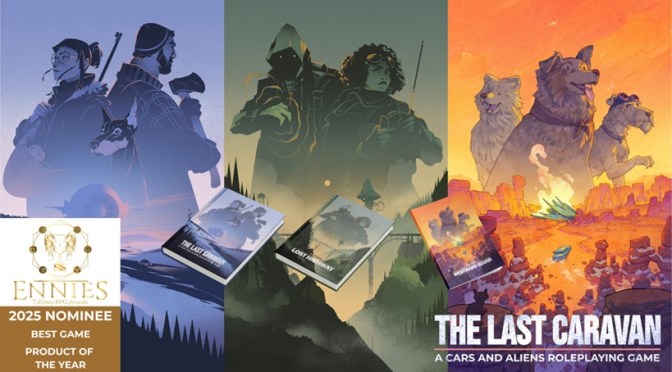
They came less than a year ago. The war was swift – and brutal.
Humans and aliens bombed each other to smithereens, and now both sides are licking their wounds. Mysterious new factions rise to join the struggle of the fallen titans. In this landscape of shifting allegiances, we may have to choose sides. Debris from the explosion of the aliens’ mothership has clouded the atmosphere, lowering the temperature and creating the coldest winter in a thousand years.
We find ourselves in a melancholy, wintry landscape — quiet, until it’s not. Egg-shaped alien structures thirty stories tall now squat, humming, over the cities they crushed. Xenofauna and lost invaders stalk the woods and highways. A war is brewing in the aching silence.
We are navigating the waking remnants of human and alien empires — and all we’ve got is a car, our fellow travelers, and the road.
It’s time to head west with The Last Caravan.
Created by Ted Bushman and published by Mythworks, The Last Caravan is a ‘cars and aliens’ roleplaying game about a midwinter road trip across the continental USA, from the eastern coast to the western one, in the aftermath of a massive war – the repercussions of which are still developing. The alien Aernians appeared in orbit above Earth, and a series of mishaps quickly lead to all out conflict. Importantly, nobody won – humanity and the Earth are devastated, but the Aernian mothership failed as well, stranding both species on a planet that is rapidly changing from the effects of the fighting and the introduction of alien life. Our player characters are survivors – possibly family, possibly scientists trying to figure out what’s happened and what’s going on, possibly veterans of the war – who have realized that life on the East coast is getting far too dangerous. Rumors of safety out west prompt them to begin a perilous journey, as winter and numerous threats dog them the whole way.
The Last Caravan is based on Blades in the Dark, although it doesn’t officially carry the Forged in the Dark moniker or iconography. I’d wager because that’s there’s actually a fair number of changes that have been made, both in terms of how characters work and with additional mechanics to create the gameplay loop and and narrative feel that the game is going for.
At the most basic, you’re rolling d6s to accomplish things, with the standard array of results based on the highest die: a 6 is a full success with additional 6s leading to a critical one, a 4 or 5 is a success with trouble, and 1 through 3 is just straight up trouble. Damage is referred to as Harm, clocks are frequently used to deal with tasks and trouble alike, and so on.
The Caravan
Character ‘playbooks’ are here referred to as Imprints, and the actions available to all characters as Gambits: Be The Boss, Fight Under Pressure, Lie & Trick, Sneak Around, Do Science, Drive A Car, Harmonize With Alien Stuff, Rig & Repair Stuff, Search & Survey, Take Aim, and Talk Out.
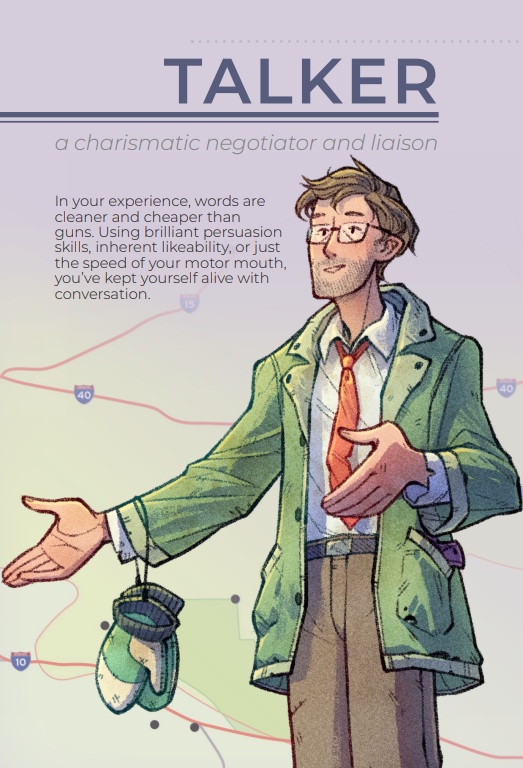
Each character has an Inadequacy, something that brings them down, like regret or fear or disenchantment. Along with roleplaying material, this will plug into a few mechanical things as well. Characters can gain points of Heroism by doing things like aiding a faction or making things worse because of your inadequacy, plus a few options unique to each Imprint. The Wrench, for example, can gain Heroism by improvising with materials on hand, while the Bandage does so by diving deep into someone’s feelings. Heroism can then be spent on things like finding useful items, adding +1d to a Gambit, increasing the harm dealt by an attack, or activating special abilities.
Characters have a Harm track instead of slots for different degrees of harm, but you also won’t see things like dice penalties. Instead, halfway through said track they reach a Turning Point, and have to roll 1d6. On a 6 they’re Undaunted, and gain +1d to all rolls for the remainder of the current phase. On anything else, though, they’re Shattered, and for the remainder of the phase they’re overtaken by their inadequacy: they can’t make any Gambits at all unless it makes sense with the inadequacy.
Each Imprint has a few starting dice in specific Gambits, and each has a list of Special Abilities, starting with access to one of them. For a few examples, the Bruiser is described as ‘a tough fighter and protector’ who starts off with two dice in Fight Under Pressure, one each in Be The Boss and Drive A Car, and special abilities like Witness Me! which lets you grant a teammate +1d to their next Gambit after you attempt something wild and dangerous. The Stargazer, ” a curious researcher and scientist,” has two dice in Do Science, one each in Harmonize With Alien Stuff and Rig & Repair Stuff, and starting abilities like Gosh I Hope This Works that lets you destroy an alien item to create either an intense gravitational anomaly or a burst of blinding light and sound that deals harm.
There are two standouts that I can’t not mention, though. First is the Innocent, “an inspiring person on the cusp of change”, not always but often a younger person than the other members of the caravan. They’re missing some Gambits like Be The Boss and Fight Under Pressure, instead possessing Distract & Impair. Their special abilities include things like I Hear The Music, which inclines an alien who otherwise cannot commune with humans to like and understand you. The Innocent has a smaller harm track, but can instead choose to mark a Hard Truth track; once filled the Innocent transforms into ” a changed person with unlocked potential”, gaining the usual list of Gambits and seeing many of their special abilities change – I Hear The Music is the only one that doesn’t, actually.
The last is the Good Boi. In this game you can’t just pet the dog, you can be the dog. The Good Boi comes with some more unique Gambits – Chase & Catch, Dig Up & Drag, and Sniff Out – that highlight their canine nature, and special abilities like Wolfkin, which sees you meet your lupine cousins to learn about the area you’re in. These two playbooks Imprints are one of the more obvious indicators that Bushman wasn’t just slapping a new coat of paint on Blades in the Dark and calling it a day – they’re neat, appropriate to to the genre and themes, and unique.

Of course, this is a road trip, so you’re going to need a ride. Vehicles (you typically start with a Compact one) have a certain number of Seats, can carry a certain amount of Storage, can take a certain amount of Wear, and burn a specific amount of Fuel. Most of them are going to have some cons, like Bald Tires or a Damaged Radio, and some might have pros like being Built Tough or having Great CDs. If your Fuel runs out you’re going nowhere, and if the vehicle takes too much Wear it’s destroyed, and only having so much Storage means you can only have so many Supplies which you’ll take harm from running out of, so keeping the vehicle in good order and well-stocked is going to be vital.
The Campaign
The gameplay loop of The Last Caravan consists of three phases: Detour, Upkeep, and Travel. Detours are encounters, places, events, and persons you stop for along the wrong. They could be checking out a mysterious lighthouse with strange glowing lights, running a checkpoint, visiting a small farm to see if any aid can be offered or given, and so on.
After every Detour is the Upkeep phase. First, you add to Noise, adding more the larger an impact the group had on the area during the Detour – more on Noise in the Travel phase. Next, you spend Fuel, and if possible you may choose to Advance – more on how that goes when we address Regions. Third, you consume a point of Supply, plus an additional one for every two passengers you’ve picked up and brought with you. Fourth, you might Worsen – characters who are on the wrong side of the turning point in their Harm track take another harm. Yes, this might mean you’ve made your escape from a particular dangerous Detour, only for the Bandage character who saved everyone else to quietly slip away in the back seat because of their wounds. Oof.
While Detours are singular, notable events, in-universe you’ll probably spend most of your time Traveling. It’s an opportunity for scenes between the characters when they’re not in the fire, but it also has a few options for things to do. Each Travel phase the caravan takes three Travel Actions – more if you spend more Fuel, with passengers adding dice by helping out. You can Lie Low to reduce Noise, make a Resupply run to get more supplies or fuel, Recover to reduce a character’s harm, Work on a Slow Project to do exactly that, or Work on a Vehicle to modify or repair it. At the discretion of the GM, aka the Atlas, the caravan may have to pay a Toll, unexpected or unique events that the caravan runs into. They might be brief little encounters, but they may even become forced Detours. What kind of Toll is broadly determined by how much Noise the characters have acquired. The more Noise, the more dire and dangerous a Toll will be. Aside from bad Tolls, Detours eventually happen at the discretion or either the GM (Atlas) and/or the players, and once they’re done you’re back on the road.
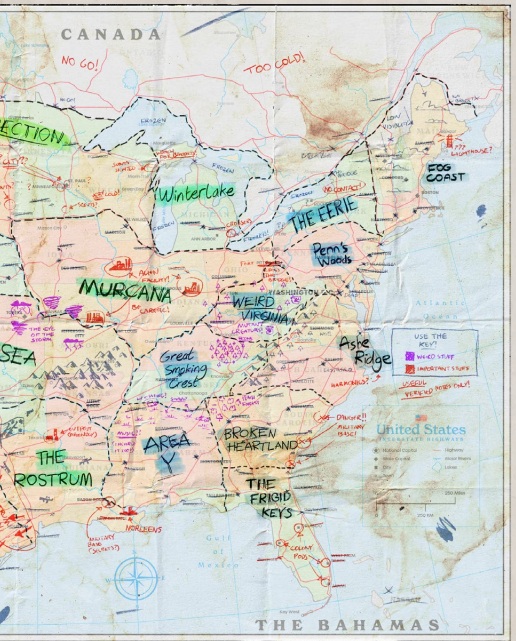
The journey is broken up into Regions, which are organized into phases – you’ve visit one Region per phase as you make your way from east to west, and while getting from the Phase 1 New England (now known as the Fog Coast) to the Phase 2 Area Y (Alabama, Mississippi) isn’t the most logical there’s nothing forbidding it. Sticking to the logical view, though, most Phases have 3-4 regions that border 1-2 regions in the next phase. Each region has a list of which factions are present, some face NPCs, a couple of Detour and Toll ideas, and the Way Out. The Way Out needs to be found in order to be able to Advance during the Travel phase, and can consist of taking a certain number of detours or dealing with a particular threat, obstacle, or issue.
There are no experience points in The Last Caravan – rather, once the caravan arrives in a new region, each character can choose to either clear their harm track, add a dot to one Gambit, or gain a new Special Ability.
I find myself engaging in a bit of a miniature System Split, because, well, if I had a nickel for every Blades in the Dark-inspired TTRPG about a cross war-torn-country trip with branching paths and defined ends, I’d have two nickels. Which isn’t a lot, but it’s weird that The Last Caravan and Band of Blades could both be described that way.
Both games gather strength from the constraint of ‘have to go west/have to reach Skydagger Keep’. Band of Blades is more ruthless with Pressure and the passage of Time potentially bringing an early end to the campaign. The Last Caravan’s Noise will certainly make things more difficult for the characters, but there’s no back door game over state here. aside from being out of Supplies for multiple Upkeeps, which seems unlikely. Band of Blades gathers some extra stability for having a singular end goal to drive the campaign on, but does end somewhat inflexibly (and, at this point, on something of a cliffhanger). The Last Caravan’s ending feels more wibbly wobbly by comparison, really only offering ideas and scenarios for how the journey might end instead of something truly definitive. However, with a GM who can improvise and build off of what they’re given over the course of the game that does mean that the choices the players have made, the factions they’ve courted, and the beliefs they hold most strongly seem more likely to have a big impact on the ending, satisfyingly so.
A bit of a digression, but I think it’s an interesting example of how games with similar base mechanics and form factors can still be wildly different. Anyway…
The Book and The Future
The game-as-product is a great one. Easy to read, good layout, well-organized, respectable index, and some really awesome art from a variety of talents- oh hey, Galen’s in there! It’s good enough in PDF, but the physical hardcover is particularly nice, with a glossy cover and a purple ribbon bookmark.
I love me a good ribbon bookmark.
In somewhat typical Seamus fashion, I’ve gotten this article out with a brief window of opportunity, because as of this writing Bushman is Kickstarting The Last Caravan’s next installment. There are a few goodies in the mix, like a deluxe map, but the heart of the crowdfunding effort is split between two items. One is Lost Highway, a hardcover expansion with a ton of new content, the most stand-out for me being new Imprints that include the option to play some aliens!
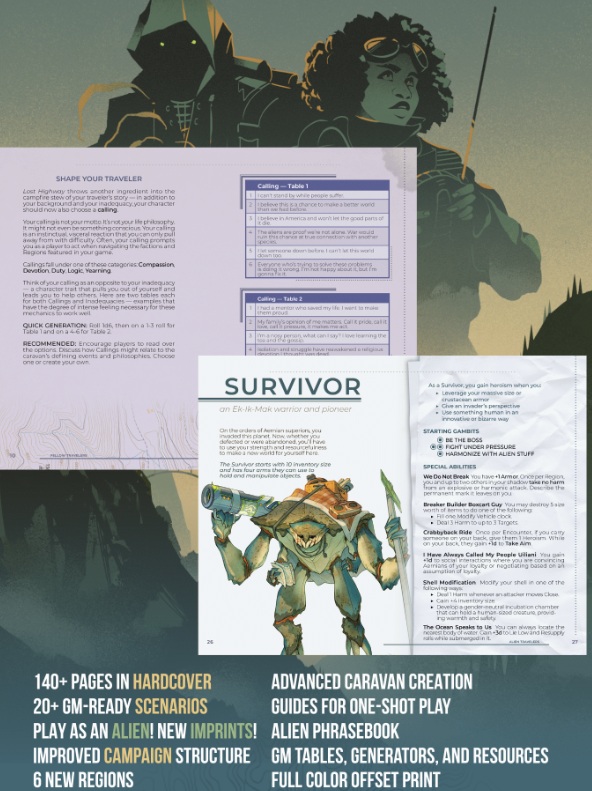
The second is Westward Bound, which gives the overall project its name, a softcover zine focused on one-shot and short campaign play, that is all about the Good Boi being joined by an entire cast of animal Imprints looking to help their hapless human friends. It looks awesome. I mean, come on, there’s a dog wearing goggles!

Now, I don’t have review copies of these, but based on what I see from the core book, my confidence level is high.
Destination
There are a lot of worldbuilding details I don’t want to get into here, because a fair amount of the book is Atlas-only – the players and the player characters, even if they fought in the war, have a very limited understanding of what happened, what’s happening, and who everyone that’s involved – human and Aernian alike – really is and what they want. But I will tell you that there is a lot of interesting stuff under the hood here. Black-and-white, good vs. evil is not the order of the day by a fair stretch, and all of the factions and Regions are extremely interesting. Between that, the cool Imprints, and the tight gameplay loop, well, The Last Caravan was nominated for Best Game and Best Product in the 2025 ENNIES, and after reading through this book I can say those were nominations well-earned.
The Last Caravan: Westward Bound Kickstarter is live until 1:00 PM EDT 10/16/25 – getting the two expansions together in PDF form will cost you $26, while getting both in print+PDF will cost you $59. There are also $1 tiers that will let you add on things during a Backerkit phase, in case you need some more time to weight your options than I’ve bought for you here.
As for the core rulebook, you can find The Last Caravan on DriveThruRPG and itch.io in PDF form for $19.99. The physical form is listed in places like Mythworks’ own shop and IPR for $39.99, although as of this writing both locations are sold out – good time to mention the hardcover core rules are an option in the Westward Bound Kickstarter?
Check your fuel gauge, pack you bags, and brace yourself for a few Detours – it’s a long ride to the west coast.
Thanks to Mythworks for sending us a hardcover copy to review!
Thanks to Wil for a small correction on the Innocent’s Harm/Hard Truth tracks.
 Cannibal Halfling Gaming
The Gameplay Loop sounds a lot like Ultra Violet Grassland’s Loop. As does the unidirectional travel. (Both The Last Caravan and UVG allow you to wander, because, that’s how Journeys often work, but the layout as a Linear Travel Map is similar.)
LikeLiked by 1 person