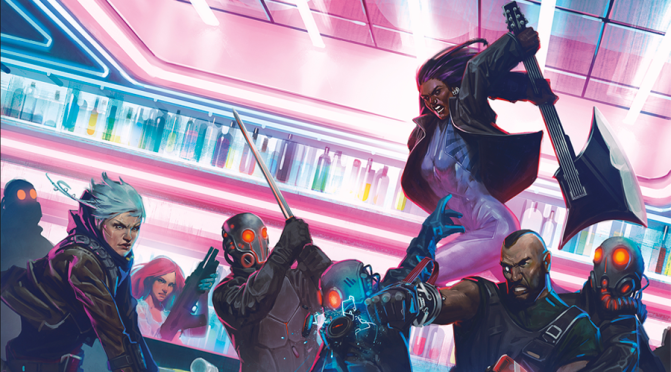
For decades of R. Talsorian Games’ Cyberpunk line (both in realspace since 1992 and in-universe since 2011), The Forlorn Hope’s been a bar where those Night City denizens who refuse to play by the Corporate rulebook go to unwind, connect, and reaffirm their humanity. But today (2024/2045), in the Time of the Red, The Forlorn Hope’s in trouble! Will this classic Night City institution die a whimpering death or survive and thrive, helping the next generation of cyberpunks navigate life on The Edge? Well in game that’s a question only you and your Crew can answer… but in the real, we’re going to be seeing how Tales from the RED: Hope Reborn can answer the same question!
Released back in October, Tales from the RED: Hope Reborn is the newest Cyberpunk RED offering, and its quite a different kettle of cybernetically augmented fish. Other products have provided a few missions, new gear, or NPCs, but this is first complete campaign for the edition since it was released in 2020. Per the foreword, it’s also the first genuinely street level campaign, as the old 2020 campaign books like Eurotour and even the original Tales from the Forlorn Hope were pretty high level. So, what’s behind the bar?
Hopeful Rules
I’m going to start at the end, because the final section of the book includes some rules which give me a good opportunity to highlight something about Cyberpunk RED as a product line: it has oodles, noodles, and SCOP-based toaster strudels of free content. RED gets a new DLC pretty much every month. For those who like physical products, they eventually get bundled into volumes of Interface along with some new content, but every DLC put online remains there, and every one of them is free. I mention this both to point it out to those who may have missed it, and because in this case four DLCS have been bundled into Hope Reborn because of their potential utility for the book. They also get that content in front of people who aren’t chipped in enough to R. Talsorian’s online presence to be always grabbing the DLC, it must be said.
All About Agents is about the personal communication devices/computers that nearly everyone in the Time of the Red is using to stay in touch, get their work done, and manage their lives. For the Netrunners of 2045, equipment and rules for hacking into Agents remotely opens up a lot of opportunities – a stepping stone to the quickhacks of the 2070s.
Hot Pursuit expands the vehicle rules from the core book to include chases – rules for ending them, extra actions for drivers to perform like pitting and ramming, and suggestions for passenger actions.
Chasing the Rabbit establishes rules for the full-contact sport of roller derby. Niche? Yes, but flavorful as all get out, and you never know; there’s one for bicycles that I’ve gotten way more use out of then I expected.
No Place Like Home focuses on building a base, or Headquarters, for the player character. As the party is awarded Improvement Points from the Group column of advancement, so too are they given HQ IP. These can then be spent on any space the player characters have their hands on to add features which can do things like boost skill checks, allow for item creation, establish a NET Architecture, and so on.
Some details aren’t included in Hope Reborn – for one example, All About Agents includes some apps that can be installed in an Agent, but which are left out here. Still, everything needed for the DLCs to function is part of the package.
Now, for the real heart of the book: the campaign.
The Tales Themselves
I’m going to try and keep it light, but there’ll be some spoilers for the campaign, so read with caution.
Exactly how Marianne Freeman knows to give you a call to come by the Forlorn Hope for a job is more or less up to the GM – there are some hints throughout the book that some of the missions from Tales of the RED: Street Stories and the Data Pack have already happened, which may be your in – but either way it’s pretty straightforward. A dealer of extreme (read: wildly unsafe) braindance chips has starting making threats after being thrown out of the Hope, so Marianne wants him put out of business. There’s nothing too complex about it, but the back of the book’s claim that the Hope is in trouble is a bit of an understatement – fire, death, and destruction come for the bar as the player characters make their way back, and opportunistic vultures descend soon after.
Once that first mission (The Angel’s Share) is over, Marianne vows to see the Forlorn Hope rise from the ashes, but she’s going to need your help. The next five missions are about building the Hope back up, fending off those who want to see it burn again, and getting vengeance on whoever torched it in the first place. Assuming that means this is a campaign of six sessions would be inaccurate, however. Each mission comes with a time estimate, and the shortest one’s shortest length is four hours – it’s also the first one. Several of the missions are really multiple related but separate jobs. Real Estate Rumble involves helping out a real estate agent with a few problems (several of a distinctly and disturbingly clownish nature, as only Night City can manage) while they try and scout a new location for the Hope. Welcome to the Neighborhood is itself a six pack of jobs as the crew tries to get a feel for the bar’s future neighbors, ranging from hostage situations to drunken shenanigans involving murder plants. The Devil’s Cut gets the crew into heist mode – the new Hope needs booze, and some corpos with bright ideas have been hoarding the good stuff. Hope’s Calling!!! is the grand re-opening – but first there’s a whole list of things that need to get done, and then someone decides to crash the party. Rather, a whole lot of someones. Finally, Ripping the Ripper reveals who attacked the original Forlorn Hope, and tasks the Crew with taking them out without drawing more trouble the Hope’s way.
There are a few mechanical issues; when reviewing the Edgerunners Mission Kit I remarked that R. Tal got themselves into some design cul-de-sacs with RED, and while they’ve made some impressive moves within those cul-de-sacs the curbs can still be felt here. For instance, a fire extinguisher gets treated like a type of Very Heavy Pistol, and the only way to handle things like shifting heavy rubble or spreading fire is as ‘NPCs’ with hit points and combat numbers for them to ‘attack’ or ‘evade’. On paper it seems like they’ll function just fine, but they come across as a little awkward.
From a campaign design position there’s a bit of a disconnect when it comes to plot. Your players will deal with all sorts of opposition, from clowns to corpos to fellow edgerunners, but the campaign has two overarching points of threat: who destroyed the original Forlorn Hope, and who wants to keep it from being Reborn. The fact is that they’re different people, and they don’t interact with each other. That’s not too much of a problem, it even might be a feature of how difficult it is to build and protect a community in Night City. However, while the ones who want to make a name for themselves by keeping the Hope from rebuilding are present early on in the campaign and can be heard of in rumors as they build towards their final move, the one responsible for the Hope’s original fall are kind of a non-entity in the campaign outside of rumors until an NPC figures out who they are and what they did and the players get sent after them.
The problem with this is that the last mission in the book has you going after the one who brought all that fiery death and destruction to the Hope in the first mission, after the big showy battle that takes place in the longest mission of the book and sees the Forlorn Hope either be truly Reborn or burn away forever. Literally, if Hope Calling!!! goes badly the campaign outright ends. Having the shorter, comparatively lower-stakes Ripping the Ripper follow it reads as a bit anticlimactic to me. For my money I’d strongly consider at least switching the order of the two.
Finally, there are a few points where Things Just Happen, regardless of the players’ actions. I want to be very clear, that’s not to say that the players’ actions don’t matter – at minimum their choices and successes or failures can dictate their reputation and their pay, some people are going to get flatlined if they don’t step in, and obviously there won’t be a comeback for the Forlorn Hope without the Crew’s help. For one example, though, there is a small side quest of sorts to recruit some bandmates for the new Hope’s in-house band (most of the original one, uh, well…). Fulfilling it can be done over the course of several jobs, and it can lead to some nice character moments… but if the players don’t do it, then a member of the Hope goes out and does it themselves. It would have been nice to have some more negatives or positives for not completing or completing things like that… although there is a lot going on already, so maybe there just wasn’t room.
Okay, so that’s a lot of nitpicking. What do I like about this (hopefully you know I wouldn’t bother writing about it if I didn’t)? Well, most of it, to be honest.
Aside from the additions in the Hopeful Rules section above, there were quite a few interesting mechanical bits and bobs. Several times the campaign uses clocks – not visually in the PbtA style – to act as measurement for time-sensitive events, and some player actions can speed them up or slow them down. The big battle features ‘trash mob’ adversaries – they don’t group up like Minions, but they still officially fill a neat little niche of low-HP strength-in-numbers opponents to give players a different kind of challenge that can get knocked down easily. Speaking of that big battle, there’s a mass combat mechanic that operates within the Combat Number-based mechanics (your enemies and your allies each roll 1d10+CN, winner reduces the loser’s CN), with plenty of ways for the players to tip the scales in their favor.
Each mission includes rumors that are great fodder for and examples of Streetwise checks and/or a Media’s capital-R Rumors mechanic. They do some world-building, show how the players’ activities have impacted the people and places they’ve interacted with, and provide some foreshadowing/threads for the Media to tug on. On that note, multiple other role abilities are given unique chances to shine; Nomads who can drive around their living space have a place to bring the Crew to in Welcome to the Neighborhood, and the Lawman’s Backup can make a big difference in Hope’s Calling!!!
The sheer variety of missions is awesome. You have your Friday Night Firefights, your heists, chases, negotiations, wacky shenanigans, and more. This has the knock-on effect of introducing players to a very wide swathe of Night City – various boostergangs, edgerunner bands, fixers, techies, rockerboys, corpos, and ‘average’ folk just trying to live their lives. As tours of what life is like in the City of Dreams in the Time of the Red go, this is a great one
Most importantly, though, is that the wide majority of encounters in the campaign can be handled multiple ways. I know I ragged on Ripping The Ripper a bit for its placement, but in terms of mission design it’s among the most interesting, featuring either a scheme to make someone else pull the trigger so the revenge plot can’t be traced back to the Hope or a trek through the Hot Zone so there’ll be no witnesses – and the chance to jump from one path to the other if the Crew changes their minds. Overall, there are very few situations that can only be solved with a bullet, and none that require some sort of hyper-optimized combat monster to survive. Clever thinking from the players (and a readiness on the GM’s part to adapt to same) is encouraged throughout the book, and tapping into the growing network of NPCs the players are connecting with is highlighted as an option for covering group deficiencies.
I really like the opening bit of fiction, which serves as an interesting bridge between the original Tales from the Forlorn Hope and this book. Oh, there’s also a real drink recipe to commemorate the Forlorn Hope’s rebirth (and yes, getting the ingredients for it is a problem to deal with in-campaign). Unlike the drinks at the Afterlife, with luck nobody will have to get flatlined to justify ordering one.

Final Conclusions
A pinch of salt might need to be added to everything I’ve written so far, though, in that I have not run nor played through Hope Reborn – with an estimated run time of 38 hours on the low end and 53 on the high, the time requirements for an actual play review are too steep for me to get it out any time in the next year. Also, while I’m actively running Cyberpunk RED, the Alleyway Regulars are both a touch past the street level of Hope Reborn and have their own combat zone bar to worry about.
Both places end up needing to heist some booze, though. Parallel thinking at work! That, or R Tal has netrunners lurking in our session meetings.
So, apply salt to taste. I equally think that a campaign like this is definitely something that truly needs to be played to fully grok (which is why I’m pointing out that this is a reading review in the first place) and that an actual play review would be highly subjective in any case, even more than usual seeing as how a good number of beats might be completely skipped by player choices, but that’s me on my soapbox again. Even if you add that NaCl, though, I think a reading review reveals two points of objective Hope Reborn value.
First of all, looting! Things like clocks and trash mobs and mass combat rules can obviously be used in other campaigns. I have an immediate need for the Agent-hacking rules (although I’ll be replacing the need for a Breacher with a connection to the Old Net because netrunner Alffluenza is Just Like That), plenty of the missions could be pulled out and used as one-off runs, and there are lots of NPCs to kidnap or be inspired by. There’s a Lucky Charms-themed bunch of Edgerunners working for Continental Brands, I need to get them into trouble in my own game.
Most importantly, though, is that I think something like Hope Reborn was desperately needed and long overdue for Cyberpunk RED. First, as line manager J Gray states in the foreword, it fulfills a Pondsmithian promise about the edition, that edgerunners in the Time of the Red can make a difference. Maybe a small one, but big things are made of little things, and I think it’s really important that this promise has been fulfilled. Second, though, is that we finally have a published example of what a Cyberpunk RED campaign looks like, as opposed to a group of completely unrelated missions. I think experienced GMs over the past four years have probably been doing just fine – my own campaign is past the twenty session mark, and surely they would have told me if it was outright terrible by now – but even for them it’s great to have an example that got through the entire apparatus of publishing a book. For newer GMs who may be unsure how to answer the question of ‘what do I actually do with this game in the long-term?’, they’ve now got an excellent example to either jump into or build off of.
You can find PDF copies of Tales from the RED: Hope Reborn in DriveThruRPG for $20, and physical versions on the R. Talsorian store for $40.
Hope’s Calling!!! Will you answer, choom?
Thanks to J and Rob from R. Talsorian for providing us with review copies of Tales from the RED: Hope Reborn at PAX Unplugged!


One thought on “Tales of the RED: Hope Reborn – Cyberpunk RED Campaign Review”