
Invention is a word that most people understand. Inventing is the process of creating something new, and thanks to the patent office we even have broadly accepted standards for what constitutes an invention (novel, unique, non-obvious). Innovation is a bit more difficult to put a finger on, in no small part due to its continual dilution as a popular buzzword. Broadly, though, innovation is the combination of invention and value creation, the ability to make new things useful. I’ve actually talked about the invention/innovation dichotomy before, when I opined on how Most Games Don’t Matter. Indeed, a lot of the gap between invention and innovation in the tabletop RPG world is the gap between the hundreds if not thousands of games that come to market and those which actually make a market impact. That said, I don’t need to retread the grounds of how oversaturated the RPG market is. I want to discuss the innovation that does occur and what it actually means to bring that innovation to market.
Continue reading Invention and Innovation in TTRPGsTag Archives: D&D

Weekend Update: 7/27/2024
Welcome to the Cannibal Halfling Weekend Update! Start your weekend with a chunk of RPG news from the past week. We have the week’s top sellers, industry news stories, something from the archives, and discussions from elsewhere online.
Continue reading Weekend Update: 7/27/2024
The TTRPG Fleet
If you hang around in bicycle spaces long enough, you’re going to hear someone say ‘n+1’. This is a joke among the cycling community: “The correct amount of bikes to own is n+1, where n is equal to the number of bikes you currently have.” Needless to say the collector’s impulse in the cycling hobby runs strong, and even if you aren’t interested in trying all the brands or vintage frames or anything like that, you still may find yourself in the throes of n+1. After all, you start with a mountain bike, want to try a road bike, then you need a gravel bike, and a cross bike, and an endurance road bike, a climbing bike, a pub bike, a fixie…
It’s no wonder the collector’s impulse is even stronger within RPGs; you can get twenty hardcover sourcebooks for the price of a relatively cheap bike. And yet, collecting RPGs comes with a stronger risk of missing something. There are many, many bikes out there to enjoy, but at the end of the day you’re still going to be riding bikes, and the forty miles you put down on one bike will still help your legs when you pull out the next bike. The TTRPG hobby is a bit different; playing Masks and playing Pathfinder aren’t going to be similar experiences or pull in the same direction.
While RPG reviewers such as myself are often the ones most liable to try and catch all the RPGs like so many Pokemon, there is another way to consider approaching RPGs and actually playing them, and it comes right from bicycling. N+1 may be a joking mantra, but most cyclists have neither the money to acquire a collection of bikes nor the time to ride them. Instead, most cyclists end up with their ‘fleet’, a group of two to eight bicycles that cover the range of disciplines and experiences they want to have. While having twenty Italian road bikes may not amplify your understanding of cycling, having both a road bike and a mountain bike is something that pretty much every cyclist can understand, collector or not.
Continue reading The TTRPG FleetWeekend Update: 7/20/2024
Welcome to the Cannibal Halfling Weekend Update! Start your weekend with a chunk of RPG news from the past week. We have the week’s top sellers, industry news stories, something from the archives, and discussions from elsewhere online.
Continue reading Weekend Update: 7/20/2024
Nostalgia, consumption, and D&D
I am not too proud to admit I’ve watched every episode of Netflix’s That 90’s Show. Unlike the first attempt at a spinoff, That 90’s Show is nakedly and obviously a sequel to That 70’s Show while also fishing in the shallow pool of 90s nostalgia, including groaningly obvious musical numbers and cameos specifically meant to induce memories of going to high school in the 90s. I’m technically a bit too young for the target market, as well as someone who thought themselves too aware of tropes and psychological ploys to get sucked into this kind of TV. And yet, get sucked in I did. It’s a blatant comfort-watch, calling back to the original series, the magical time before social networking, and also the bygone era when multi-camera sitcoms were still the bulk of network TV programming (remember network TV?).
Nostalgia plays aren’t limited to TV, and of course in the TTRPG world we see them all over. There’s arguably two angles to nostalgia within TTRPGs: The RPG as nostalgia tendril, where the game is simply the marketing device used to exploit the audience’s existing love for Star Wars, or Marvel, or My Little Pony. These games can be good or bad, but they’re built around their existing property and serve that property (and its licensors) first. There’s also nostalgia for the TTRPG itself. While a cynic may call the OSR solely a nostalgia play, there’s much more obvious examples at play here; Goodman Games is clearing half a million dollars in crowdfunding for what is effectively a reprint of a module from 1979. They’re making a t-shirt as part of this campaign, so it’s definitely at least a little bit for the money. That said, I don’t think the Caverns of Thracia reprint is entirely indefensible. Goodman is doing a service by taking a great old module and keeping it available, including updating it for new rulesets; it’s still arguable whether that’s worth half a million dollars and t-shirt sales. And that’s the primary issue with nostalgia: Where do we draw the line between archiving and reviewing the past, and wallowing in it?
Continue reading Nostalgia, consumption, and D&DWeekend Update: 7/6/2024
Welcome to the Cannibal Halfling Weekend Update! Start your weekend with a chunk of RPG news from the past week. We have the week’s top sellers, industry news stories, something from the archives, and discussions from elsewhere online.
Weekend Update: 6/1/2024
Welcome to the Cannibal Halfling Weekend Update! Start your weekend with a chunk of RPG news from the past week. We have the week’s top sellers, industry news stories, something from the archives, and discussions from elsewhere online.
Weekend Update: 4/20/2024
Welcome to the Cannibal Halfling Weekend Update! Start your weekend with a chunk of RPG news from the past week. We have the week’s top sellers, industry news stories, something from the archives, and discussions from elsewhere online.
Weekend Update: 3/30/2024
Welcome to the Cannibal Halfling Weekend Update! Start your weekend with a chunk of RPG news from the past week. We have the week’s top sellers, industry news stories, something from the archives, and discussions from elsewhere online.
Continue reading Weekend Update: 3/30/2024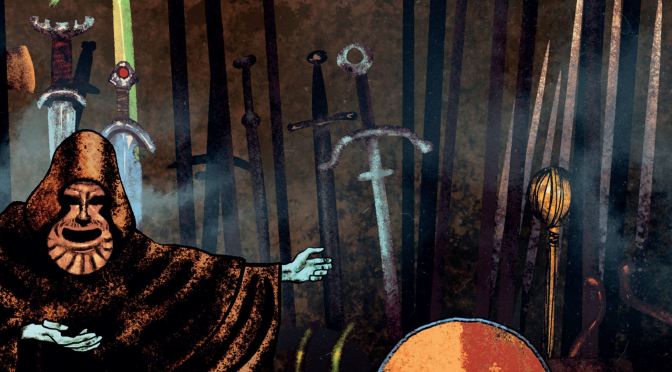
Black Sword Hack and the evolving OSR
The Old School Renaissance is a microcosm within the RPG world. Although many (including myself) refer to the OSR as a whole, cohesive thing, the reality is that the movement is more the result of at least half a dozen origins that random-walked into game preferences which, to an outsider, look similar. The broad preference towards the genre establishment of Dungeons and Dragons (or at least Appendix N, if not the system itself) bounds the definitions we work with; other retroclones and revivals like Cepheus and RuneQuest aren’t included, even if they too are ‘old school’. No, the main thing that all vectors of the OSR have in common is that they are trying to recreate the time when the roleplaying game was new. And when RPGs were new, either literally or in the eyes of the designer, the new thing that they first touched was (almost always) D&D.
All OSR games are aiming for either D&D as it was, D&D as it could be, or D&D as it was supposed to be. D&D as it was is simple; Old School Essentials is a straight-up retroclone and proves that ‘Basic D&D without shitty layout and shitty editing’ is a winning recipe. It’s the best known and best selling retroclone, but the retroclone camp of the OSR is arguably the oldest (to the degree that OSR is a label we can trace it back to OSRIC). D&D as it could be is where we start getting a lot of the distillations; the rules in early editions were such a mess you barely used any of them, so clearly one could write a game only using those few rules we could actually make work. This is where Into the Odd comes in, this is arguably where The Black Hack comes in, and, if rules were in any way supposed to be primary in the game, this might be where Mork Borg would come in. This example shows setting and tone are a different topic here than ‘game’. D&D as it was supposed to be is a tough one, and there aren’t many games that really aim for this mark. Whitehack is the one that comes to mind for me, taking the length and complexity of the original booklets and turning that into something much more flexible and consistent.
Continue reading Black Sword Hack and the evolving OSR Cannibal Halfling Gaming