The online gaming group that (in part) gave birth to Cannibal Halfling Gaming works on a rotating roster of gamemasters and campaigns. The typical arrangement is that two campaigns are being run by two different GMs, trading off our weekly slot so that we can maximize the number of games we play, give GMs a rest between sessions, and get back into thing quickly if we have to scratch a week. Exactly who those two GMs are also changes; in terms of first session to last session most campaigns last about a year, with perhaps 15-20 sessions, and many GMs then step down to let another step up.
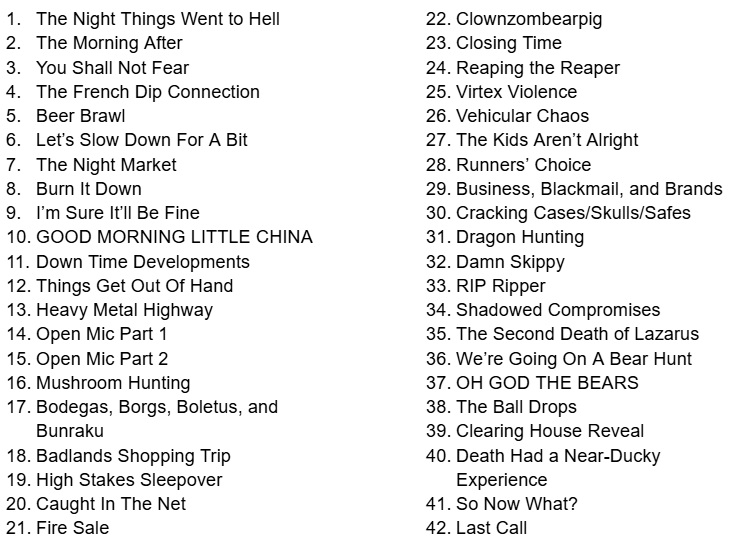
This last July, I wrapped up a game of Cyberpunk RED that had lasted three and a half years with 42 sessions.
Depending on how you count things (because Aaron built a DIE-shaped trap door into a Burned Over campaign, cheeky bugger that he is), Cyberpunk RED: The Alleyway ran alongside/outlasted 2-3 other campaigns. Unsurprisingly, I’m no longer in the GM seat for that group. It will likely be a few years before I return to the GMing chair in that group, actually, and that’s okay! However, after a few weeks I realized that, for the first time in maybe a decade… I wasn’t running anything for anyone.
Before the Alleyway there was my longest runner, which itself overlapped with a bunch of other campaigns over the years. Now? No plots, no schemes, no keeping track of which player characters had which non-player characters/organizations/deities mad at them specifically, no antagonist/encounter design, no maps, no resource tracking, no XP log, nothing. Instead, all I have to worry about are the personal travails of my gunslinger in an already-ongoing Pathfinder 2e campaign (a simple gnoll kholo making his way through Alkenstar) and, in the online group, my Fae in Urban Shadows 2e and my Itzenko Tempest in the Wildsea.
With part of my brain doing the neuron version of fluttering its hands somewhat helplessly, I’m trying to unpack what lessons can be learned from not running games after having run them for so long.
First of all, and probably the most important, is the ability to rest up. This follows the same logic as the online group cycling between gamemasters and campaigns week to week – most people in the hobby have lost campaigns and even groups to the spectre of GM burnout. Taking not just a short hiatus of a week or longer off from running games, but instead letting someone else outright assume the role, gives the formerly-Forever-GMs chance to recover their energy and enthusiasm for the craft. My GMing workload has waxed and waned over the years, keeping me away from burnout, but the idea of resting fully has some appeal.
Second, it is a truth universally acknowledged that a master of games becomes better at the job by playing more and more varied games. The more mechanics, settings, and vibes you get exposed to, the larger the pantry of inspiration you can pull from. Obviously this can be partially achieved by running different games yourself, but getting out of the big chair helps accomplish it in a new way. For one thing it means you’re playing games that you would never otherwise run yourself. Pathfinder 2e and Urban Shadows 2e were nowhere near my list of ‘games I’m planning to run some day’, and the Wildsea was only on the list as a little footnote somewhere in the margins with a lot of question marks around it. Second, you can learn by watching what shenanigans your own GM gets up to – what their overall style is, how they tweak existing mechanics, what new tricks and tools of the trade they add in, and so on – that you wouldn’t have thought to do yourself.
Third, it’s not a bad idea to remember how the other side of the GM screen lives now and again. Just like players can benefit from learning what goes on behind the GM’s side, it can be beneficial to an otherwise-Forever GM to lose their godly powers. A lot of this third point has to do with the second, but there’s another skill to be honed here: not always being in charge of where the spotlight ends up. Getting some practice in waiting your turn and negotiating for and sharing the spotlight with the other main characters isn’t just good table practice in general, it will specifically be useful when you get back into the GM chair and you are in charge of that spotlight.
Finally, it’s just kind of nice to be able to focus on a single character, getting into their head and learning their mechanics. Sure, there might be mechanical synergy or narrative connections with other characters to explore, but that’s part of the overall conversation that is the game. Having a single point of view into the story is where you can really become attached to and develop a character in interesting ways. I have plenty of time now to enjoy telling the stories of Farfang, Colm of the Iron Court, and Kizo Wanderwing, contributing to the overall story those groups of players and characters will tell without needing to burden myself with running the show.
. . .
. . .
So, in a different group entirely, I’m trying to spin up a whole campaign of Cowboy Bebop.
I have learned nothing.


Well said. Well done.
Maybe you could explore a different space in Cowboy Bebop? Dual GMs? Run it with an Antagonist Player?
Taking a break from GMing is Great! (Only, you have to remove the boots and spurs, and it’s just so much effort. And the Badge was so heavy the table you put it on leaned. Can’t damage the furniture. Much better to take it back and put it into the comfy dimple in your chest that it wore into you over the years. Everything is fine!)
🙂
LikeLike
Actually, someone did raise the idea of round robin GMing, and I did have to force myself to not suggest some games that might work for that, but this would be this group’s first real foray into playing remotely, and it was decided to keep things relatively normal on the GMing front.
(For the GM there among them had a dice bag on his hip…)
LikeLiked by 1 person
Seamus’s and my core online group has never attempted round robin GMing, though as we have four core GMs (and at least two supporting GMs beyond that), it’s definitely been talked about. I strongly considered in my Apocalypse World: Burned Over campaign to pick a different gamechanger than I did…there is one where the GM says “you’re it!” to one of the players, hands them all their GMing notes, and then makes a character. Would have been fun. Despite having conversations about it, there hasn’t been any solid game concept that both seemed to be improved by round-robin GMing and had everyone go in with the degree of trust necessary to hand everything off. I’m still planning something, though, even if it’s down the list of my somewhat immense ‘to-run’ list. That said, I got the group to agree to a three day long game of Seven Part Pact, how hard would it be to find a good Round Robin game?
LikeLike
I don’t know if any of this will be interesting or relevant?
My experience with Shared Worlds comes from different campaigns and a variety of systems (Homebrew High Level DnD, Ars Magica, GURPS, Shadowrun and anecdotally Dangerous Journeys).
Four things have really stood out:
Additionally …
I think a concept of designated Final Authority might be useful, where each GM takes different Organisations and Locations in the world, and becomes the “Expert” of those things. I have seen this in play, a little, where a GM has a Player become the (Temporary?) Expert.
In my Earthdawn Campaign, one of the Players convinced me he knew certain details about Barsaive (the setting) that I had not thought of. He was correct (I tried stubbornly to disprove his observations). His ideas very much changed the shape of the game from that point forward. For the better, to be clear.
This experience also changed how I run games. I realised I needed to listen to my Players better. And it put a concrete example of how sharing the storytelling could really improve the game.
Another thing I did in a birthday party game of DnD 4th Edition was hired an Adversary Player.
I tapped the Mother of the Birthday Boy to play the Goblins the adventurers were trying to drive out of a village. She played the Goblins very smartly, very direct combat avoidant, and seriously challenged the wits of the party of teenage boys. It was fascinating.
I doubt another game without those dynamics would be interesting in the same way. But I did see real advantages from being a neutral overview GM. The Adversary could really try to win (survive), with no apologies for macro knowledge altering her choices. At the same time, I could work on keeping things moving fluidly for the whole group.
One advantage the Shadowrun campaign resulted in was the build up of shared history. A PC in one game became an employer in another (partly because the character was the new GM’s character, and partly because she had become rich). Maybe not a necessary thing, but it was nice.
We knew much more about that character, because we knew how certain of her (in play) experiences had affected her behaviour. (She had a serious. drinking problem after bad exposure to a horde of ghosts.)
As for what kind of system/game is a good fit, other than something like Ars Magica, which has some notion of multiplicity in its design, I think games that allow sequestered control can be helpful.
But I also think you want something where the texture established by one GM carries forward to the next situation. That and the contiguity of characters and institutions are places where the differences between GMs can add good depth.
We had a lot of fun in some of those games. Other games, where the GMs had difficulty negotiating sharing were not as fun.
LikeLiked by 1 person