Are you not satisfied with the dystopia in your life? Is Paranoia too tongue-in-cheek? Is Dark Heresy not tongue-in-cheek enough? Is Cyberpunk just too grounded for what you had in mind? Well, loyal readers, there is another dystopia out there. Combine Paranoia’s sense of humor, Dark Heresy’s grim and dark setting, and Cyberpunk 2020’s love of guns, and you get something altogether different but still, well, ‘British Isles’ in its sensibilities. It’s time to freshen up your resume and go work for SLA Industries.
Continue reading SLA Industries 2E ReviewCategory Archives: Editorial
So You Don’t Want To Play D&D
It’s wildly common on Reddit: A thread complaining about the popularity of D&D, or a thread complaining about 5e being hacked into things it doesn’t work well for (I am guilty of that second one). Half the commenters will agree that yes, there are so many other games out there, and people should broaden their horizons! The other half will say that if people are having fun with D&D, why must you rain on their parade! And the fights continue, eventually, like they do in all discourse, repeating themselves. But you out there, venty thread creators and venty thread agree-ers, I see you. I know the real reason you’re creating these threads. You, personally, don’t want to play D&D, and either you can’t find a group to play something else with, or, more likely, your home table has you outvoted. Or, if you’re in a slightly better position, maybe you see these threads online and simply can’t imagine going back to playing only D&D (and you like fighting on the internet).
No matter the reason, I know the pain of playing a game you’re not really interested in because you still want to hang out with your friends and roll dice. There are ways to diversify your gaming experiences and be a happier gamer in general. Unsurprisingly, it doesn’t involve complaining on the internet. It also doesn’t involve slagging on D&D.
Continue reading So You Don’t Want To Play D&D
The Elusive Shift Review
Jon Peterson has done it again, my friends. The author of Playing at the World, arguably the most comprehensive history of the creation of Dungeons and Dragons on the market, has released another book. While Playing at the World covered anything and everything that led up to the first publication of Dungeons and Dragons in 1974, Peterson’s second book, The Elusive Shift, focuses narrowly on the time it took for ‘role-playing game’ to become an established medium. The story of how D&D and indeed the tabletop RPG itself matured in this roughly five year period is fascinating, eye-opening, and ends up asking a lot of questions about the state of the hobby some forty years later.
Continue reading The Elusive Shift Review
Four Years of Cannibal Halflings
Cannibal Halfling Gaming has been working to Bring Games and Gamers Together for four years, and this last one has been by far the strangest. Despite everything, while it has definitely been a year of two steps back, I think in the ways that mattered we managed to take three steps forward. Let’s take a look at what we’ve done, and have a think about where we’re going next.
Vaesen Review
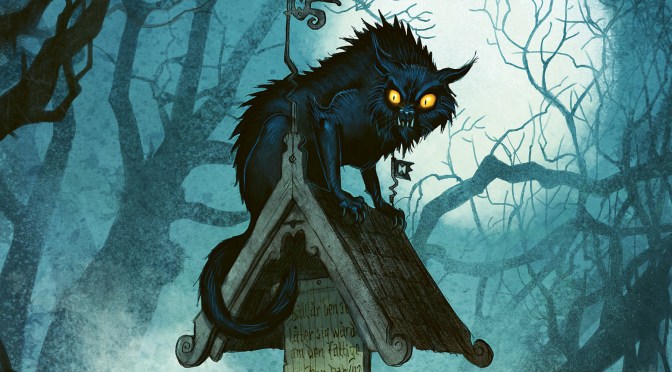
For reasons not entirely clear to me, I have never reviewed a Year Zero game. The Year Zero engine is Fria Ligan’s centerpiece, and maybe even their house system as well. Named for Mutant: Year Zero, the game system powers designs as widely varied as the Alien RPG and Tales from the Loop. And now Free League Publishing’s Vaesen. Vaesen is new territory for the Year Zero engine and indeed mainstream tabletop RPGs in general, being a game of fairy tale horror and specifically Scandinavian fairy tale horror at that. While fairy tale horror may not seem like the most natural fit for a system better known for maps, bases, and colored dice, Vaesen ends up being a pretty wonderful take on the system, its juxtaposed strengths working well provided that you buy into the high concept.
Factions 1 Review – Organizations in Genesys from Keith Kappel
Let’s be blunt: things have been very quiet on the Genesys front lately. The switch from Fantasy Flight Games to EDGE Studio has not exactly hit the ground running, although in fairness a lot of that can be attributed to disruption caused by the pandemic. Still, that means that aside from promises and rumors – good money says Twilight Imperium will be the next IP tapped for the system – there’s been nothing coming out . . . except what’s found in the Genesys Foundry.
Player characters often find themselves interacting with much larger groups, organizations, and factions – but how does a character actually gain prestige and support in such groups? Sure, many games can handle that narratively, but what if you want something crunchier? Out of the Foundry and the mind of FFG-veteran Keith Ryan Kappel comes Factions 1, a Faction Talent Supplement for Genesys!
Continue reading Factions 1 Review – Organizations in Genesys from Keith Kappel
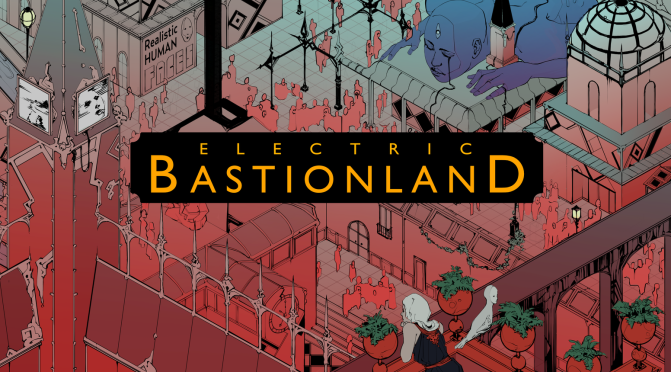
Electric Bastionland Review
Role-playing games are rooted in rulesets which provide a simulation to help determine what happens in-game. In most traditional games, this simulation is, in broad strokes at least, based on physics; the game provides rules intended to reflect a world which players find consistent and believable. In many recent indie games, the simulation is based on narrative; the rules define what happens next based on what makes the story either adhere to a given narrative schema or, in some cases, just more interesting. What about the middle ground, though? What would it look like if a game were simulating tropes rather than physics, but of a setting rather than a storyline? It would look an awful lot like Electric Bastionland.
Continue reading Electric Bastionland Review
The Trouble With Discourse
For as long as tabletop RPGs have existed, people have wanted to talk about them. At the very very beginning we had amateur press associations (APAs), zines, and good old mailing lists; today we have forums, Discord, and Twitter. As our media have changed, so too has how we talk about games and what ends up coming to the forefront of any day’s given discussion. Discussing RPGs is very much like discussing anything else, except the number of people involved is often much smaller. Combine this with the excessive bandwidth of our platforms, and…well, let’s say I could cause way more of an uproar on Twitter with the right mention than anyone ever could have writing an inflammatory letter to Dragon Magazine.
Continue reading The Trouble With Discourse
Cyberpunk Red Review
A review is, at the end of the day, an opinion. Good reviewers call upon their experience, their expertise, and their effort to make their reviews relevant and useful, but no matter how well-researched the writing, how polished and considered the perspective, reviews are always subjective. A hallmark of good writing is not to attempt and claim objectivity, but rather to list your biases as comprehensively as you can in an effort to help a reader understand and gain value from your perspective. This is why you all need to know that I’m an in-the-tank seventeen years running serious fan of R. Talsorian’s Cyberpunk.
In 2005, while I was still in high school, Cyberpunk v3 landed with a resounding thud. I had discovered Cyberpunk 2020 only a couple years previous and was excited by the notion of a new edition coming out. Like many fans who had been with the game longer, though, I was disappointed, both by the change in thematic direction and also in the game’s editing, game design, and art direction. This review, though, is not about Cyberpunk v3, nor is it about Fuzion, nor is it about Mike Pondsmith’s extensive action figure collection. It’s about the edition of Cyberpunk that, years ago, many fans resigned themselves to never getting. It’s about Cyberpunk Red.

The Trouble with Canon
The most passionate fans of fictional properties are rarely satisfied with consuming them passively. Fanfic, the convention circuit, cosplay, and yes, roleplay are all ways that fans engage with their favorite shows, movies, and books, and it’s no surprise that tabletop RPGs based on fan favorite licenses have become immensely popular. Engaging with these licensed games can pose challenges, though. Every fictional world, be it that of Star Trek, Star Wars, Discworld, or Marvel, has a body of work upon which it’s based; this body of work is referred to as its canon. While the definition of canon dates far back and has roots in Christian theology, canon as we nerds typically refer to it is most directly traced back to Arthur Conan Doyle and the Sherlock Holmes stories. Sherlock Holmes was an immensely popular character and also an early example of a character who was the subject of fan fiction, or fanfic. Sherlock Holmes is also the first example of trouble with canon, as there are Doyle-penned works which are not necessarily considered ‘canon’ Sherlock Holmes stories. Arguing over canon is one of the pillars of nerd discourse, propped up by numerous comic book retcons and bigger events like the recent revision of the Star Wars canon by Disney. To say the least, the arguments don’t necessarily stop when we sit down at the gaming table.
 Cannibal Halfling Gaming