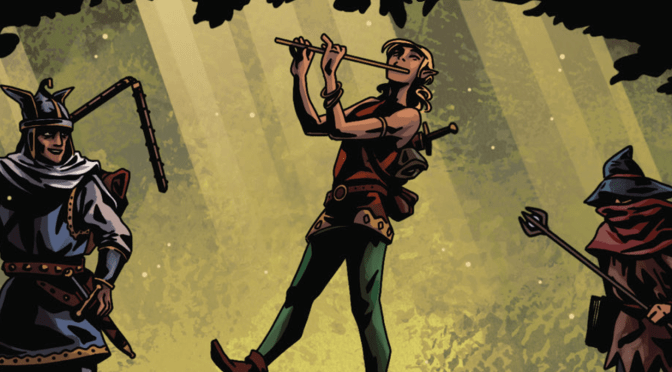
When Dungeon World was released in 2012, it slammed the door to Powered by the Apocalypse open so hard it broke the hinges. By taking the recipe crafted in the Baker House and mating it to the memetic power of Dungeons and Dragons, suddenly everyone could see what was so powerful about PbtA. Of course, Dungeon World was hardly a perfect recipe. Using the architecture of ‘moves’ established in PbtA but keeping both the stats and classes of D&D made for an incomplete match, and some of the mechanical choices made to get the two to pair up have received more significant criticism now that the design community has had a good decade and a half to really figure out what PbtA is. Still, the combination of a solid foundation and a lot of good ideas made Dungeon World into a rare specimen: The commercially successful fantasy heartbreaker.
Continue reading Is Grimwild the next Dungeon World?Tag Archives: D&D

Weekend Update: 2/8/2025
Welcome to the Cannibal Halfling Weekend Update! Start your weekend with a chunk of RPG news from the past week. We have the week’s top sellers, industry news stories, something from the archives, and discussions from elsewhere online.
Continue reading Weekend Update: 2/8/2025Weekend Update: 1/18/2025
Welcome to the Cannibal Halfling Weekend Update! Start your weekend with a chunk of RPG news from the past week. We have the week’s top sellers, industry news stories, something from the archives, and discussions from elsewhere online.
Weekend Update: 1/4/2025
Welcome to the Cannibal Halfling Weekend Update! Start your weekend with a chunk of RPG news from the past week. We have the week’s top sellers, industry news stories, something from the archives, and discussions from elsewhere online.
Continue reading Weekend Update: 1/4/2025Weekend Update: 12/21/2024
Welcome to the Cannibal Halfling Weekend Update! Start your weekend with a chunk of RPG news from the past week. We have the week’s top sellers, industry news stories, something from the archives, and discussions from elsewhere online.
Continue reading Weekend Update: 12/21/2024Weekend Update: 11/30/2024
Welcome to the Cannibal Halfling Weekend Update! Start your weekend with a chunk of RPG news from the past week. We have the week’s top sellers, industry news stories, something from the archives, and discussions from elsewhere online.
Continue reading Weekend Update: 11/30/2024
Network effects make you play D&D
As children of the social media age, we’ve heard the term ‘network effects’ before. Network effects are the observation that, for certain goods and services, their utility (benefit to the user) increases the more people are using them. The classic example is a social network like Facebook: The more of your friends are on a social network, the more useful it is to you. Services with strong network effects are also built with strong switching costs; a network effect is only defendable if there’s a disincentive to join multiple networks at once, and if leaving one network for another is difficult. This is why extracting your data from a service like Facebook is a pain, and why these services try to prevent you from exporting your contact list at all costs. Make the service more useful by getting more people on it, but then make it hard to leave so these people stay.
What does this have to do with RPGs? There are few direct network effects or switching costs involved with the act of playing a game: You find a group of your friends who are willing to play (and maybe learn) the game, then you play it. If you want to play something else, you put it down. For better or worse, though, roleplaying games are a hobby which involves multiple points of interaction and modes of social signaling. And while the hobby may not have switching costs, it does have barriers to entry. These are both real barriers, like finding a group of people you play well with, scheduling multiple game sessions, and spending a fair amount of time prepping campaigns and characters, as well as imaginary ones, like the amount of effort it takes to learn the next new system, and the risk of playing the ‘wrong game’. It’s important to acknowledge perceived barriers to entry because that’s where network effects within the hobby begin to affect your behavior; specifically, indirect network effects are quietly encouraging you to play D&D.
Continue reading Network effects make you play D&DWeekend Update: 11/9/2024
Welcome to the Cannibal Halfling Weekend Update! Start your weekend with a chunk of RPG news from the past week. We have the week’s top sellers, industry news stories, something from the archives, and discussions from elsewhere online.
Weekend Update: 9/14/2024
Welcome to the Cannibal Halfling Weekend Update! Start your weekend with a chunk of RPG news from the past week. We have the week’s top sellers, industry news stories, something from the archives, and discussions from elsewhere online.
Continue reading Weekend Update: 9/14/2024Weekend Update: 8/17/2024
Welcome to the Cannibal Halfling Weekend Update! Start your weekend with a chunk of RPG news from the past week. We have the week’s top sellers, industry news stories, something from the archives, and discussions from elsewhere online.
 Cannibal Halfling Gaming