Welcome to Crowdfunding Carnival for June! We’re just starting to creep into con season here in the US, and there is an attendant slowdown in major campaigns as a result. That said, there’s still a lot of energy in crowdfunding, and this month it felt pretty easy to come up with at least ten to cover. More of an issue were some of the campaigns themselves. Did you know I actually opened a campaign, started to write about it, and then had to actually Google the name of the game to find out that the campaign was for a fourth edition of the game, because that hadn’t been written anywhere in the campaign’s text? Don’t do that! Don’t assume we know anything about your game, because the fact is that unless your name is Mike Pondsmith or Mr. Paizo (or Gary Gygax, I suppose), we don’t! No one knows anything about your game! Anyways. There are some solidly interesting campaigns here, both from your larger studios and some completely new outfits. Let’s check them out.
Continue reading Crowdfunding Carnival: June, 2024Tag Archives: RPG

Weekend Update: 5/25/2024
Welcome to the Cannibal Halfling Weekend Update! Start your weekend with a chunk of RPG news from the past week. We have the week’s top sellers, industry news stories, something from the archives, and discussions from elsewhere online.

How do you become an RPG publisher?
The RPG hobby is nearly 100% self-published. This makes sense on itch.io and when talking about the many solo designers with DBAs like ‘Sine Nomine Publishing’ or ‘Bastionland Press’, but it extends across the whole hobby. At no point did Mike Pondsmith submit Mekton to a publisher; he formed his own company, R. Talsorian Games (and had investors in his company, somewhat unusual then and much rarer now). Steve Jackson Games was formed, unsurprisingly, by Steve Jackson. Even TSR was just designers trying to get their games out into the world.
This dearth of publishers creates a problem for aspiring RPG designers: A complete lack of support services. You can hire an editor, artists, even a marketing consultant, but that’s money out of your pocket and a severe constraint for most designers who haven’t yet sold a game. That’s the reason the publisher model is so appealing: For a promise of future revenue, a publisher will provide a designer with all the resources they need to succeed. All the designer needs to do is bring them a game that all parties agree is good.
It works great for fiction, it’s been used much less often in the RPG world. Some designers who extend into publishing, companies like Evil Hat Productions, typically represent games by designers they’re already familiar with as a way to reduce downside risk. It’s a reasonable business strategy but it greatly diminishes the number of new games that can be elevated if fewer risks are taken to discover them. Others, like Indie Press Revolution, do a great service getting games into print and distributed but, once again, they’re curating existing games and designers more than discovering new ones. It all begs one question: Is there an effective business model to discover promising game designers and give them the resources they need to stand toe to toe with the big guys?
Continue reading How do you become an RPG publisher?Weekend Update: 5/18/2024
Welcome to the Cannibal Halfling Weekend Update! Start your weekend with a chunk of RPG news from the past week. We have the week’s top sellers, industry news stories, something from the archives, and discussions from elsewhere online.
Continue reading Weekend Update: 5/18/2024
System Split: War Never Changes
The Fallout show on Amazon Prime is actually good, the latest video game property to successfully push back a decades-old curse that has sent similar adaptations plummeting to the bottom of box office rankings and critics’ opinions. And, like any good mass media property, the Fallout TV show has inspired interest in other formats. The contemporary video games were already big hits; with the newest one being six years old the tail effect has been relatively modest (both Fallout 4 and Fallout 76 did re-enter Steam’s top 10 most played games, but that impact has already abated). In the smaller TTRPG world the impact on the official licensed Fallout RPG has been a bit more pronounced, with both the game’s core rulebook and its most recent supplement staying in the DriveThruRPG top ten for weeks now. Much as happened for Cyberpunk Red in the wake of Cyberpunk 2077, Fallout is seeing a wave of renewed TTRPG interest.
Continue reading System Split: War Never ChangesWeekend Update: 5/11/2024
Welcome to the Cannibal Halfling Weekend Update! Start your weekend with a chunk of RPG news from the past week. We have the week’s top sellers, industry news stories, something from the archives, and discussions from elsewhere online.
Continue reading Weekend Update: 5/11/2024
Deathmatch Island Review
Back in 2020 I reviewed the newest edition of John Harper and Sean Nittner’s Agon. Agon is a fascinating game, taking the characters on an Odyssey-like journey of myth through a number of islands. Like Greek myth, though, the game has a strict structure and, barring a small chance of premature retirement, usually ends in the same way. It’s great for generating stories, but not what I’m typically looking for.
Deathmatch Island is based on Agon’s mechanics, but casts the strict structure differently. The structure of each island is because the characters are contestants in a game show, a twisted game show where physical challenges and loot boxes give way to a literal battle to the death. Survivors make their way from one island to another until they reach the end game with Production, the shadowy administrators of the whole thing, shaping the game based on how many social media followers each contestant gets. The last surviving contestant may win a big prize…or wake up on yet another island with a job offer they never could have imagined.
Continue reading Deathmatch Island ReviewWeekend Update: 5/4/2024
Welcome to the Cannibal Halfling Weekend Update! Start your weekend with a chunk of RPG news from the past week. We have the week’s top sellers, industry news stories, something from the archives, and discussions from elsewhere online.
Continue reading Weekend Update: 5/4/2024Crowdfunding Carnival: May, 2024
Welcome to the Crowdfunding Carnival for May! The push in April means that the crowdfunding machine is quiet, at least in terms of big names pushing big games. For newcomers, though, there is some variety. We’ve got dystopias, we’ve got mecha, and we’ve got…maggots. Come with me, and see what games you want to throw some money to this spring.
Continue reading Crowdfunding Carnival: May, 2024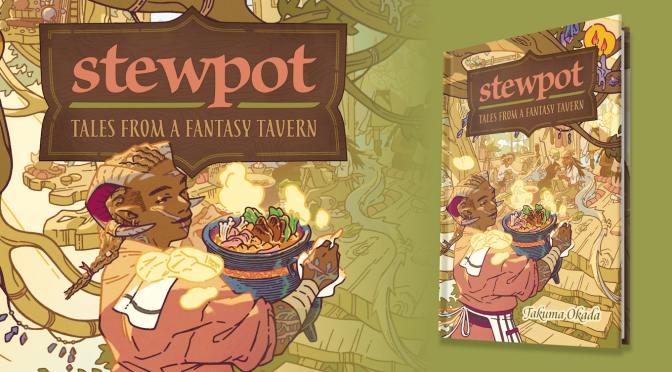
Stewpot: Tales from A Fantasy Tavern Backerkit Review
The tavern is the fulcrum point of the adventuring lifestyle. It’s where wandering heroes can find food and shelter after weeks out in the wilderness, it’s where quests can often begin… and it’s where quite a few stories find their happy ending. After all, being an adventurer is a tough life. Many adventurers, whether they retire after a successful career or call it quits early, get the idea to be the ones running the tavern, providing the same things they needed back when to a younger generation. It can take some doing, however, integrating back into settled society after a life living on the road and by sword and spell. How do you let go of who you were, and who will you become? Let’s have a taste of Stewpot: Tales from a Fantasy Tavern from Takuma Okada, now on Backerkit with Evil Hat Productions!
Continue reading Stewpot: Tales from A Fantasy Tavern Backerkit Review
 Cannibal Halfling Gaming