While the focus in RimWorld is on the stretch of land that you’ve claimed for your base, the entire planet is available to you to explore. You can see the spread of different biomes and factions when you select your landing site at the beginning of the game, but really exploring and interacting with the broader world is dependent on either sending out risky caravans or developing later-game technologies like drop pods and (now with Odyssey) gravships. For our System Hack, the base site is likely to feel a bit smaller, and venturing out onto the world map is something that happens sooner. Luckily, we have decades of wilderness exploration in TTRPGs to help us out. When looking at our overworld map, we want to make sure that exploration and venturing beyond the base site both provides interesting decisions and helps us populate a world with people and places that our players will want to explore.
The overworld is also where we start considering some of the setting assumptions of RimWorld, and deciding where we converge or diverge. RimWorld’s implied setting is fascinating, but the place where all of the setting ideas fail to emulsify is in the overworld. Beyond the dispersion of settlements being a clear game contrivance, the lack of any population buildup or agglomeration is just not how any planet would look after years of colonization. There is a line to be walked here; a ‘RimWorld’ would likely self-select for individualists who may want space and to be left alone, but there’s simply too many personal and economic benefits for larger settlement to assume there wouldn’t be any.
Welcome to the Cannibal Halfling Weekend Update! Start your weekend with a chunk of RPG news from the past week. We have the week’s top sellers, industry news stories, something from the archives, and discussions from elsewhere online.
For years I have served my Master faithfully. A loyal companion, I accompanied my Master through the difficult times, and the good times. Now, I am called in a moment of dire need: a Stranger has challenged my Master to a duel, alluding to time before me. My Master rises to the challenge, calling me forth. This is my moment. I have trained for this. It is time to do my Master proud.
This post is brought to you thanks to Lady Tabletop, who prompted folks to write about their own gaming experiences of the year and give out their own fun awards. Like Seamus I thought this was a neat idea, and was also glad (and relieved) that ‘The Endies’ weren’t trying to be yet another award given out because someone disagrees with the ENnies. Thinking back on the year and giving your own awards is more useful (and more fun!), anyway.
I had a much more constrained gaming year than Seamus in part because I had a very busy year; in the middle of this year my partner and I moved, which involved buying a condo, selling two condos, moving one person once and another person (and a cat) twice. In a way I’m surprised I got as much gaming in as I did, and also surprised I was able to write anything from May to August. Still, the difference in absolute number hides the point that Seamus made to me that, due to the number of campaigns I’m in and how often I run, I probably ran and played more sessions by absolute count than Seamus did.
The RPG theory ship sails on unbidden, even as RPG networks of practice seem to be drifting apart. In November, there was a great post over on The Dododecahedron which bucked the trend and pulled theory work from outside of the author’s primary discipline, the OSR. Starting from a description written by Vincent Baker about the PbtA ‘conversation’, Dododecahedron author Rowan describes OSR play as an onion with four concentric layers: Character on the outside, then working inward to Mechanics, Procedures, and finally Adventure. Adventure is in the middle as the diegetic ‘fiction’ that the players are engaging with is the source of truth for OSR play. From there are Procedures, which describe the rules for how to go about play; that is to say, what travel looks like, or when random encounters occur, or how to track consumables. The next layer out is Mechanics, which describe the “rules” as most RPGs understand them; this is where initiative, ability checks, and all those specific bits live. Finally on the outside is Character, where elements like attributes, experience points, and skill ratings, all the things that make characters unique, sit.
This post is brought to you thanks to Lady Tabletop, who prompted folks to write about their own gaming experiences of the year and give out their own fun awards. I like the idea a lot, and as it turns out I actually have a lot of games to mention and talk about and give accolades to. I still plan to write up my usual X Years of Cannibal Halflings on the 31st to look back on the year, but this seems like a fun idea that focuses more on the games than the writing about them. So, let’s see what I played, what I thought about them, and who won what!
Welcome to the Cannibal Halfling Weekend Update! Start your weekend with a chunk of RPG news from the past week. We have the week’s top sellers, industry news stories, something from the archives, and discussions from elsewhere online.
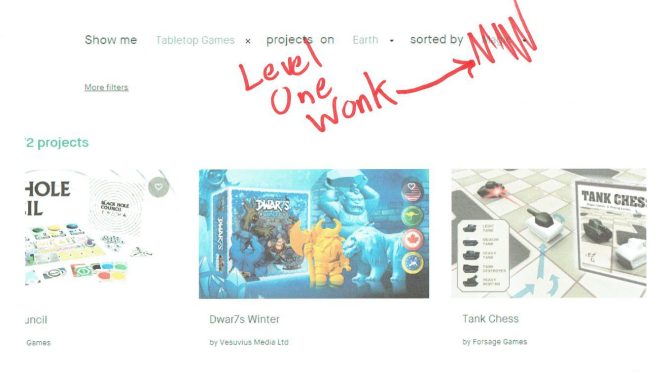
Welcome to Crowdfunding Carnival for December! Con season is well and truly over, with PAX Unplugged wrapping before Thanksgiving. That, combined with the upcoming holidays, has caused Kickstarter to slow…turns out game designers need a vacation too! We don’t have ten campaigns to look at this month, but there are still a number of interesting games on the horizon which are worth examination.
Ever feel like the world is out to get you? It is. Five radical teens with attitude should not be responsible for saving the world. You’re a bunch of god-damned teenagers. You might act like you have it all figured out, but you don’t. How could you when there is a literal evil force making your lives harder? So go ahead, seek out some normal high school goals like dominating on the sports field, kissing the mean girl, or becoming class president. While you play pretend, the darkness will seep in. The darkness colors the world so nothing is quite right. This is a world where disputes can be resolved via duels, where the next town over seems a world away, and where monsters live in secret. Normal doesn’t have a chance. What will you do before it all ends?
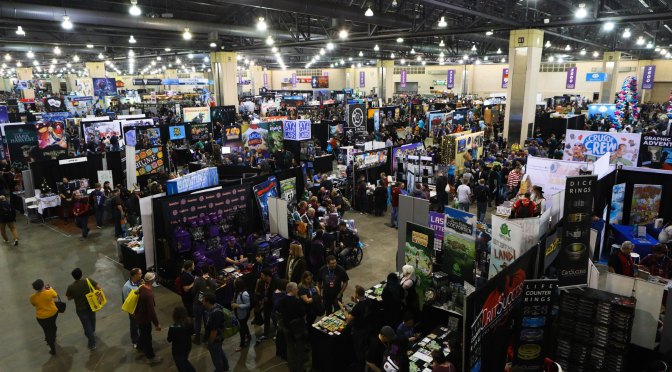
When it comes to nerd hobbies, the convention scene is bifurcated. There are local, volunteer-driven cons that put a lot of effort into building content from enthusiasts around the area. There are also the massive, national affairs that bring attention and revenue to their parents. Gaming cons moved quickly into the latter category, even if the initial efforts were modest; both GenCon and Origins came to prominence after their alignment with TSR and GAMA, respectively. And now there’s a massive leader in the corporate con sphere: Penny Arcade Expo, or PAX.