Tag Archives: Sine Nomine Publishing

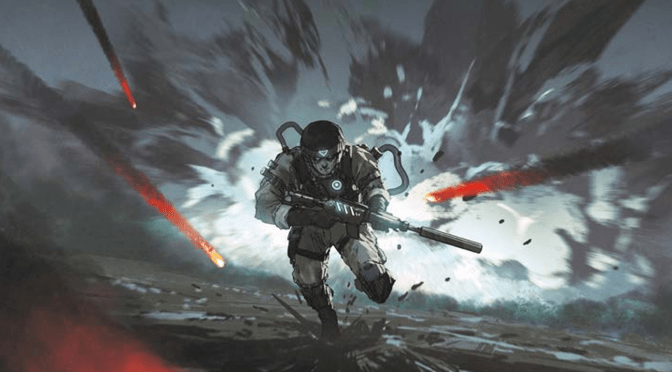
Hit points: A cyberpunk case study

Are hit points meat? Does the answer to that question even matter? Hit points are an old mechanic, ported into RPGs at the beginning from wargames, where they made the assessment of unit health more granular than ‘alive’ or ‘dead’. D&D took the concept and applied it to player-characters and monsters alike, and from there it became profoundly common. Measuring damage taken and time until expiration is one of those things where the simplest approach is often the most fun, even if it’s hardly the most realistic.

Hit points as a mechanic are not a monolith. Not even D&D still uses the original mechanic where you have a number and when it’s reduced to zero, you’re dead. Death saves, critical wounds, damage thresholds and any other number of modifiers to the hit point schema make the act of bleeding out after being stabbed a lot more complex than it necessarily has to be, but sometimes more fun, too. Of course, a lot of the relationship that a game has to how its characters get shot and die has to do with genre.

Continue reading Hit points: A cyberpunk case study
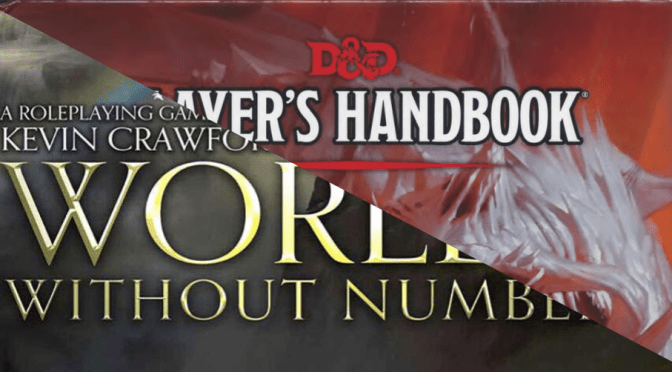
System Split: Worlds Without Number and D&D Fifth Edition

It’s never been a better time to be a dungeon crawler. Dungeons and Dragons Fifth Edition and Pathfinder, two versions of the same underlying D&D ruleset, are bestsellers 1 and 2 in the RPG world, and have been for some time. Pathfinder is built for detail and breadth of options, while D&D’s Fifth Edition is built for accessibility and continuity with earlier versions and settings. They offer two versions of a fairly modern D&D experience, where GMs run story arc-based campaigns built around fighting monsters and exploring dungeons. Characters are treated like protagonists, and death is relatively rare. At the same time, we’ve seen a resurgence in “old-school” playstyles, usually represented within the D&D ecosystem by the OSR. Old-school games tend to have fewer rules, presenting challenges and decisions to the players rather than the characters. They tend to have weaker characters who aren’t treated like protagonists, and they need not be organized around a story.

There is a middle ground, though, and a new entrant in the middle ground has stormed into the DriveThruRPG sales charts. Worlds Without Number presents a dangerous old-school world, but uses rules innovations from later versions of D&D (and other role-playing games) to make the game more accessible and make the characters feel a bit more heroic. On top of all that, it provides tons of tools to help GMs run interesting game worlds with or without a driving story. Although many people will simply call Worlds Without Number an OSR game (and there are fair reasons for that), I think that it deserves to be examined against the current state of the art. That’s why this System Split pits Worlds Without Number against Dungeons and Dragons Fifth Edition.

Continue reading System Split: Worlds Without Number and D&D Fifth Edition

Stars Without Number

Are you an old-school gamer, or a new-school gamer? I’m the Level One Wonk, and I consider myself both, which may be why I enjoy this week’s game so much. Today we’re going to talk about Stars Without Number, a game designed by Kevin Crawford. Crawford has released many games through his Sine Nomine Publishing imprint, which are all built around similar design principles: hackable sandbox experiences with an old-school heart. Games like Godbound, Scarlet Heroes and Stars Without Number are all designed to bolt right in to both old-school D&D and its retroclones, but these games are no mere clones. While Stars Without Number has characters with six familiar stats, saving throws, classes, and levels, it stretches the D&D framework quite far. As you may be able to guess from the name, Stars Without Number is a science fiction game.

Continue reading Stars Without Number