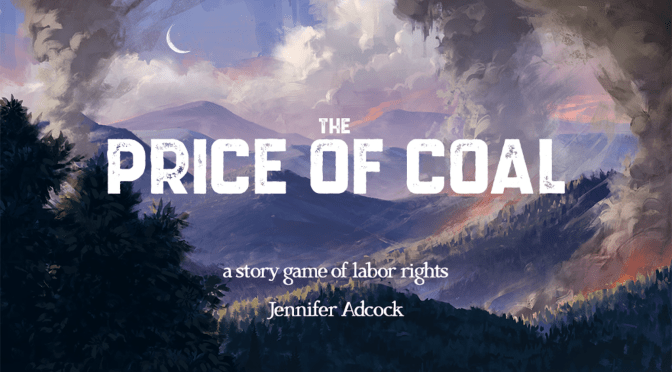
“In 1920, the coal miners of West Virginia faced shameful living conditions, and even worse working conditions. Miners were paid subsistence wages, despite high profits, or even paid only in scrip which could only be used at the company-owned store. Within the mines themselves, workers experienced frequent cave-ins and other dangerous accidents, as the operators were reluctant to reduce production for the sake of safety. Whispers of unionization began to arise in the mountains. The coal companies responded harshly, employing company gun thugs to violently and cruelly enact the company’s will upon the miners. Events escalated from there, including the declaration of martial law, spiraling into the 1921 assassination of Sid Hatfield, who had by then become a local icon and a leader to the miners throughout the region. Federal troops were dispatched to Blair Mountain, including aerial bombers equipped with leftover gas and explosive bombs from the Great War. Days of guerrilla warfare followed, during which as many as one hundred miners were killed for the crime of wanting a better life.”
This is, in actual real life, The Price of Coal – and for our purposes, it is also a GMless storytelling game for 3-5 players by Jennifer Adcock!
It’s Labor Day today here in the USA, and as a union member myself (Laborers’ International Union of North America Local 223) there’s always something of a compulsion to make a note somewhere or the other that it’s about more than just a day off, some sales, and a sign that kids here will be going back to school soon if they haven’t already. This time I’m making that note with a review from the tabletop! The events described above are things that actually happened, culminating in the Battle of Blair Mountain – a real life story of labor rights that ended in gunfire. The Price of Coal uses the lens of a roleplaying game to let players tell their own version of the story – although some parts of history are immutable.
Aside from the rules and X-Card, the game consists of Miner cards, Family cards, Interlude cards, and Season cards from Fall to Summer – as well as cards for transitioning between seasons. There are seven cards each for Fall, Winter, Spring, and Summer – setup starts by removing two cards at random from each season’s deck, introducing a bit of randomness to how your game is going to go. The only exception is the Ordinance card from the Summer deck; if that one gets pulled at this stage, you put it back in and draw another. We’ll address why that is towards the end.
Next, each player takes turns choosing a Miner card that depicts an actual coal miner. The card provides that character’s name, background information, and some questions that we’ll address shortly. For example, Andre Pellegrini was a sculptor in Italy who was forced into the mines when opportunities in his chosen trade were denied to him as an immigrant. Another example is David Burke, a veteran of World War I and an average miner but an excellent marksman, who suffers from PTSD and whose gentler side is mostly hidden by a legendary temper.
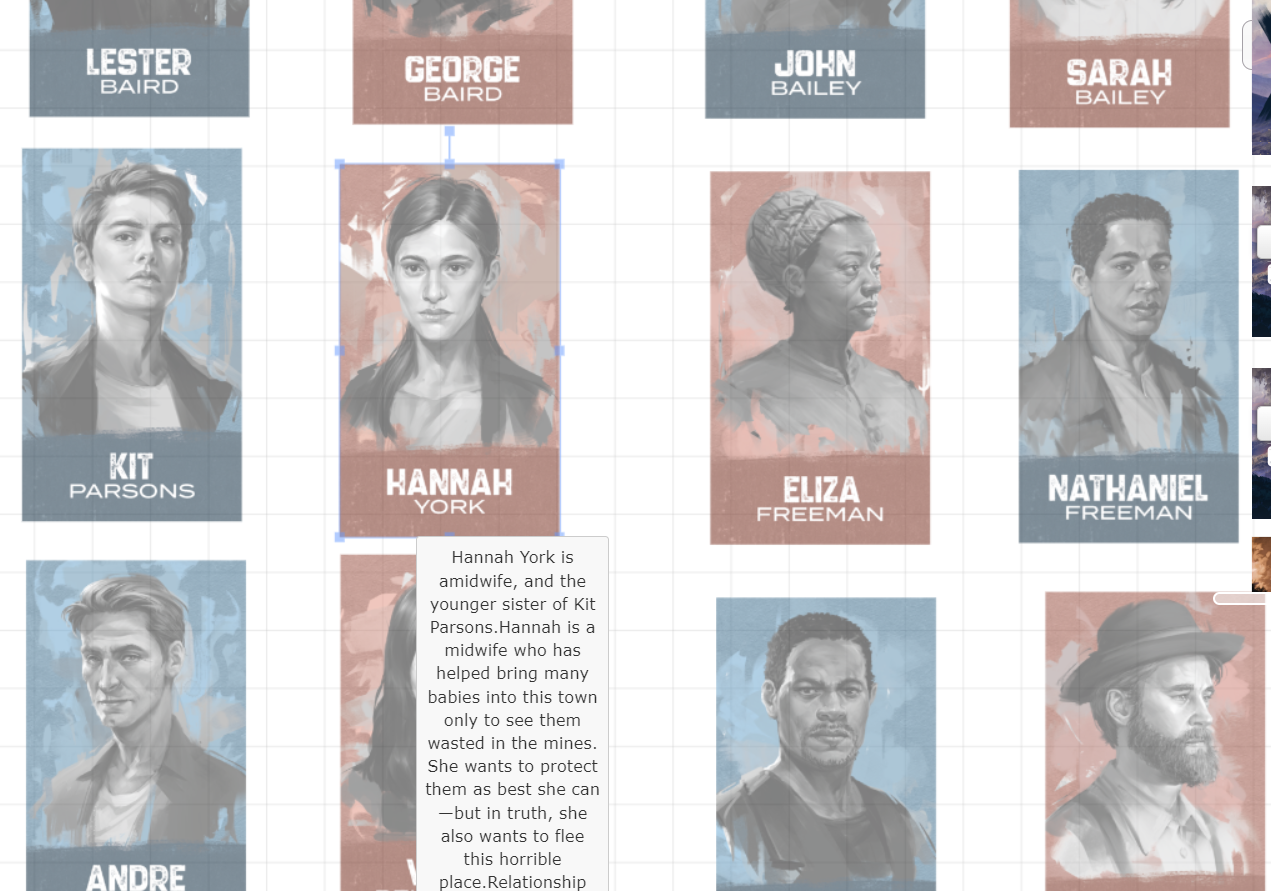
Then, in reverse order from how they picked their Miner, the players takes turns picking out a Family card – each one is related to a Miner in some way, although by no means do you have to pick your Miner’s relative. George Baird is a deputy sheriff and the younger brother of jaded miner Lester Baird; he has to keep the peace, and he has to keep the townsfolk alive, but his obligation to enforce the law above all else makes it difficult to always do both. Sarah Bailey is a young woman and the wife of idealist miner John Bailey who is coming into her own as a leader among the miners’ spouses, although privately the couple are at odds.
Once every player has their two characters, they ask their characters’ relationship questions of one another. Each character has two, and they have to ask each one of a separate character, linking the entire ‘cast’ together. Non-binary miner Kit Parsons, who has pretended to be a man for years to support their family, asks “How do you love them? and “How do you surprise them?” Eliza Freeman, a postal clerk who has seen worse than Pinkertons in her long life (she’s a Black woman in 1920s West Virginia, after all), asks “Why do you avoid them?” and “How do you keep them safe?”
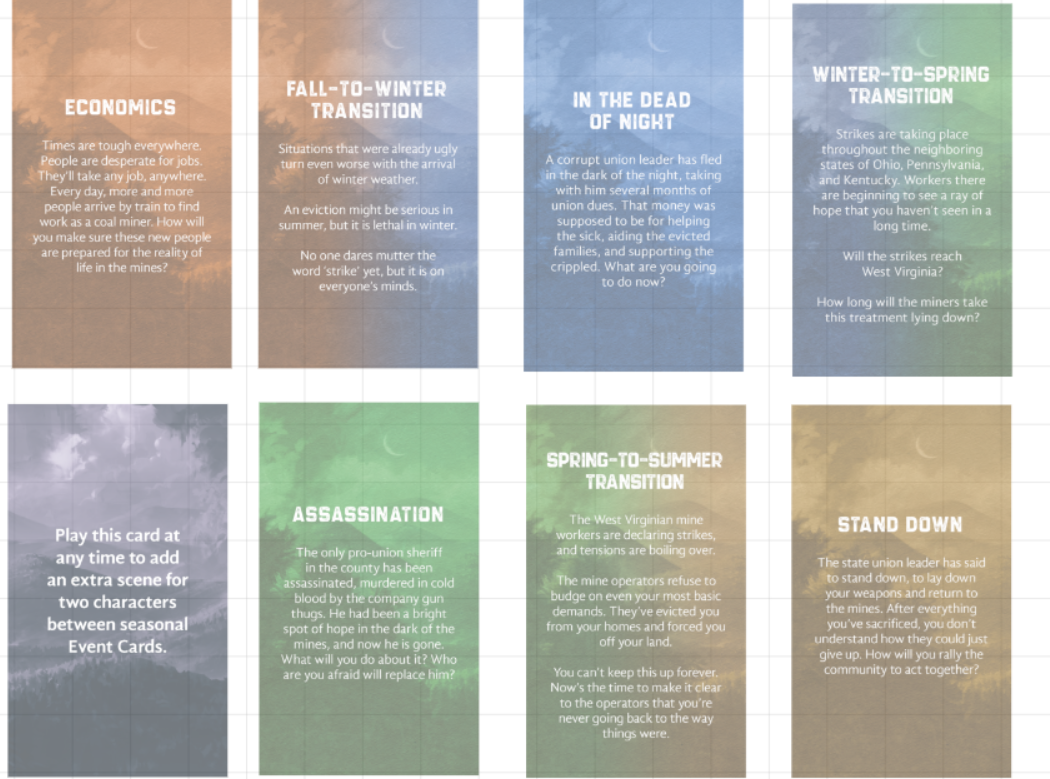
Whoever volunteers to go first, they become the Active Player, drawing the top card from the Fall deck and using its prompt to establish a scene. They’ll provide context for which characters are present (each player will only be playing one of their two characters per scene), describe where it is happening, and detail what else might be going on in the scene. Then, everyone plays the scene out in character, roleplaying until the prompt is resolved. Going forward players then take turns being the Active Player, setting up scenes and playing them out together, until the season ends. Then the transition card is read (not an actual scene, more of a narrative guide for how things are changing/getting worse overall for the characters), and the game moves on to the next season.
In the Fall the prices at the company store are raised and all other stores are closed, and new workers are hired under contracts forbidding them from meeting with union members. In the Winter entire families are evicted without any explanation, and workers in neighboring Ohio launch a strike of their own. In the Spring the mining companies try to stoke racial tension between the miners, figuring a divided workforce will be too busy to stand up for itself, and a pro-union sheriff is assassinated. In the Summer a union leader calls for the miners to stand down and return to the mines, seemingly betraying everything they’ve sacrificed, and the governor calls in the state militia to add their firepower to that of the company gun thugs.
One thing I skipped describing earlier during setup is how each player gets a certain number of Interlude cards (three each for a 3 player game, two each for 4-5 player games). Each one simply allows a player to play them in between Season card scenes to add an extra scene between two specific characters, allowing the players to flesh out relationships and follow up on story points that have caught their interest.
Once the players reach Summer, eventually the Ordinance card will be drawn. “The United States military is dropping gas and explosive bombs leftover from World War I on your town. The government is treating you like traitors to your country for defending your rights to human dignity. Despite everything you’ve sacrificed, it’s clear they’ve won.” Each player talks about what happens to their characters and whether or not they survive, including an epilogue if they so wish, and then the story and the game comes to an end.
In real life, it was a crushing defeat for labor. It ended in arrests and trials for treason (the one mercy being that most were acquitted by sympathetic juries of their peers) and the demonization of organized labor. While in the long term it helped to raise awareness of the workers’ plight, it would be years before they would be able to organize effectively again.
The reason that this article is sailing under the banner of A Glimpse Into The Vault, despite being a roleplaying game, is that the name fits because finding physical copies is now a vanishingly rare occurrence. Originally Kickstarted in 2021 (100 years after the events it focuses on, it must be noted), the game is out of stock at IPR and most other retailers; searching around has uncovered only one in Petaluma, California of all places that still seems to offer it as of this writing. However, you can get a PDF version for $15 and a Print-on-Demand version of the cards for $30 at DriveThruRPG and a virtual copy at Roll20 for $19.99. Very interesting is that there is also a text-only version of the game on itch, available for free. With some effort you could kitbash it into a physical, art-free version of the game, but this version also includes commentary from Adcock on the rules and pretty much every card that makes for a fascinating read. There’s no reason not to check it out!
The Price of Coal is not a game with a happy ending – just as with those real people whose story the game is based on, while individuals may very well scrape something together in the epilogue it is by and large a tale of struggling and then failing. It is, however, an excellent example of how a game can use prompts and character relationships to help us tell a story about such a struggle, grounded in real events, a story of where we’ve been and how we got here, and a reminder of the Price that had to be paid. It is a story worth telling.
Happy Labor Day.
 Cannibal Halfling Gaming
Thanks for this.
LikeLike