All posts by Aaron Marks

Gaming for nearly twenty-five years and writing about it for over fifteen, I've always had a strong desire to find different and interesting things in the hobby. In addition to my writing at Cannibal Halfling Gaming, you can follow me on Bluesky at @levelonewonk.bsky.social and read my fiction and personal reflections at newwonkmedia.com.

A Glimpse into the Vault: Infomocracy

A Glimpse into the Vault is one of the oldest features on Cannibal Halfling, giving us opportunities to look into our respective “vaults” at other media we consume. These articles have covered a range of different items, but tended to stay in the gaming space…until now. You see, my personal vault doesn’t have many board games in it, but I do live surrounded by books. And recently, I finished a book that is not only a great read, but has some pointed lessons that gamers can learn about worldbuilding.

Infomocracy is written by Malka Older and was first published in 2016. It tells the story of a world in the near future where most of the world is ruled over by a unified micro-democratic government. The population that participates is divided into “cententals” of 100,000 people, who each vote on a government to represent them. Each government has power based on the centenals which elect them, but there is special influence (and statistical benefits) afforded to a government able to win a “Supermajority” of these centenals. The story, which I’ll summarize soon, focuses on the lead-up to an election where such a Supermajority is in play.

Continue reading A Glimpse into the Vault: Infomocracy →

“I’m going to turn my campaign into a novel!”

When we play RPGs, we tell stories. For some it’s a fun consequence of the characters’ exploits, while for others it’s the whole point of the game. These stories can often have great power for the groups who create them, creating characters more personal and compelling than any novel ever could. It’s natural, then, to want to share these stories outside the group. The problem here, really, is that a tabletop campaign is a big, extended instance of “you had to be there”. As fun or dramatic or gutwrenching as it was at the time, you cannot recapture those feelings by turning your campaign into a novel.

Continue reading “I’m going to turn my campaign into a novel!” →

Kickstarter Wonk: August, 2020

Welcome back to Kickstarter Wonk! In case you’re wondering, no, nothing is normal yet, and I’m still not covering the ‘normal’ spread of ten games. Fear not, though, because Kickstarter volume does appear to be picking up! Once you sift through the awful pandemic and political cash-grab board games, there are a slowly increasing number of RPG Kickstarters, almost enough for me to start upping my numbers again. Of course, there’s also an increase in shorter campaigns, so I’m missing more of them. One example of this? Necronautilus, by Adam Vass, ended the day before this article was published, sadly. Still, I’d watch that one for late pledges if I were you.

Missed opportunities not withstanding, there’s a great crop here, including games about Chinese restaurants, athletes, sign language, and of course, rodents.

Continue reading Kickstarter Wonk: August, 2020 →

Burning Wheel In-Depth

Some RPGs are demanding. While you can’t homebrew D&D into anything, it is still flexible and doesn’t demand that you play it a specific way. Some games do. There is no end of teeth-gnashing about this; for some reason people take more issue with RPGs having set procedures than, say, board games. But, as the entire indie RPG community knows very well, making a game for a specific purpose and experience often nets you a better version of that experience than trying to simulate it with a ruleset designed with breadth in mind. I’ve been having some revelatory experiences with such a targeted game recently; I will say though that when I say “targeted game” and “specific experience”, most are imagining a zine, something small, not a 600 page hardback with red and gold filigree. Yeah, I’m talking about Burning Wheel.

Continue reading Burning Wheel In-Depth →

Level One Wonk: Fantasy Economics

Tabletop RPGs are not realistic, and this is a good thing. On one extreme we don’t really want to simulate the hygiene of our fantasy worlds, and on the other we don’t really want to play Apartment: The Playstationing. What RPGs should and do have, though, is verisimilitude. Verisimilitude is the appearance of being real, and in RPGs this means that the characters exist in a world which behaves in a way the players expect. One place where games fall down in this respect is in having a world that changes around the characters, one that might even be responsive to their actions. That is why I’m returning to my old stomping ground, the field of economics.

Continue reading Level One Wonk: Fantasy Economics →

Quest Review

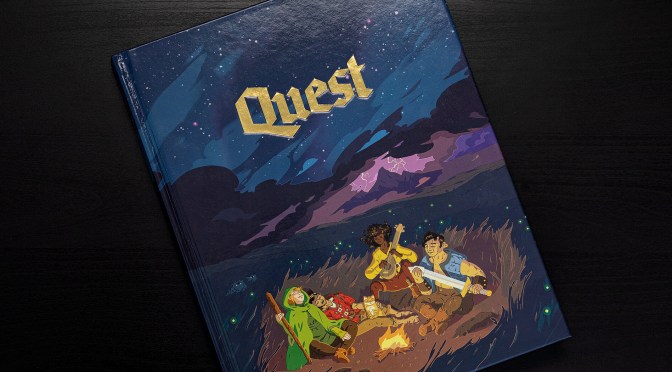
Dungeons and Dragons is the 800 pound gorilla of the role-playing game world. For what is arguably such a small slice of the space (swords and sorcery fantasy), D&D is utterly dominant, commanding a plurality of the hobby’s mind and market share (and that’s a majority if you count all games which are direct derivatives, like Pathfinder and many OSR games). For this reason, when someone lists “overtake D&D” as one of their design goals, even if it’s just part of a Twitter thread, your ears perk up. Indeed, TC Sottek did post those words, in that order, on Twitter. But people are listening. TC Sottek is the designer of Quest.

Continue reading Quest Review →

System Hack: A Not-Advancement System for PbtA

Every creative endeavor has a ‘how’ and a ‘why’. Even if you don’t spend a lot of time thinking about it, your project will have something you’re trying to do or say, and then a method by which you do or say it. A couple weeks ago, I meditated on the prevalence and necessity of advancement in RPGs, coming to the conclusion that advancement as a story concept in games is a truism, a trope, and not necessarily a requirement. That article provided me with a ‘why’; today we’re going to talk about one potential ‘how’.

Continue reading System Hack: A Not-Advancement System for PbtA →

Kickstarter Wonk: July, 2020

Welcome back to Kickstarter Wonk! As we enter into July, the world shows no sign of getting less interesting…and I mean that in the proverbial curse sort of way. Still, though, there are Kickstarters being launched and games being funded! Like before, we’ll take a look at a reduced list of Kickstarter campaigns, and hopefully add some valuable flavor to the discussion. Remember that with everything going in the world, often creators need the support to continue creating, so if you have the means, look for ways to help the creators that enrich your life, whether it’s through Kickstarter, itch.io, DriveThruRPG, Patreon, or one of the other platforms out there.

Continue reading Kickstarter Wonk: July, 2020 →

Level One Wonk: Advancement

How much of a meme is RPG advancement? It’s so much of a meme that it’s right there in my pseudonym. Levels, experience points, and the various versions of same filtered through the ‘TSR don’t sue me’ lens have been considered inseparable from the notion of a tabletop RPG pretty much since D&D sold actual copies. The notion of awarding experience points (or XP) has become so ingrained in the concept of an RPG that tack-on advancement mechanics are *the* thing added to video games to give them “RPG elements”. The reason why this is the borrowed element is fairly clear: experience points have always been and continue to be an elegant mechanic to turn a game into a Skinner Box, to get us to keep pushing the lever in modern video games with perhaps repetitive mechanics. So why do they continue to be a mainstay of tabletop RPGs, where there should be more going on than just watching numbers go up? Well, read on.

Continue reading Level One Wonk: Advancement →

Secrets of the Crucible Review

In 2018, 25 years after the debut of Magic: The Gathering, Fantasy Flight Games released Keyforge, a game from Magic designer Richard Garfield. Keyforge is a hybrid between a trading card game like Magic and a living card game like Netrunner, which has no trading aspect and includes all the cards needed to play. Keyforge is sold in complete, playable decks, so the card trading and acquisition (and significant financial outlay) aspects are reduced, though not eliminated. In 2020, Fantasy Flight decided the Keyforge setting was strong enough to be the basis for the next setting book for the Genesys RPG. And in June of 2020, my copy of that book, Secrets of the Crucible, showed up on my doorstep. Time to take a look.

Continue reading Secrets of the Crucible Review →