The early 2010s produced the indie darlings of today. While game design moves fast, systems like Fate and Powered by the Apocalypse still form the bedrock of what most gamers consider ‘indie’, even though they are relatively conservative extensions of traditional games like Dungeons and Dragons. There were other games that pushed further, though. In 2012, Robin D. Laws and Pelgrane Press campaigned a game called Hillfolk on Kickstarter. The Hillfolk campaign emphasized its Iron Age setting, even including a neat bit of interactivity in the campaign where backers could choose to back either the ‘Lion Clan’ or the ‘Wolf Clan’. The mechanics, though, were significantly more important and more interesting than the setting, as well as the most divisive feature of the game.
Continue reading Hillfolk ReviewCategory Archives: Editorial
Reviews, opinions, and whatever else strikes our fancy!
On Being An RPG Reader
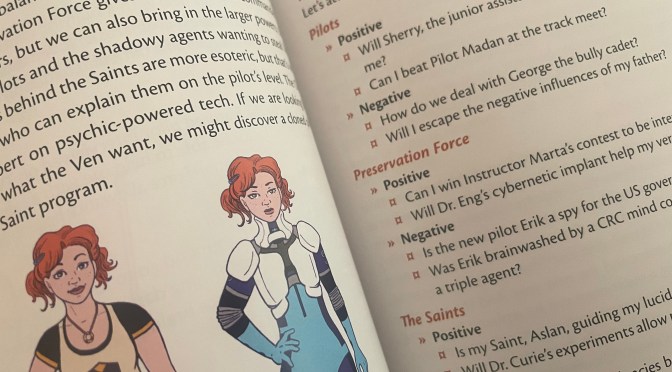
There was something in the air last week. We talk all the time about playing roleplaying games, and last week Aaron focused on Collecting them. When we went to gather up content for the Weekend Update, it turned out the hive mind was in agreement with us: playing, collecting, and reading are all different iterations of the roleplaying game hobby. So what, then, of reading? Collectable items grant satisfaction simply by possessing them, but play is the main event, right? Surely, if you only ever read a roleplaying game book but never get to play its game, it gets relegated to the Shelf of Shame? Well, if the hobby is a Playing/Collecting/Reading Venn Diagram, I’m going to zoom in on that Reading section and explore what I think is another Venn Diagram for the motives behind that reading: Learning, Research, and Enjoyment.

On Being an RPG Collector
Like many commentators in the tabletop RPG world, we at Cannibal Halfling Gaming focus on the act of playing games. Making characters, running games, campaigns, one-shots, trad games, indie games, solo games, you name it. To the degree that the TTRPG hobby has a body of critique, it’s one that focuses on how games are played and we’re happy to be part of that. Playing games isn’t the only thing that drives the hobby, though, and in certain segments of the hobby it doesn’t have the largest financial impact. When it comes to the consumption of gaming materials, there are players, there are readers, and there are collectors.
Playing, reading, and collecting games are different activities which demand different things out of the games which are consumed. These activities aren’t mutually exclusive; in fact, I’d say the vast majority of gamers participate in all three to some degree. That said, the one which defines how many gamers buy RPGs is collecting, and as a result collecting RPGs is an activity that has an enormous impact on how the hobby evolves, how games are sold, and what games end up looking like.
Continue reading On Being an RPG Collector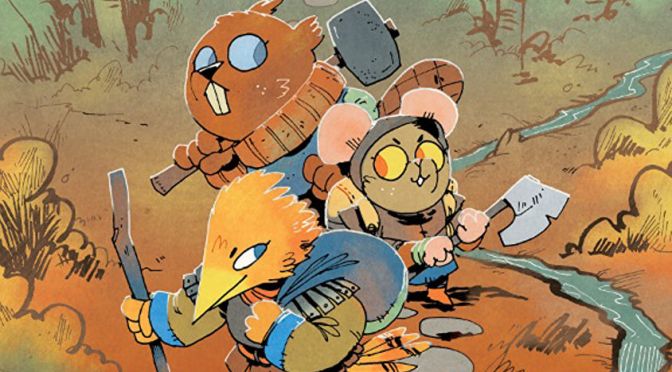
Root: The Roleplaying Game Review
Ten years ago, Dungeon World kicked Powered by the Apocalypse into the mainstream by tying the system back to Dungeons and Dragons, the hobby’s most popular game. Now, Powered by the Apocalypse (or PbtA) is the newest rules system entrant into the world of licensed RPGs, thanks to Magpie Games,. While Root: The Roleplaying Game might not be the very first licensed PbtA game it is certainly the biggest one to date, using the look, feel, and logo of Leder Games’ critically acclaimed board game to catapult it to a $600,000 Kickstarter success. It also quite likely opened the gate for Magpie’s upcoming Avatar game, which leapfrogged the Kickstarter success of Root more than tenfold.
So now that Root is available not only to backers but to the world at large, what does a game by the largest PbtA publisher look like these days? Magpie Games has built their business on PbtA, scoring hits with the innovative Urban Shadows, Masks, and Bluebeard’s Bride, among others. Given their long track record it’s no surprise that the company has sought out opportunities for licensing like they found with Root. From the outside, though, there are questions about Magpie’s product strategy. Root’s final PDF was delivered to backers over a year late, and Urban Shadows second edition, currently in process, will likely be almost as late as that (original ETA for delivery was September of 2021 for PDFs). While the pandemic and other exogenous factors are clearly part of this, having multiple high-profile Kickstarters in fulfillment at once (Urban Shadows, Root, and Avatar: The Last Airbender were all concurrent prior to Root’s fulfillment) seems to be stretching the team thin.
Continue reading Root: The Roleplaying Game Review
The Five Mechanic Game
There’s a wide world of games out there, but the ones that get played and talked about the most are more similar than you may think. In the realm of traditional games, most games have their rules structured the same way, at the same level of detail, to accomplish roughly the same goal. It means many of us that grew up among the bursting libraries of games in the 80s and 90s thought we were well-read, only to be waylaid by some markedly different ideas when the games of the Forge era like Burning Wheel and Apocalypse World started becoming popular.
Last week, I talked a bit about the idea of complexity, and grounded it to the idea of how many mechanics a game has interacting at once. This makes a game like Blades in the Dark, with many overlapping systems, more complex, while a game like Dread, where there is only one mechanic and it’s essentially ‘Jenga Or Die’, is less complex. What’s more interesting, though, is what it says about the middle. Basically every traditional game, from the real bloats like Exalted all the way down to little digest editions like Savage Worlds, have roughly the same type and number of mechanics. That number is five: character creation, task resolution, combat, game mastering, and at least one subsystem of note.
Continue reading The Five Mechanic Game
Pacing Problems
How fast do you burn through a storyline? If you’re like me, sometimes that core conflict is approaching a climax halfway through what you thought was your campaign. Or, if you’re like me at a different point in time, you find your players have cracked the advancement mechanics on the cool new system you wanted to try and now the power curve is shooting upwards, taking the storyline in places you weren’t ready for it to go. Whether it’s from game mechanics or your own writing, it’s easy for a GM to find themselves with a pacing problem.
There are a few issues with figuring out how to pace a role-playing campaign that don’t appear in other media. The first one is simply that other media have it way easier. It might be challenging to write a novel or direct a movie, but that author or director has complete control over how fast or slow events progress. When you’re GMing a game, with players staring back at you and wondering what’s going to happen next, that control is illusory. The second is that many of the tricks we’re taught in interactive media, like video games, either don’t translate or translate poorly back to the tabletop. Once again, a lot of that has to do with the fact that there’s more than one person playing and setting the clock.
Continue reading Pacing Problems
The One Ring Review
So here it is. After a whole bunch of hubbub and more angry Tweeting than you can shake a stick at, The One Ring has been released. And what does that get us? The One Ring, Second Edition, is the official licensed roleplaying game of The Lord of the Rings, and is the jewel of the crown of Sophisticated Games, a company you’ve likely never heard of because all they do is hold intellectual property. Sophisticated Games is the root cause of every kerfluffle about this particular game, because they decided to hang Cubicle 7 out to dry back in 2019.
Continue reading The One Ring Review
The Trouble With Kickstarter
In December of 2021, Kickstarter made an announcement that it was going to develop a new platform for crowdfunding, using blockchain technology. The announcement received a significant negative response, given the negative environmental impacts of current blockchain applications and the widespread use of blockchain tech, through both cryptocurrencies and non-fungible token (NFT) schemes, to commit fraud. It’s a fair response, though given how little the Kickstarter announcement said, perhaps not entirely warranted.
That all said, the end state of Kickstarter’s blockchain plans don’t particularly matter. Whether or not the new platform comes to fruition, whether or not it uses less energy-intensive proof-of-stake software, whether or not people leave the platform, these are in the long run irrelevant. What the announcement should have revealed to anyone who felt strongly enough to leave the platform over it is that the TTRPG hobby has let Kickstarter become infrastructure. Leaving Kickstarter sounds great in a tweet, but ultimately doing so is going to be tough for many of the creators who, without the company, would have never gotten off the ground.
Continue reading The Trouble With Kickstarter
Five Years of Cannibal Halflings
Five years! Half a decade! That, uh, that wasn’t really the plan, you understand. Not that there was a plan, it was more of an eyes-closed death-and-glory charge into the void… Let’s see how we did this year, and what the future holds!
The Forest Primordia, or, My First Module
There’s a vast diversity of experiences that fall under the big tent of tabletop roleplaying. From different playstyles to games to even venues of play, everyone plays a little bit differently. There are some things that are common at one table and unthinkable at another. And some products, from battlemats to GM screens to even pre-written adventures themselves just aren’t seen at every gaming table. That said, if someone, say, reviewed RPGs for five solid years and had never once ran a pre-written module, you could be forgiven for saying they might be missing out on a common gamer experience. Well, that someone is me, and this month I made a change.
Do not think that the title of this review is a quip about the Troika module The Forest Primordia. I do not call it “My First Module” out of snark, it is literally the first prewritten module I have ever run in a serious game (my attempt to run the Tomb of Horrors doesn’t count, for multiple reasons). I don’t think I’ve ever had anything against modules, but for me the interest in running games was always couched in writing, and using pre-written material always seemed to produce a disconnect where there didn’t need to be one. As a result, it took about twenty years of my RPG career before I decided to give one a whirl.
Continue reading The Forest Primordia, or, My First Module Cannibal Halfling Gaming